
Author: admin

  • Fred Loyal Insurance: Did You Mean Fred Loya Insurance?

    Editorially reviewed informational content for U.S. car insurance topics

    • Fred Loyal Insurance
    • Fred Loya Insurance
    • Auto Insurance Coverage

    The LoyalInsurance.org Editorial Team creates informational content focused on auto insurance costs, insurer profiles, coverage types, quote comparison, policy terms, claims information, and practical shopping topics for U.S. drivers.

    Articles are written to help readers better understand how company names, policy documents, coverage limits, deductibles, claims steps, payment terms, and state requirements may affect the process of shopping for car insurance.

    This content is for general informational purposes only and does not constitute insurance, legal, or financial advice. Coverage availability, pricing, discounts, fees, claims handling, and policy terms vary by insurer, state, location, and driver profile.

    Name Clarification Guide

    Fred Loyal Insurance is a phrase many drivers may type when they are trying to find information about Fred Loya Insurance. The correct company name commonly used in the auto insurance market is Fred Loya Insurance, and this guide explains how to review coverage, claims information, policy documents, and quote options without relying only on a search result or an old page title.

    If you searched for “Fred Loyal Insurance,” you may be looking for help with a quote, coverage type, payment question, local office, claim, or policy document. Before choosing or renewing any car insurance policy, compare the actual limits, deductibles, exclusions, payment fees, and claims instructions listed in your documents.

    For a broader overview, you can also read our Fred Loya auto insurance guide or compare related topics in our Loya car insurance guide.

    Is It Fred Loyal Insurance or Fred Loya Insurance?

    The phrase “Fred Loyal Insurance” is usually a spelling variation or mistaken version of Fred Loya Insurance. That difference matters because insurance shoppers should confirm the exact company name, policy number, claims contact, coverage limits, and billing information from official documents rather than assuming that a similar-sounding name points to the same policy details.

    If your insurance card, declarations page, quote form, billing notice, or claim document mentions Fred Loya, Loya Insurance Group, or a related insurer name, review the document carefully. The name on a policy document can help you identify who issued the policy, where to report a claim, and which coverage terms apply.

    Important coverage reminder: A search phrase does not tell you what your policy covers. Your actual protection depends on your declarations page, policy contract, endorsements, limits, deductibles, exclusions, payment status, state rules, and claim facts.
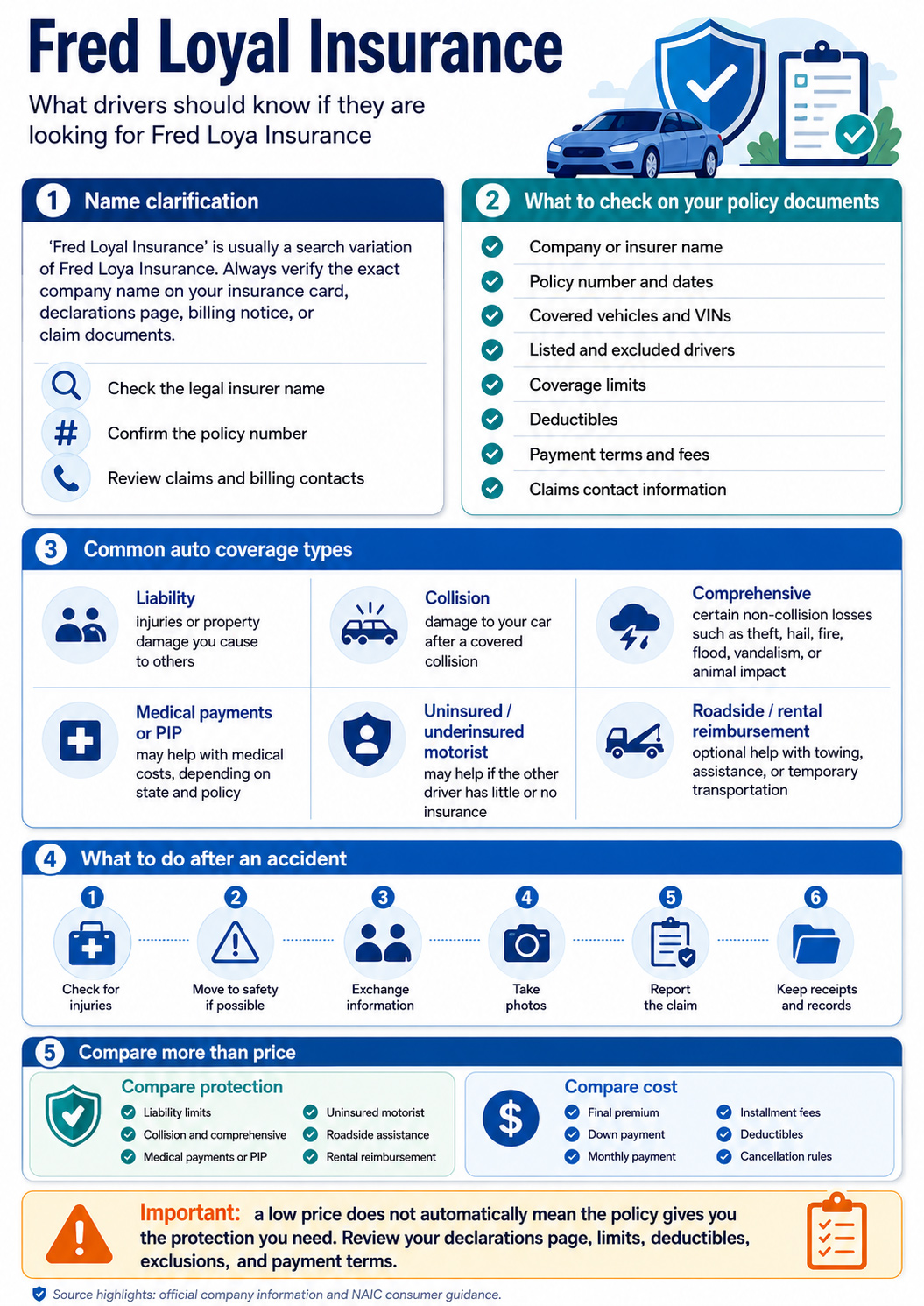
    Infographic explaining Fred Loyal Insurance as a common search variation for Fred Loya Insurance, with policy document checks, auto coverage types, accident steps, and tips for comparing protection and cost.

    What Fred Loya Insurance Coverage May Include

    Fred Loya’s own coverage information describes common auto insurance coverage categories such as liability, comprehensive, collision, medical payments or personal injury protection, uninsured or underinsured motorist coverage, rental reimbursement, and roadside assistance.[1] The exact coverage available to you can depend on your state, driver profile, vehicle, lender requirements, selected limits, and policy terms.

    Coverage Type What It May Help With What to Review Before Buying
    Liability coverage May help pay for injuries or property damage you cause to others in a covered accident. Review bodily injury limits, property damage limits, state minimums, and whether higher limits are available.
    Collision coverage May help pay for damage to your own vehicle after a covered collision. Check the deductible, vehicle value, lender or lease requirements, and exclusions.
    Comprehensive coverage May help with certain non-collision losses such as theft, fire, vandalism, hail, flood, falling objects, or animal impact, depending on the policy. Review covered causes of loss, deductible amount, vehicle value, and policy exclusions.
    Medical payments or PIP May help with medical costs after an accident, depending on state rules and policy terms. Ask whether it is required, optional, available, or excluded where you live.
    Uninsured or underinsured motorist May help when another driver has no insurance or not enough insurance, depending on the policy and state. Confirm whether this coverage is included, optional, required, rejected, or subject to separate limits.
    Roadside or rental reimbursement May help with towing, flat tire assistance, fuel delivery, or rental costs after a covered situation, depending on the selected option. Check whether the option is included, added separately, limited by dollar amount, or subject to time restrictions.

    Why Liability Coverage Is Not the Same as Full Protection

    Many drivers shop for the lowest monthly price, but liability-only coverage does not usually repair your own vehicle after an at-fault accident. Liability coverage is mainly designed to address covered injuries or property damage you cause to other people. Fred Loya’s FAQ also explains that liability does not cover your own medical bills and that medical payments or personal injury protection may be purchased for that type of need, depending on availability and policy terms.[2]

    This is why drivers should compare more than the advertised premium. A cheaper policy may satisfy a state minimum but still leave gaps for your own car, your own medical costs, rental transportation, towing, or higher liability exposure.

    Protection details to compare

    • Liability limits
    • Collision and comprehensive coverage
    • Medical payments or PIP
    • Uninsured or underinsured motorist coverage
    • Roadside assistance
    • Rental reimbursement

    Cost details to compare

    • Final premium
    • Down payment
    • Monthly payment amount
    • Installment fees
    • Deductibles
    • Cancellation or reinstatement rules

    What to Check on Your Policy Documents

    If you already have a policy or quote, the most important document is usually the declarations page. It summarizes the named insured, covered vehicle, policy period, coverages, limits, deductibles, premium, lienholder, listed drivers, and sometimes excluded drivers or special endorsements.

    • Company name Confirm the legal insurer or company name shown on the paperwork.
    • Policy period Check the effective date and expiration date.
    • Vehicle information Confirm the year, make, model, and VIN.
    • Drivers Review listed drivers and any excluded drivers.
    • Coverage limits Compare liability, medical, uninsured motorist, and physical damage limits.
    • Deductibles Check collision and comprehensive deductibles if included.
    • Payment terms Review down payment, installment amount, fees, and due dates.
    • Claims contact Save the correct claim phone number and instructions.

    What to Do After an Accident

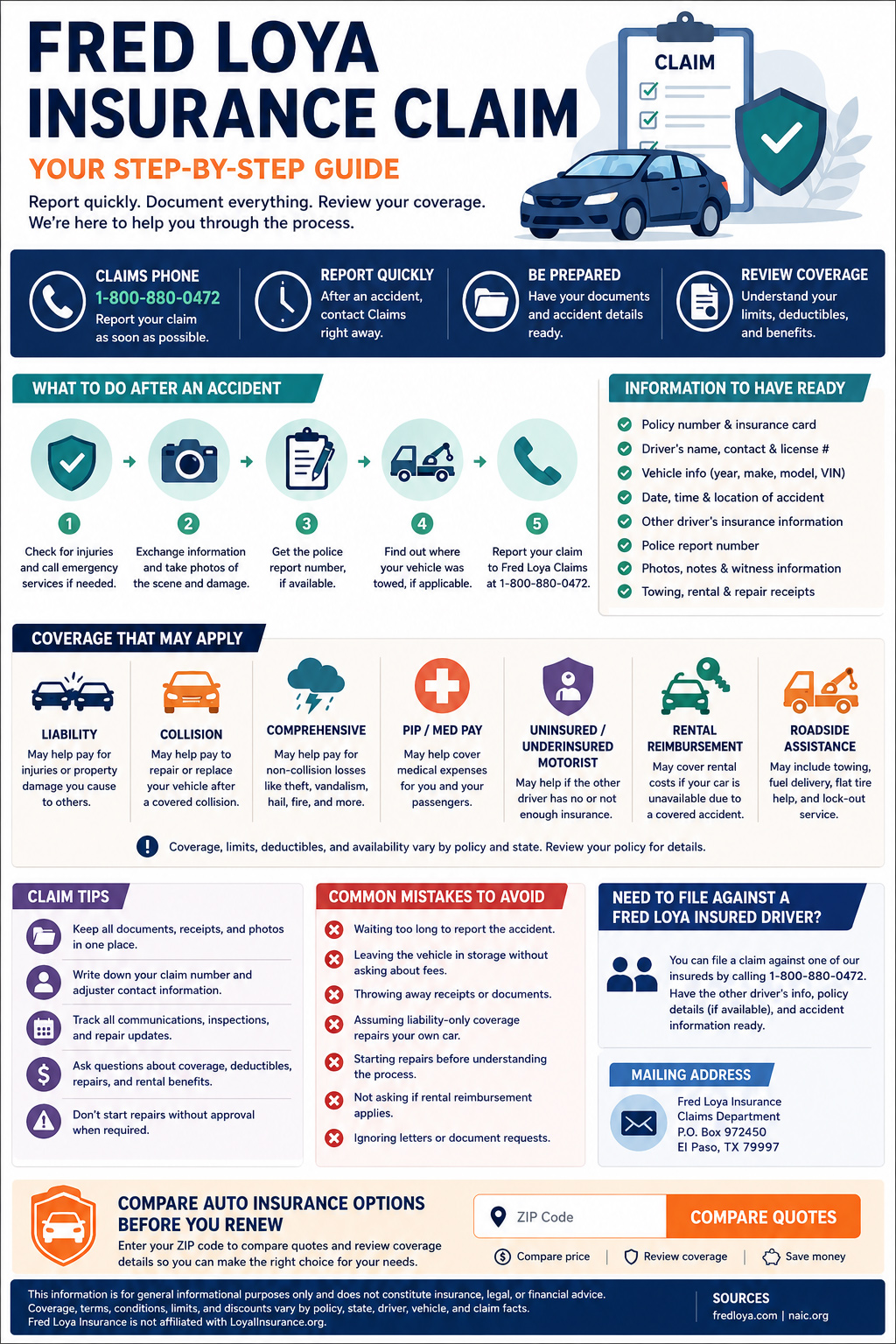
    Fred Loya’s claims information says a claim should be filed as soon as possible after an accident and lists Loya Insurance Group’s claim reporting number as 1-800-880-0472.[3] Its accident guidance also tells drivers to report the claim, protect the vehicle from further damage, find out where the vehicle was taken if it was towed, and create a file with documentation related to the loss.[4]

    Basic accident checklist

    • Check for injuries and call emergency services if needed.
    • Move to a safe location if it is legal and safe to do so.
    • Exchange driver, vehicle, and insurance information.
    • Take photos of the vehicles, damage, road conditions, signs, and surroundings.
    • Collect names and contact details from witnesses when available.
    • Report the claim using the instructions on your policy documents.
    • Keep police reports, claim numbers, repair estimates, towing receipts, rental receipts, and correspondence.

    Questions to Ask Before Choosing or Renewing Coverage

    The NAIC advises consumers to understand what auto insurance covers and to compare policy terms carefully before buying coverage.[5] That advice is especially important if you are comparing a low monthly payment against a policy with higher limits or broader optional coverage.

    Ask these questions before you buy

    • Is this quote for liability-only coverage or does it include physical damage coverage?
    • What are the bodily injury and property damage liability limits?
    • Does the policy include uninsured or underinsured motorist coverage?
    • Are medical payments or PIP available in my state?
    • What deductible applies to collision or comprehensive coverage?
    • Are rental reimbursement or roadside assistance included or optional?
    • Are any drivers excluded from coverage?
    • What fees apply to installment payments, cancellation, or reinstatement?
    • How do I report a claim and what documentation should I keep?

    Should You Use This Page If You Searched “Fred Loyal Insurance”?

    Yes, if you were trying to understand Fred Loya Insurance coverage, quote options, claim steps, or policy terms. The phrase “Fred Loyal Insurance” is best treated as a search variation, not as a separate coverage product. For company-specific details, always compare the information you find online with your actual policy documents, official company resources, and state insurance department information.

    If your goal is to compare prices, you can start with a quote comparison and then review coverage details carefully before making a decision. You can also visit our Loya insurance quotes guide for more information about comparing quote options.

    Frequently Asked Questions About Fred Loyal Insurance

    Is Fred Loyal Insurance the same as Fred Loya Insurance?

    In most cases, “Fred Loyal Insurance” appears to be a spelling variation or mistaken search phrase for Fred Loya Insurance. Drivers should confirm the exact company name on their quote, insurance card, declarations page, billing notice, or claim document.

    Does Fred Loya offer liability coverage?

    Fred Loya describes liability coverage as part of its auto insurance coverage information. Liability coverage generally relates to covered injuries or property damage you cause to others, subject to policy limits, exclusions, and state rules.

    Does liability insurance cover my own car?

    Usually no. Liability coverage is mainly for covered injuries or property damage you cause to others. Coverage for your own vehicle usually depends on whether collision, comprehensive, or another applicable coverage is included in your policy.

    What number does Fred Loya list for claims?

    Fred Loya’s claims page lists 1-800-880-0472 for reporting an auto insurance claim. Drivers should still check their own policy documents for the most relevant claim instructions.

    Should I choose the cheapest auto insurance policy?

    Not automatically. A low premium can be useful, but drivers should also compare coverage limits, deductibles, excluded drivers, optional coverages, payment fees, cancellation rules, and claim instructions before choosing a policy.

    Compare Quote Options

    Compare Auto Insurance Quotes by ZIP Code

    Enter your ZIP code to compare auto insurance quote options and review coverage details before choosing a policy.

    Compare price, coverage limits, deductibles, fees, and policy terms before choosing auto insurance.

    Sources

    This article was updated using official company information, state insurance consumer guidance, and national auto insurance education resources. Drivers should confirm final rates, coverage availability, policy terms, discounts, fees, claims handling, and legal requirements directly with the insurer, agent, quote provider, or state insurance department before buying coverage.
    1. Fred Loya Insurance — Official Coverage Information
    2. National Association of Insurance Commissioners — Auto Insurance Consumer Information
    3. National Association of Insurance Commissioners — What Does Auto Insurance Cover?
    4. California Department of Insurance — Auto Insurance Information Guide
  • Fred Loya Review

    Editorially reviewed informational content for U.S. car insurance topics

    • Fred Loya Review
    • Auto Insurance
    • Policy Comparison

    The LoyalInsurance.org Editorial Team creates informational content focused on auto insurance costs, insurer profiles, coverage types, quote comparison, claims information, policy terms, and practical shopping topics for U.S. drivers.

    Articles are written to help readers better understand how company names, policy documents, coverage limits, deductibles, claims steps, payment terms, and state requirements may affect the process of shopping for car insurance.

    This content is for general informational purposes only and does not constitute insurance, legal, or financial advice. Coverage availability, pricing, discounts, fees, claims handling, and policy terms vary by insurer, state, location, and driver profile.

    Auto Insurance Review

    Fred Loya Insurance is often searched by drivers who want basic car insurance, local agency access, payment options, or help comparing coverage. This review explains what to know before choosing a policy, including coverage types, policy documents, claims considerations, and how to compare Fred Loya with other auto insurers.

    This page is not an official Fred Loya website and does not sell insurance directly. It is an independent informational review designed to help drivers understand what to check before buying, renewing, or comparing an auto insurance policy.

    Main focus Auto insurance
    Best use Quote comparison
    Check first Limits and fees
    Before buying Compare policies

    Fred Loya Insurance Review: What Drivers Should Know

    A useful Fred Loya review should do more than say whether the company is “good” or “bad.” Auto insurance depends heavily on your state, driving record, vehicle, selected coverages, deductibles, payment plan, and claims history. A company that works for one driver may not be the right fit for another driver with different coverage needs.

    Fred Loya’s official coverage information describes common car insurance options such as liability, comprehensive, collision, medical payments or personal injury protection, uninsured or underinsured motorist coverage, roadside assistance, and rental reimbursement.[1] However, availability, pricing, limits, and terms can vary, so the policy documents matter more than a general review.

    Important coverage reminder: Do not choose an auto insurance policy based only on the monthly price or a company review. Review the declarations page, coverage limits, deductibles, excluded drivers, payment terms, cancellation rules, and claims instructions before buying.

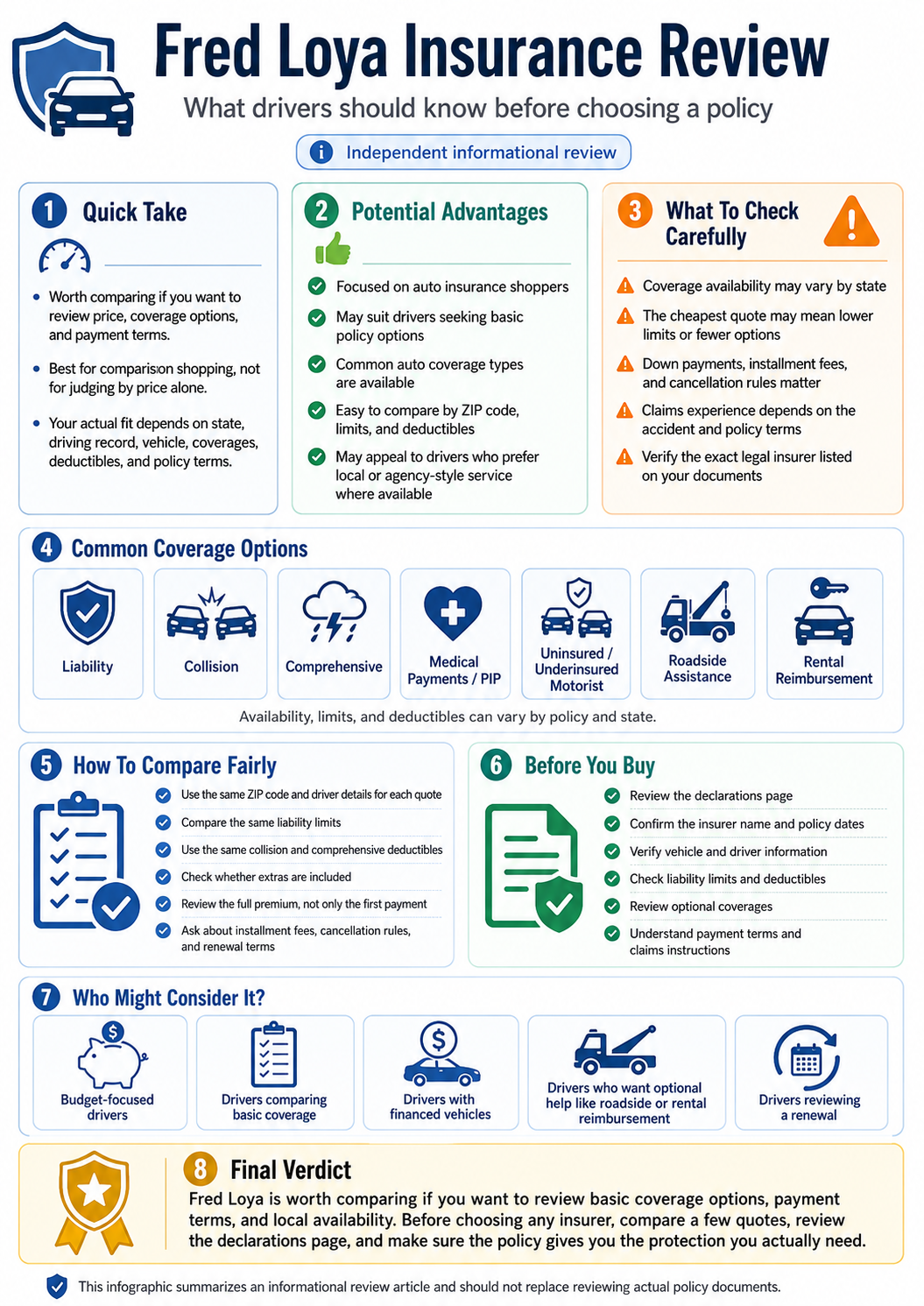
    Infographic summarizing a Fred Loya Insurance review with key points on coverage options, possible advantages, policy details to check, quote comparison tips, and reminders before buying auto insurance.

    Quick Review: Possible Pros and Cons

    The strongest use of this page is to help you compare Fred Loya with other auto insurance options. The points below are general shopping considerations, not guarantees about your quote, claim, or final policy terms.

    Potential advantages

    • Focused on auto insurance shoppers.
    • May appeal to drivers looking for basic policy options.
    • Coverage pages explain common auto insurance terms.
    • Can be compared with other insurers by ZIP code, limits, and deductibles.
    • May be useful for drivers who prefer local or agency-style service where available.

    Possible drawbacks to check

    • Coverage availability may vary by state and location.
    • The cheapest option may provide lower limits or fewer optional coverages.
    • Installment fees, down payments, and cancellation rules can affect total cost.
    • Claims experience can depend on the facts of the accident and policy terms.
    • Drivers should verify the exact legal insurer listed on their documents.

    What Coverage Does Fred Loya Offer?

    Auto insurance is not one single product. A policy can include different coverage parts, each with its own limits, deductibles, exclusions, and state-specific rules. The NAIC explains that collision and comprehensive coverage are different from liability coverage and often come with deductibles.[2]

    Coverage Type What It May Help With What to Compare
    Liability coverage May help pay for injuries or property damage you cause to others in a covered accident. Compare bodily injury limits, property damage limits, state minimums, and whether higher limits are available.
    Collision coverage May help pay for damage to your own car after a covered collision. Review the deductible, vehicle value, lender or lease requirements, and exclusions.
    Comprehensive coverage May help with certain non-collision losses such as theft, hail, fire, vandalism, flood, falling objects, or animal impact, depending on the policy. Check covered causes of loss, deductible amount, vehicle value, and policy exclusions.
    Medical payments or PIP May help with medical costs after an accident, depending on state rules and policy terms. Ask whether it is required, optional, available, or excluded in your state.
    Uninsured or underinsured motorist May help when another driver has no insurance or not enough insurance, depending on the policy and state. Confirm whether it is included, optional, required, rejected, or subject to separate limits.
    Roadside or rental reimbursement May help with towing, roadside help, or temporary transportation after a covered situation. Check whether the option is included, added separately, limited by dollar amount, or subject to time restrictions.

    Is Fred Loya Good for Cheap Car Insurance?

    Fred Loya may appear in searches from drivers looking for affordable auto insurance, but “cheap” does not always mean “best.” A lower premium can be helpful if it fits your budget, but it may also come with lower liability limits, higher deductibles, fewer optional coverages, or stricter payment rules.

    Before deciding whether Fred Loya is a good option for you, compare the same coverage levels across multiple companies. For example, compare liability limits against liability limits, collision deductibles against collision deductibles, and monthly payment plans against the full policy cost.

    How to compare fairly

    • Use the same ZIP code and driver information for each quote.
    • Compare the same liability limits when possible.
    • Use the same collision and comprehensive deductibles.
    • Check whether uninsured motorist, medical payments, roadside assistance, or rental reimbursement are included.
    • Review the full premium, not only the first payment.
    • Ask about installment fees, cancellation rules, and renewal terms.

    Who Might Consider Fred Loya Insurance?

    Fred Loya may be worth comparing if you are shopping for auto insurance and want to review basic coverage options, payment terms, and local availability. It may also be worth comparing if you want to see whether a policy can meet your state’s minimum requirements while still allowing you to add optional protection.

    • Budget-focused drivers Compare the monthly cost, down payment, and total premium.
    • Drivers comparing basic coverage Review liability limits and state requirements carefully.
    • Drivers with financed vehicles Confirm whether collision and comprehensive are required by your lender.
    • Drivers who want optional help Ask about roadside assistance, rental reimbursement, and medical payments.
    • Drivers reviewing a renewal Compare the renewal premium with new quotes before accepting.
    • Drivers with policy questions Check the declarations page, endorsements, and claims instructions.

    What to Check Before Buying a Policy

    The most important document in an auto policy is often the declarations page. This page usually summarizes the insured drivers, covered vehicles, policy period, coverage limits, deductibles, premium, lienholder, and selected options. A review online can help you ask better questions, but your policy documents control the actual coverage.

    Policy details to verify

    • The exact company or legal insurer name on the policy.
    • The policy number, effective date, and expiration date.
    • The vehicle year, make, model, and VIN.
    • All listed drivers and any excluded drivers.
    • Bodily injury and property damage liability limits.
    • Collision and comprehensive deductibles if physical damage coverage is included.
    • Medical payments, PIP, uninsured motorist, roadside, or rental options.
    • Down payment, monthly payment, installment fees, and cancellation rules.
    • Claim reporting instructions and required documentation.

    Claims and Customer Experience: What to Know

    Claims experience can vary from one accident to another. The outcome may depend on fault, coverage type, limits, deductibles, exclusions, documentation, state rules, repair estimates, and how quickly information is provided. This is why drivers should save photos, police reports, claim numbers, repair estimates, rental receipts, towing receipts, and all claim-related correspondence.

    Before buying or renewing, ask how claims are reported, whether online or phone reporting is available, how inspections are handled, and what documents are needed after an accident. You can also use state insurance department resources and NAIC consumer tools to verify company information, complaints, licenses, and financial health.[3]

    Practical tip: If your documents show a company name you do not recognize, confirm the insurer name through your policy paperwork, your agent, the insurer, or your state insurance department before relying on coverage.

    How Fred Loya Compares With Other Auto Insurers

    The best way to compare Fred Loya with another insurer is to compare the same coverage package side by side. A policy with a lower monthly price may not be better if it has lower limits, higher deductibles, fewer included coverages, or extra fees that raise the total cost over time.

    Compare protection

    • Liability limits
    • Collision and comprehensive
    • Medical payments or PIP
    • Uninsured or underinsured motorist
    • Roadside assistance
    • Rental reimbursement

    Compare total cost

    • Full policy premium
    • Down payment
    • Monthly payment
    • Installment fees
    • Deductibles
    • Cancellation or reinstatement rules

    Final Verdict: Is Fred Loya Worth Comparing?

    Fred Loya is worth comparing if you are shopping for auto insurance and want to review policy options, payment terms, and coverage availability. It may be especially relevant for drivers who are focused on price, basic coverage, or local agency access where available.

    However, this review should not replace your own quote comparison. Before choosing Fred Loya or any other insurer, compare at least a few quotes, review the declarations page, check the legal insurer name, and make sure the policy gives you the protection you actually need.

    Frequently Asked Questions About Fred Loya Insurance

    Is Fred Loya Insurance a good company?

    It depends on your needs, location, driving profile, coverage limits, payment plan, and expectations. Some drivers may consider Fred Loya when comparing affordable auto insurance options, but you should compare quotes, policy terms, claims instructions, and coverage details before buying.

    Does Fred Loya offer full coverage?

    “Full coverage” is not a single standard policy. Drivers often use the phrase to describe a policy with liability plus collision and comprehensive coverage, but the actual protection depends on the specific policy, limits, deductibles, exclusions, and state rules.

    Does Fred Loya offer liability insurance?

    Fred Loya’s coverage information describes liability coverage as part of its auto insurance coverage options. Liability coverage generally relates to covered injuries or property damage you cause to others, subject to limits and exclusions.

    Should I choose Fred Loya only because the quote is cheaper?

    No. A cheaper quote can help your budget, but you should also review limits, deductibles, optional coverages, fees, excluded drivers, cancellation rules, and claims instructions before choosing a policy.

    How can I verify an insurance company?

    You can check your policy documents, contact the insurer or agent, and use state insurance department resources. NAIC consumer tools can also help consumers find information about insurance company complaints, licenses, and financial health.

    Compare Quote Options

    Compare Auto Insurance Quotes by ZIP Code

    Enter your ZIP code to compare auto insurance quote options and review coverage details before choosing a policy.

    Compare price, coverage limits, deductibles, fees, and policy terms before choosing auto insurance.

    Sources

    This article was updated using official company coverage information and consumer-focused insurance guidance. Drivers should confirm final rates, coverage availability, policy terms, discounts, fees, claims handling, and legal requirements directly with the insurer, agent, quote provider, or state insurance department before buying coverage.
    1. Fred Loya Insurance — Official Coverage Information
    2. National Association of Insurance Commissioners — Auto Insurance Topics
    3. National Association of Insurance Commissioners — Consumer Insurance Search
  • Loya Basic Car Insurance

    Editorially reviewed informational content for U.S. car insurance topics

    • Basic Car Insurance
    • Loya Insurance
    • Auto Coverage Guide

    The LoyalInsurance.org Editorial Team creates informational content focused on auto insurance costs, coverage types, quote comparison, policy terms, claims information, and practical shopping topics for U.S. drivers.

    Articles are written to help readers better understand how coverage limits, deductibles, state requirements, lender rules, payment terms, and policy documents may affect the process of shopping for car insurance.

    This content is for general informational purposes only and does not constitute insurance, legal, or financial advice. Coverage availability, pricing, discounts, fees, claims handling, and policy terms vary by insurer, state, location, vehicle, and driver profile. LoyalInsurance.org is an independent informational website and is not affiliated with Fred Loya Insurance or any insurer.

    Basic Auto Coverage Guide

    Loya basic car insurance is best understood as a search phrase drivers may use when they want simple, affordable auto coverage. It is not usually a single fixed coverage package. A “basic” policy can mean different things depending on your state, vehicle, lender requirements, selected limits, deductibles, and optional coverages.

    For many drivers, basic car insurance starts with liability coverage. Depending on the state and policy, it may also involve uninsured or underinsured motorist coverage, personal injury protection, medical payments, collision, comprehensive, roadside assistance, or rental reimbursement. The key is to compare what the policy actually covers instead of judging it only by the monthly payment.

    Main topic Basic auto coverage
    Compare first Limits and deductibles
    Do not ignore Fees and exclusions
    Best next step Review real quotes

    What Does Loya Basic Car Insurance Mean?

    The phrase “basic car insurance” usually describes a practical coverage level rather than a formal product name. Some drivers use it to mean the lowest legal coverage required by their state. Others use it to mean a simple policy that includes liability plus a few extra protections.

    That difference matters. A state-minimum policy may help you drive legally, but it may not protect you well after a serious accident. A basic policy with stronger limits or selected optional coverages may cost more, but it may reduce financial risk if you cause damage, are hit by an uninsured driver, or need repairs after a covered loss.

    Important coverage reminder: Do not choose auto insurance only because it has the lowest monthly payment. Review the declarations page, liability limits, deductibles, excluded drivers, payment fees, cancellation rules, optional coverages, and claims instructions before buying.

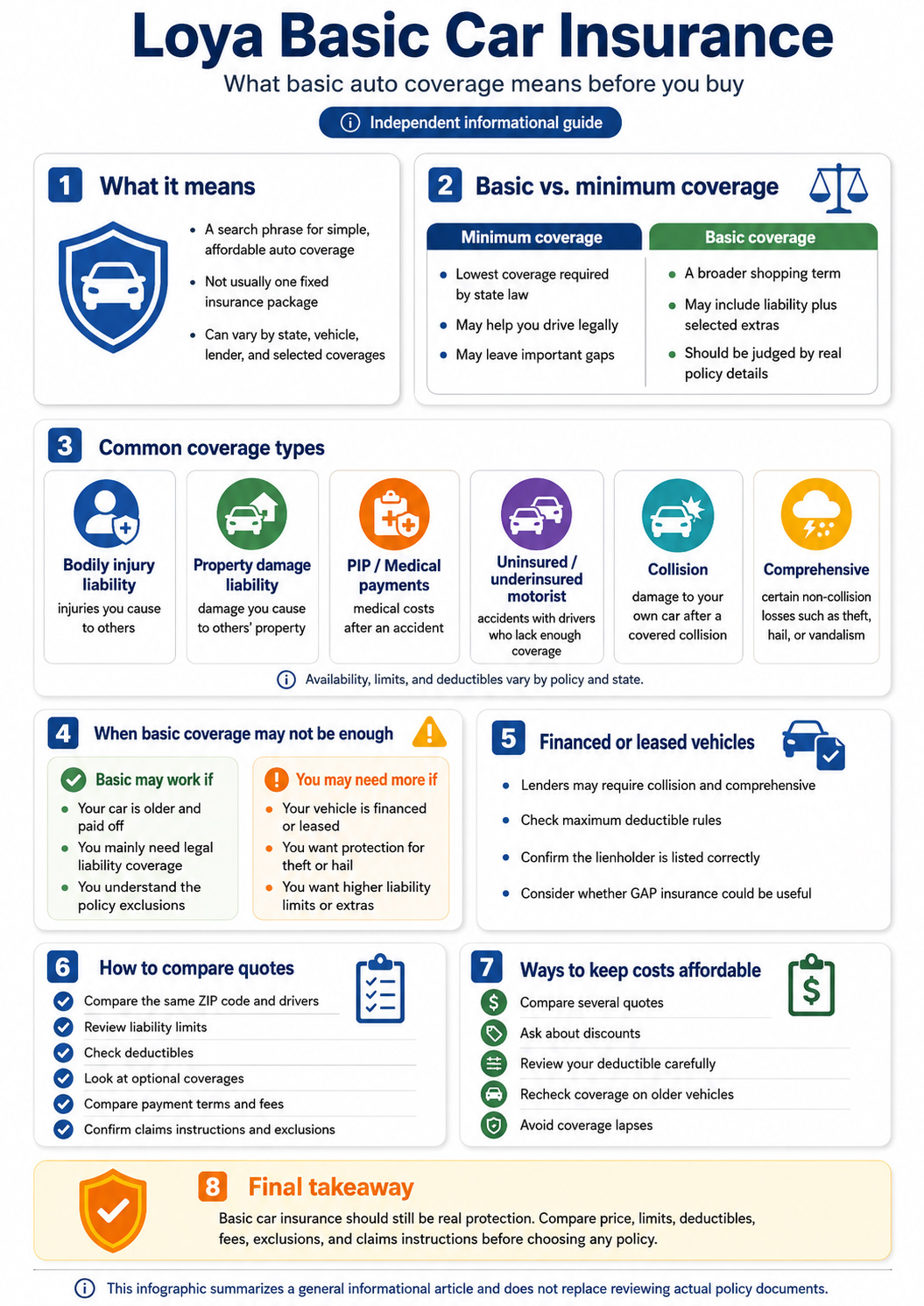
    Infographic explaining Loya basic car insurance, including basic versus minimum coverage, common coverage types, financed vehicle requirements, quote comparison tips, and ways to keep auto insurance costs affordable.

    Basic Coverage vs. Minimum Coverage

    Minimum coverage means the lowest coverage level required by your state’s financial responsibility or auto insurance laws. Basic coverage is a broader shopping phrase. It may include state-minimum liability only, or it may include additional protection depending on what you choose.

    The NAIC explains that auto insurance coverage can include liability, collision, comprehensive, medical payments, personal injury protection, uninsured or underinsured motorist coverage, and other options depending on the policy and state rules.[1] Fred Loya’s coverage information also describes common options such as liability, comprehensive, collision, medical payments or PIP, uninsured or underinsured motorist coverage, rental reimbursement, and roadside assistance.[2]

    Coverage Type What It May Help With What to Compare
    Bodily injury liability May help pay for injuries you cause to others in a covered accident. Compare per-person and per-accident limits, exclusions, and state requirements.
    Property damage liability May help pay for damage you cause to another person’s vehicle or property. Review the property damage limit and whether higher limits are affordable.
    Personal injury protection or medical payments May help with medical costs after an accident, depending on your state and policy. Ask whether it is required, optional, available, or excluded where you live.
    Uninsured or underinsured motorist coverage May help after certain accidents involving drivers with no insurance or not enough insurance. Confirm whether it is required, included, optional, rejected, or subject to separate limits.
    Collision coverage May help pay for damage to your own vehicle after a covered collision. Review the deductible, lender requirements, vehicle value, and exclusions.
    Comprehensive coverage May help with certain non-collision losses such as theft, hail, fire, vandalism, flood, falling objects, or animal impact, depending on the policy. Check covered causes of loss, deductible amount, vehicle value, and exclusions.

    Liability Coverage Is Usually the Starting Point

    Liability coverage is often the foundation of a basic auto policy. It generally has two parts: bodily injury liability and property damage liability. Bodily injury liability may help with covered injuries you cause to another person. Property damage liability may help with covered damage you cause to another person’s vehicle, fence, mailbox, building, or other property.

    Most states require drivers to carry liability coverage or meet financial responsibility requirements. New Hampshire is commonly discussed as an exception because state materials explain that New Hampshire motor vehicle laws do not require every driver to carry auto insurance, although drivers remain responsible for meeting financial responsibility requirements if they cause damage or are required to file proof of insurance.[3]

    Practical tip: Even when a state minimum is legally enough to drive, it may not be enough to protect your finances after a serious accident. Compare minimum limits with higher-limit quotes before deciding.

    When Basic Coverage May Not Be Enough

    A basic policy can be useful if you need affordable legal coverage, but it may leave important gaps. Liability coverage generally does not repair your own vehicle after an at-fault accident. It also may not cover your own medical costs unless the policy includes medical payments, PIP, or another applicable coverage.

    Basic coverage may be enough if:

    • Your car is older and paid off.
    • You mainly need legal liability coverage.
    • You can afford certain out-of-pocket repair costs.
    • You understand what the policy excludes.
    • You are comparing several quotes with the same limits.

    You may need more coverage if:

    • Your vehicle is financed or leased.
    • You could not afford to replace your car after a loss.
    • You want protection for theft, hail, vandalism, or animal impact.
    • You want rental reimbursement or roadside assistance.
    • You want higher liability limits than the state minimum.

    Financed or Leased Vehicles May Need More Than Basic Liability

    If your vehicle is financed or leased, your lender or lease company may require collision and comprehensive coverage. These coverages can help protect the vehicle itself, while liability coverage mainly addresses covered injuries or property damage you cause to others.

    Before choosing a basic policy, check your loan or lease agreement. Removing physical damage coverage from a financed or leased vehicle can create problems with the lender and may leave you responsible for repairs or replacement costs after a covered loss.

    Questions to ask if your car is financed or leased

    • Does the lender require collision and comprehensive coverage?
    • Is there a maximum deductible allowed by the lender?
    • Does the policy list the lienholder correctly?
    • Would GAP insurance be useful if the car is worth less than the loan balance?
    • Would you need rental reimbursement if your car is being repaired?
    • Can you afford the deductible after a claim?

    How to Compare Loya Basic Car Insurance Quotes

    The best way to compare basic car insurance is to use the same information for every quote. Compare the same ZIP code, drivers, vehicles, liability limits, deductibles, and optional coverages. If one quote is much cheaper, look closely to see whether it has lower limits, fewer protections, a higher deductible, or extra fees.

    • Liability limits Compare bodily injury and property damage limits, not just monthly price.
    • Deductibles Review collision and comprehensive deductibles if physical damage coverage is included.
    • Optional coverages Ask about uninsured motorist, PIP, MedPay, roadside, rental, and GAP options.
    • Payment terms Compare down payment, monthly payment, installment fees, and due dates.
    • Policy exclusions Look for excluded drivers, use restrictions, coverage gaps, or special endorsements.
    • Claims process Confirm how to report a claim and what documents you may need after an accident.

    Ways to Keep Basic Car Insurance More Affordable

    There is no single discount or trick that guarantees the cheapest rate for every driver. Auto insurance prices vary by state, ZIP code, vehicle, driving history, prior coverage, selected limits, deductible, and insurer. However, some practical steps may help you compare lower-cost options more carefully.

    The Insurance Information Institute recommends shopping around, comparing insurance costs before buying a vehicle, asking about higher deductibles, reviewing coverage on older vehicles, and asking about discounts as ways to lower auto insurance costs.[4]

    Cost-Saving Step How It May Help What to Watch For
    Compare several quotes Different insurers may price the same driver differently. Use the same limits and deductibles so the comparison is fair.
    Ask about discounts Discounts may be available for safe driving, low mileage, autopay, paperless billing, or multiple policies. Discount names and eligibility vary by company and state.
    Review your deductible A higher deductible may lower the premium for collision or comprehensive coverage. Do not choose a deductible you could not afford after a claim.
    Review older vehicle coverage Collision or comprehensive may not always be cost-effective on an older paid-off vehicle. Removing coverage means you may have to pay for your own repair or replacement.
    Avoid coverage lapses Keeping continuous coverage may help avoid legal and pricing problems later. Do not cancel your old policy before a new one is active.

    Should You Choose the Cheapest Basic Policy?

    Not automatically. A cheaper policy can help your budget, but it may also have lower limits, fewer coverages, higher deductibles, stricter exclusions, or additional payment fees. The right choice is the policy that gives you legal coverage, fits your budget, and provides enough protection for your real risk.

    If two quotes look similar, compare the declarations page details. The declarations page usually summarizes the named insured, covered vehicles, listed drivers, policy period, coverage limits, deductibles, premium, lienholder information, and selected options.

    Before buying, confirm:

    • The legal insurer name on the policy
    • The policy number, effective date, and expiration date
    • The vehicle year, make, model, and VIN
    • All listed drivers and excluded drivers
    • Liability limits and optional coverages
    • Collision and comprehensive deductibles if included
    • Down payment, monthly payment, fees, and cancellation rules
    • Claim reporting instructions and required documents

    Where Loya Fits Into Basic Car Insurance Searches

    Some drivers search for basic coverage because they want a simple policy that helps them meet state requirements without adding options they may not need. A Loya car insurance option may be worth comparing if you want local office support, payment discussions, or a straightforward auto policy, but the final decision should still depend on the actual coverage terms.

    Before choosing any basic policy, check whether the quote includes only liability coverage or whether it also includes uninsured motorist protection, PIP, medical payments, roadside assistance, rental reimbursement, collision, or comprehensive coverage. A policy can be “basic” and still have important differences from another quote.

    When a basic Loya-related quote may make sense

    • You need legal auto coverage and want to compare simple policy options.
    • You prefer speaking with a local office instead of handling everything online.
    • You want to review payment options before choosing a policy.
    • You are comparing liability-only coverage against broader coverage.
    • You want to understand the trade-off between lower monthly cost and lower protection.

    Use a quote to check the real price

    A Fred Loya quote can help you see how the price changes when you adjust limits, deductibles, vehicles, drivers, or optional coverage. Do not compare the first payment only. Compare the total policy cost, installment fees, cancellation rules, and effective date.

    If one quote looks much cheaper, check what was removed. The lower price may come from state-minimum limits, no physical damage coverage, no rental reimbursement, a higher deductible, or fewer optional benefits.

    When affordability is the main concern

    Drivers shopping on a tight budget should also review low income car insurance options before choosing the cheapest basic policy. A lower monthly payment can help, but the policy still needs to fit your legal requirements, lender rules, vehicle situation, and claim-time risk.

    Bottom line: Basic car insurance should still be real protection. Compare price, liability limits, deductibles, optional coverage, fees, exclusions, and claims instructions before choosing any policy.

    Bottom line: Basic car insurance should still be real protection. Compare price, limits, deductibles, fees, exclusions, and claims instructions before choosing any policy.

    Frequently Asked Questions About Loya Basic Car Insurance

    Is Loya basic car insurance a specific policy?

    Usually, no. It is better understood as a search phrase for simple or affordable auto insurance coverage. The actual policy depends on the insurer, state, driver, vehicle, limits, deductibles, and selected options.

    Is basic car insurance the same as state-minimum coverage?

    Not always. State-minimum coverage is the lowest coverage required by law in a state. Basic car insurance may mean state-minimum coverage, but it may also include additional options such as uninsured motorist, medical payments, roadside assistance, or physical damage coverage.

    Does liability insurance repair my own car?

    Usually no. Liability coverage generally helps with covered injuries or property damage you cause to others. Repairing your own vehicle after a covered collision usually depends on whether collision coverage or another applicable coverage is included.

    Do I need collision and comprehensive coverage?

    It depends on your vehicle, budget, lender or lease requirements, and risk tolerance. If your car is financed or leased, your lender may require both. If your car is older and paid off, you may want to compare the cost of the coverage with the vehicle’s value.

    What should I compare before choosing basic auto insurance?

    Compare liability limits, deductibles, optional coverages, payment terms, fees, excluded drivers, cancellation rules, claims instructions, and whether the policy satisfies your state, lender, or lease requirements.

    Compare Quote Options

    Compare Basic Auto Insurance Quotes by ZIP Code

    Enter your ZIP code to compare auto insurance quote options and review coverage details before choosing a policy.

    Compare price, coverage limits, deductibles, fees, and policy terms before choosing auto insurance.

    Sources

    This article was updated using official company coverage information and consumer-focused insurance resources. Drivers should confirm final rates, policy terms, coverage availability, discounts, fees, claims handling, and legal requirements directly with the insurer, agent, quote provider, or state insurance department before buying coverage.
    1. National Association of Insurance Commissioners — What You Should Know About Auto Insurance Coverage
    2. Fred Loya Insurance — Car Insurance Coverage
    3. New Hampshire Insurance Department — Automobile Insurance Consumer Guide
    4. Insurance Information Institute — Nine Ways to Lower Your Auto Insurance Costs
  • Loya Car Insurance Calculators Online

    Editorially reviewed informational content for U.S. car insurance topics

    • Car Insurance Calculator
    • Loya Insurance Estimate
    • Quote Comparison

    The LoyalInsurance.org Editorial Team creates informational content focused on auto insurance costs, coverage types, quote comparison, policy terms, claims information, and practical shopping topics for U.S. drivers.

    Articles are written to help readers better understand how ZIP code, driver profile, vehicle type, coverage limits, deductibles, discounts, payment terms, and policy documents may affect the process of shopping for car insurance.

    This content is for general informational purposes only and does not constitute insurance, legal, or financial advice. Calculator results are illustrative estimates only and are not final quotes. Coverage availability, pricing, discounts, fees, claims handling, and policy terms vary by insurer, state, location, vehicle, and driver profile. LoyalInsurance.org is an independent informational website and is not affiliated with Fred Loya Insurance or any insurer.

    Auto Insurance Estimator

    Loya car insurance calculators online can help drivers think through the details that may affect an auto insurance estimate before requesting a full quote. A calculator is not the same as a final policy offer, but it can help you compare likely cost factors such as ZIP code, vehicle type, driving record, coverage level, deductible, and payment preferences.

    If you are shopping for a new vehicle or comparing coverage before renewal, an online estimate can be a useful starting point. The final price still depends on the insurer’s rating rules, state laws, policy options, discounts, underwriting review, and the exact information you provide during the quote process.

    Best use Rough planning
    Compare first Limits and deductibles
    Do not treat as Final policy price
    Next step Request real quotes

    What Is a Loya Car Insurance Calculator?

    A car insurance calculator is a simple tool that helps estimate possible auto insurance costs based on common rating factors. It may ask for details such as your ZIP code, age range, driving record, vehicle type, coverage level, deductible, and whether the vehicle is financed or leased.

    This page is not an official Fred Loya calculator. It is an independent informational guide that explains how online estimates work, what details may affect your rate, and what you should compare before choosing a policy.

    Important estimate note: A calculator can help you plan, but it cannot guarantee your final premium. Your real quote may change after insurer review, state-specific rules, discount verification, vehicle details, driving history, prior coverage, payment plan, and selected coverage options are confirmed.

    What a Car Insurance Calculator Can and Cannot Tell You

    A calculator can help you understand why one driver, vehicle, ZIP code, or coverage level may cost more than another. It can also help you compare several scenarios before buying a vehicle or changing coverage. However, it cannot replace a full quote or a declarations page.

    Tool Best For Limitations Next Step
    Online calculator Getting a rough planning estimate before comparing quotes. It uses simplified assumptions and cannot confirm final pricing. Use the estimate to decide what coverage details to compare.
    Online quote Reviewing more detailed pricing from one or more providers. The quote may still change after verification or underwriting review. Compare limits, deductibles, fees, discounts, and optional coverages.
    Final policy offer Making a purchase decision after coverage terms are shown. The price is only useful if you understand what the policy includes and excludes. Review the declarations page before relying on coverage.

    Car Insurance Factors That Can Affect an Estimate

    Auto insurance pricing can vary by insurer and state, but many estimates use similar categories of information. The Insurance Information Institute explains that factors such as driving record, vehicle use, location, age, vehicle type, coverage amount, deductible, and other profile details can affect what you pay for auto insurance.[1]

    • ZIP code Location can affect theft risk, repair costs, accident frequency, weather risk, and local claim patterns.
    • Driving record Recent accidents, tickets, or serious violations can increase the estimated premium.
    • Vehicle type Repair cost, vehicle value, safety features, theft risk, and performance category may affect pricing.
    • Coverage level Higher liability limits or added collision and comprehensive coverage usually cost more.
    • Deductible A higher deductible may lower some premiums, but it can increase what you pay after a claim.
    • Prior insurance Coverage lapses, payment history, and prior policy details may affect some quotes.

    Coverage Options to Compare After the Estimate

    Fred Loya’s coverage information describes common auto insurance options such as liability, comprehensive, collision, medical payments or personal injury protection, uninsured or underinsured motorist coverage, roadside assistance, and rental reimbursement.[2] The NAIC also explains that auto insurance may include different coverage types depending on the state and policy.[3]

    Coverage Type What It May Help With What to Compare
    Liability coverage May help pay for covered injuries or property damage you cause to others. Compare bodily injury limits, property damage limits, and state minimums.
    Collision coverage May help pay for damage to your own vehicle after a covered collision. Review the deductible, vehicle value, lender requirements, and exclusions.
    Comprehensive coverage May help with certain non-collision losses such as theft, hail, fire, vandalism, flood, falling objects, or animal impact. Check covered causes of loss, deductible, vehicle value, and exclusions.
    Medical payments or PIP May help with medical costs after an accident, depending on state rules and policy terms. Ask whether it is required, optional, available, or excluded where you live.
    Uninsured or underinsured motorist May help after certain accidents involving drivers with no insurance or not enough insurance. Confirm whether it is required, included, optional, rejected, or subject to separate limits.
    Roadside or rental reimbursement May help with towing, roadside service, or temporary transportation after a covered situation. Check whether it is included, optional, limited by dollar amount, or subject to time restrictions.

    Calculator Estimate vs. Full Auto Insurance Quote

    A calculator estimate is useful when you are planning. A full quote is more useful when you are ready to compare real policy options. If you are comparing several vehicles, a calculator can help you see which car may be more expensive to insure. Once you choose a vehicle, request full quotes using the same coverage limits and deductibles.

    Use an estimator when you want to:

    • Compare possible insurance costs before buying a car.
    • Understand how coverage choices may affect price.
    • Test different deductibles or coverage levels.
    • Plan a budget before requesting a full quote.

    Use a full quote when you want to:

    • Compare actual quote options from providers.
    • Confirm available coverage in your state.
    • Review final limits, fees, and payment terms.
    • Decide whether to buy or renew a policy.

    How to Estimate Insurance Before Buying a Car

    Insurance costs can change the real cost of owning a vehicle. A monthly car payment may seem affordable, but the full budget should include insurance, fuel, maintenance, registration, taxes, and possible repair costs.

    Before buying a vehicle, compare insurance estimates for at least two or three options. A cheaper car is not always cheaper to insure, and a newer or financed car may require collision and comprehensive coverage. Fred Loya’s FAQ explains that lienholders may require physical damage coverage, which can include protection for collision and certain other losses, subject to policy terms and deductibles.[4]

    Before buying a vehicle, check:

    • The estimated insurance cost for each vehicle you are considering.
    • Whether the vehicle is financed or leased.
    • Whether collision and comprehensive coverage are required.
    • The deductible you could afford after a claim.
    • Whether GAP insurance may be useful if the loan balance could exceed the vehicle value.
    • How much the total monthly cost would be with insurance included.

    Ways to Lower the Estimate Before You Buy

    There is no single method that guarantees a lower car insurance rate for every driver. However, comparing several quotes, checking discounts, reviewing deductibles, and choosing coverage carefully may help some drivers find a more manageable price. The Insurance Information Institute recommends shopping around, comparing insurance costs before buying a car, asking about higher deductibles, reviewing coverage on older vehicles, and asking about discounts as ways to lower auto insurance costs.[5]

    Cost details to review

    • Compare the same liability limits across quotes.
    • Ask which discounts are included and which are still pending verification.
    • Check whether a higher deductible reduces the premium enough to be worth the risk.
    • Review whether collision or comprehensive still makes sense on an older paid-off vehicle.
    • Avoid canceling your current policy before a new policy is active.
    • Compare the full policy cost, not only the first payment.

    Common Mistakes With Online Car Insurance Estimates

    Online estimates can be useful, but they can also mislead drivers if the inputs are incomplete or if the comparison is not fair. A quote with lower limits, fewer optional coverages, or a higher deductible may look cheaper while offering less protection.

    • Comparing different limits A quote with lower liability limits may look cheaper but may provide less protection.
    • Ignoring deductibles A higher deductible can lower premium but increase claim-time costs.
    • Forgetting lender requirements Financed or leased vehicles may require collision and comprehensive coverage.
    • Skipping fees Down payments, installment fees, cancellation fees, and reinstatement rules can affect total cost.
    • Assuming discounts are final Some discounts may require documents, proof, or eligibility checks.
    • Not reviewing the declarations page The policy documents control the actual coverage.
    Estimate Tool

    Loya Car Insurance Estimate Calculator

    Enter a few basic details to see an illustrative monthly estimate range. This is not a final quote, but it can help you compare coverage choices before requesting live quote options.

    Calculator results are illustrative only and are not final rates. Live quote options may open through third-party quote platforms. Compare coverage limits, deductibles, fees, exclusions, and policy terms before choosing insurance.

    What to Compare Before Choosing a Policy

    After you use a calculator or receive a quote, compare the policy details carefully. A lower number is not always the better choice if it comes with lower limits, higher deductibles, fewer optional coverages, or extra payment fees.

    Review these details before buying

    • The legal insurer name on the policy documents
    • The policy number, effective date, and expiration date
    • The vehicle year, make, model, and VIN
    • All listed drivers and any excluded drivers
    • Bodily injury and property damage liability limits
    • Collision and comprehensive deductibles if included
    • Medical payments, PIP, uninsured motorist, roadside, rental, or GAP options
    • Down payment, monthly payment, installment fees, cancellation rules, and renewal terms
    • Claim reporting instructions and required documents

    Frequently Asked Questions About Loya Car Insurance Calculators

    Is a car insurance calculator the same as a quote?

    No. A calculator gives an illustrative estimate based on simplified information. A quote uses more detailed information and may still change after verification, underwriting review, discounts, fees, and policy options are confirmed.

    Can a calculator tell me the final price of Loya car insurance?

    No. A calculator can help you estimate possible costs, but the final price depends on the insurer, state rules, driver profile, vehicle details, coverage limits, deductibles, discounts, payment terms, and policy review.

    What information should I enter into an auto insurance calculator?

    Common details include ZIP code, driver age range, vehicle type, driving record, coverage level, deductible, vehicle ownership status, prior insurance, and optional coverages.

    Should I estimate insurance before buying a car?

    Yes. Insurance can be a major part of vehicle ownership cost. Estimate insurance for several vehicles before buying so you can compare the full monthly cost, especially if the car will be financed or leased.

    Why did my real quote differ from the calculator estimate?

    Your real quote may include rating details the calculator does not know, such as exact vehicle information, claims history, prior coverage, household drivers, discounts, fees, state-specific rules, and insurer underwriting requirements.

    Sources

    This article was updated using official company coverage information and consumer-focused insurance resources. Drivers should confirm final rates, policy terms, coverage availability, discounts, fees, claims handling, and legal requirements directly with the insurer, agent, quote provider, or state insurance department before buying coverage.
    1. Insurance Information Institute — What Determines the Price of an Auto Insurance Policy?
    2. Fred Loya Insurance — Car Insurance Coverage
    3. National Association of Insurance Commissioners — A Consumer’s Guide to Auto Insurance
    4. Fred Loya Insurance — Car Insurance Questions
    5. Insurance Information Institute — Nine Ways to Lower Your Auto Insurance Costs
  • Coverage of Loya Casualty Insurance

    Editorially reviewed informational content for U.S. car insurance topics

    • Loya Casualty Coverage
    • Auto Insurance Terms
    • Policy Comparison

    The LoyalInsurance.org Editorial Team creates informational content focused on auto insurance costs, insurer names, coverage types, quote comparison, policy terms, claims information, and practical shopping topics for U.S. drivers.

    Articles are written to help readers better understand how liability limits, deductibles, optional coverage, policy documents, lender requirements, and claim instructions may affect the process of shopping for auto insurance.

    This content is for general informational purposes only and does not constitute insurance, legal, or financial advice. Coverage availability, pricing, discounts, fees, claims handling, and policy terms vary by insurer, state, location, vehicle, and driver profile. LoyalInsurance.org is an independent informational website and is not affiliated with Loya Casualty Insurance Company, Fred Loya Insurance, or any insurer.

    Coverage Guide

    Loya Casualty Insurance coverage can refer to auto insurance coverage terms that appear on policy documents, quote materials, insurance cards, billing records, or claim paperwork connected to Loya-related insurance companies. This page focuses on the coverage terms a driver should review, not on the company profile itself.

    If you need to verify the legal company name, NAIC number, state of domicile, or regulatory profile, read our separate Loya Casualty Insurance Company profile. If your goal is to understand what the coverage may include, this guide explains liability, collision, comprehensive, PIP, medical payments, uninsured motorist coverage, roadside assistance, rental reimbursement, deductibles, and policy details to check before buying or renewing.

    Page focus Coverage terms
    Check first Policy documents
    Compare Limits and deductibles
    Before buying Review exclusions

    What Does Loya Casualty Insurance Coverage Mean?

    Insurance shoppers sometimes use the phrase “Loya Casualty Insurance coverage” when they are trying to understand what a policy covers. That phrase can be confusing because it mixes two ideas: the company name that may appear on documents and the coverage terms inside an auto policy.

    The California Department of Insurance lists Loya Casualty Insurance Company as a California-domiciled property and casualty company with NAIC #12589 and California Company ID #4961-9.[1] However, a company profile does not tell you what your specific policy covers. Your actual coverage depends on your declarations page, policy contract, endorsements, limits, deductibles, exclusions, payment status, state rules, and claim facts.

    Important coverage note: Do not assume coverage based only on a company name, brand name, old blog post, or search result. Always review the declarations page and policy documents connected to your own quote or policy.

    How This Page Differs From the Company Profile Page

    This page is designed to avoid duplicating the company profile article. The company profile page should help readers identify Loya Casualty Insurance Company as an insurer name and verify regulatory details. This page helps readers understand coverage terms that may appear in an auto insurance policy.

    Page Main Purpose Best For
    Loya Casualty Insurance Company profile Explains the company identity, regulatory profile, NAIC number, and document-verification questions. Readers who see the company name on an insurance card, bill, claim file, or declarations page.
    This coverage guide Explains common coverage types, deductibles, optional protections, and what to compare before buying. Readers who want to understand liability, collision, comprehensive, PIP, MedPay, UM/UIM, roadside, and rental options.

    Common Auto Insurance Coverage Types to Review

    Fred Loya’s coverage information describes common auto insurance options such as liability, comprehensive, collision, medical payments or personal injury protection, uninsured or underinsured motorist coverage, roadside assistance, and rental reimbursement.[2] Availability, limits, deductibles, exclusions, and pricing can vary by state and policy.

    The NAIC also explains that auto insurance coverage can include separate parts such as property damage liability, uninsured and underinsured motorist coverage, collision, comprehensive, medical payments, and personal injury protection depending on the policy and state rules.[3]

    Coverage Type What It May Help With What to Check
    Bodily injury liability May help pay for injuries you cause to other people in a covered accident. Review per-person and per-accident limits, exclusions, and whether higher limits are available.
    Property damage liability May help pay for damage you cause to another person’s vehicle, building, fence, mailbox, or other property. Compare the property damage limit with your state minimum and your real financial risk.
    Collision coverage May help pay for damage to your own vehicle after a covered collision. Check whether it is included, optional, required by a lender, or subject to a deductible.
    Comprehensive coverage May help with certain non-collision losses such as theft, fire, vandalism, hail, falling objects, flood, or animal impact, depending on the policy. Review the deductible, covered causes of loss, exclusions, and vehicle value.
    PIP or medical payments May help with medical costs after an accident, depending on state rules and policy terms. Ask whether it is required, optional, available, or excluded in your state.
    Uninsured or underinsured motorist coverage May help after certain accidents involving a driver with no insurance or not enough insurance. Confirm whether it is required, optional, included, rejected, or subject to separate limits.
    Roadside assistance May help with services such as towing, fuel delivery, or flat tire assistance, depending on the selected option. Check dollar limits, service limits, exclusions, and whether it is included or added separately.
    Rental reimbursement May help with rental car costs if your vehicle is unavailable after a covered accident, depending on policy terms. Review daily limits, maximum limits, waiting periods, and covered situations.

    Liability Coverage Is Not the Same as Full Protection

    Liability coverage is usually one of the most important parts of an auto policy, but it does not protect every loss. It generally focuses on covered injuries or property damage you cause to others. It does not usually repair your own vehicle after an at-fault accident or pay your own medical bills unless your policy includes another applicable coverage.

    Fred Loya’s FAQ explains that liability only covers third parties’ bodily injury and that Personal Injury Protection or Medical Payments may be purchased to help cover your own medical costs, depending on availability and policy terms.[4]

    Liability may help with

    • Injuries you cause to other people
    • Damage you cause to another vehicle
    • Damage you cause to another person’s property
    • Covered legal defense, depending on policy terms

    Liability may not cover

    • Your own car repairs
    • Your own medical bills
    • Rental car costs after every situation
    • Losses above your policy limits

    Collision and Comprehensive Coverage: Why They Matter

    Collision and comprehensive are often discussed together, but they cover different categories of loss. Collision generally relates to damage to your vehicle from a covered collision. Comprehensive generally relates to certain non-collision losses such as theft, fire, vandalism, falling objects, or animal damage, depending on policy terms. The NAIC describes collision and comprehensive as separate coverage concepts for protecting your own vehicle.[5]

    If your vehicle is financed or leased, your lender may require physical damage coverage. Fred Loya’s FAQ explains that coverage required by a lienholder is physical damage coverage and that it may involve vehicle damage from sand, hail, flood, vandalism, and collision, subject to the deductible and policy terms.[4]

    Questions to ask if your car is financed or leased

    • Does the lender require collision and comprehensive coverage?
    • Is there a maximum deductible allowed by the lender?
    • Is the lienholder listed correctly on the policy?
    • Would GAP coverage be useful if the loan balance is higher than the vehicle value?
    • Would rental reimbursement help if your car is being repaired after a covered loss?
    • Could you afford the deductible after an accident?

    PIP, Medical Payments, and Your Own Medical Costs

    Personal Injury Protection and Medical Payments coverage are often confused with liability coverage. Liability generally addresses covered injuries you cause to others. PIP or Medical Payments may help with your own medical costs after an accident, depending on the state, policy, and selected coverage.

    Some states require PIP or similar no-fault coverage, while others make medical payments or PIP optional or unavailable. Before buying or renewing, ask whether these coverages are required, available, included, rejected, or excluded where you live.

    Medical coverage details to compare

    • Whether PIP or Medical Payments is required in your state
    • Whether the coverage applies to you, passengers, or household members
    • The coverage limit
    • Whether deductibles or coordination rules apply
    • How claims are reported
    • What documents may be needed after an accident

    Uninsured and Underinsured Motorist Coverage

    Uninsured motorist coverage may help if an uninsured or hit-and-run driver hits you. Underinsured motorist coverage may help when the at-fault driver has insurance, but not enough to cover the loss, depending on the state and policy. The NAIC explains that these coverages can apply differently by state and policy terms.[3]

    This coverage can be especially important if you want protection beyond the at-fault driver’s insurance. However, it may be required, optional, automatically included, or rejected in writing depending on the state.

    Practical tip: If you reject uninsured or underinsured motorist coverage to lower the premium, make sure you understand what costs you could face after an accident with a driver who has no insurance or not enough insurance.

    Roadside Assistance and Rental Reimbursement

    Additional coverage options can make a policy more useful after a covered accident or roadside problem. Fred Loya’s coverage information says roadside assistance can cover costs related to towing services, fuel delivery, and flat tire repair, while rental reimbursement can cover costs associated with a rental car if your car is damaged and unavailable for use for more than 24 hours as the result of a covered accident.[2]

    These options should still be reviewed carefully. A policy may include dollar limits, daily limits, maximum limits, covered-situation restrictions, waiting periods, or exclusions. Do not assume that every rental, tow, breakdown, mechanical problem, or transportation need will be covered.

    Roadside questions

    • Is towing included?
    • Is fuel delivery included?
    • Is flat tire assistance included?
    • Are there dollar or service limits?
    • Are mechanical breakdowns excluded?

    Rental questions

    • When does rental reimbursement apply?
    • Is there a daily limit?
    • Is there a maximum total limit?
    • Does the car need to be unavailable for a covered reason?
    • Are there time restrictions?

    Non-Standard Auto Insurance and Higher-Risk Drivers

    Some drivers search for Loya-related coverage because they are comparing options after tickets, accidents, coverage lapses, limited insurance history, or other factors that may make coverage harder to find or more expensive. Non-standard auto insurance generally refers to coverage for drivers who may not qualify for preferred rates or standard-market options.

    A non-standard policy can still require careful review. The lowest monthly payment may come with lower limits, stricter exclusions, higher fees, or fewer optional coverages. If you are considered higher risk, compare the policy details even more carefully before buying.

    Higher-risk drivers should compare

    • Liability limits and whether higher limits are available
    • Down payment and installment fees
    • Cancellation and reinstatement rules
    • Excluded drivers or household-driver rules
    • SR-22 or financial responsibility filing options if needed
    • Claims instructions and repair process
    • Whether optional coverage is available or excluded

    State Rules and Company Names Can Vary

    Auto insurance requirements vary by state. Company names and affiliated entities may also vary across insurance documents. The California Department of Insurance examination report for Loya Casualty Insurance Company states that, as of December 31, 2022, the company was licensed to transact automobile insurance business only in California and wrote six-month policies for low limits of liability automobile insurance and low-value property damage automobile insurance through affiliates.[6]

    This is why it is important to confirm the legal insurer name on your own policy documents. If your policy, bill, claim letter, or insurance card lists Loya Casualty Insurance Company, use that exact name when verifying company information, claims instructions, complaint resources, and policy details.

    Document reminder: Do not assume that every Loya-related entity operates the same way in every state. Confirm the insurer name, state, policy number, coverage limits, and claims contact using your actual documents.

    What to Check on Your Declarations Page

    The declarations page is one of the most important documents in an auto policy. It usually summarizes the named insured, covered vehicles, policy period, coverages, limits, deductibles, premium, lienholder, listed drivers, and sometimes excluded drivers or special endorsements.

    • Legal insurer name Confirm the company listed on the policy, bill, or insurance card.
    • Policy dates Check the effective date and expiration date.
    • Vehicle details Confirm the year, make, model, and VIN.
    • Drivers Review listed drivers, household drivers, and excluded drivers.
    • Liability limits Compare bodily injury and property damage limits.
    • Deductibles Check collision and comprehensive deductibles if included.
    • Optional coverage Review PIP, MedPay, UM/UIM, roadside, rental, or GAP options.
    • Payment terms Review down payment, monthly payment, installment fees, and due dates.
    • Claims instructions Save claim phone numbers, online claim links, and required documentation steps.
    • Restrictions Look for exclusions, endorsements, coverage gaps, or special rules.

    What to Do After an Accident

    After an accident, start with safety. Check for injuries, call emergency services if needed, move to a safe location when legal and safe, exchange information, document the scene, and report the claim using the instructions on your policy documents.

    Coverage after an accident depends on fault, policy terms, coverage type, limits, deductibles, exclusions, state rules, available documentation, and the specific facts of the loss. Do not assume that every repair, rental, tow, medical bill, or legal expense will be covered.

    Basic accident document checklist

    • Driver names, license information, and contact details
    • Vehicle information and license plate numbers
    • Insurance company names and policy numbers
    • Photos of vehicles, damage, road conditions, signs, and surroundings
    • Police report information if available
    • Witness names and contact details if available
    • Claim number and adjuster contact information
    • Repair estimates, towing receipts, rental receipts, and correspondence

    How to Compare Coverage Before Buying or Renewing

    Before choosing or renewing a policy, compare more than the monthly payment. A lower premium may have lower limits, higher deductibles, fewer optional coverages, stricter exclusions, or extra fees. A higher premium may or may not provide enough extra protection to justify the cost.

    Compare Why It Matters Question to Ask
    Liability limits Low limits may not be enough after a serious accident. Can I afford higher bodily injury or property damage limits?
    Deductibles A higher deductible may lower premium but increase claim-time costs. Could I afford this deductible after an accident?
    Physical damage coverage Collision and comprehensive may protect your own vehicle. Is my vehicle financed, leased, newer, or expensive to repair?
    Medical coverage PIP or MedPay may help with medical expenses, depending on the state and policy. Is this required, optional, included, or unavailable where I live?
    UM/UIM coverage May help after accidents with uninsured or underinsured drivers. Is this coverage included, optional, required, or rejected?
    Roadside or rental Can help with certain towing or temporary transportation costs. What are the limits, exclusions, and covered situations?
    Payment terms Fees and cancellation rules can change total cost. What is the full policy cost, not just the first payment?

    Frequently Asked Questions About Loya Casualty Insurance Coverage

    Is this page the same as the Loya Casualty Insurance Company profile?

    No. The company profile page focuses on identifying the company, NAIC number, state of domicile, and regulatory information. This page focuses on coverage terms that may appear in an auto insurance policy.

    Does Loya Casualty Insurance coverage mean one specific policy?

    No. Coverage depends on the specific policy, state, limits, deductibles, endorsements, exclusions, payment status, and selected options. Always review your declarations page and policy documents.

    Is liability coverage enough?

    It depends on your state requirements, vehicle, budget, and risk tolerance. Liability may help with covered injuries or property damage you cause to others, but it usually does not repair your own car or cover your own medical bills unless other coverage applies.

    Do financed vehicles need collision and comprehensive?

    Many lenders or lease companies require physical damage coverage, which may include collision and comprehensive coverage. Check your loan or lease agreement before choosing liability-only coverage.

    Does rental reimbursement cover every rental car situation?

    No. Rental reimbursement usually depends on policy terms, limits, covered reasons, waiting periods, and exclusions. Review the daily limit, maximum limit, and covered situations before relying on it.

    Compare Coverage Options

    Compare Auto Insurance Quotes by ZIP Code

    Enter your ZIP code to compare auto insurance quote options and review coverage details before choosing a policy.

    Compare price, liability limits, deductibles, optional coverage, fees, and policy terms before choosing auto insurance.

    Sources

    This article was updated using official company, regulatory, and consumer-focused insurance resources. Drivers should confirm final rates, coverage availability, policy terms, discounts, fees, claims handling, and legal requirements directly with the insurer, agent, quote provider, or state insurance department before buying coverage.

    1. California Department of Insurance — Loya Casualty Insurance Company Profile
    2. Fred Loya Insurance — Car Insurance Coverage
    3. National Association of Insurance Commissioners — What You Should Know About Auto Insurance Coverage
    4. Fred Loya Insurance — Car Insurance Questions
    5. National Association of Insurance Commissioners — Does Your Vehicle Have the Right Protection?
    6. California Department of Insurance — Loya Casualty Insurance Company 2022 Examination Report
  • How to switch your car insurance

    Editorially reviewed informational content for U.S. car insurance topics

    • Switch Car Insurance
    • No Coverage Gap
    • Quote Comparison

    The LoyalInsurance.org Editorial Team creates informational content focused on auto insurance costs, policy changes, quote comparison, coverage types, claims information, and practical shopping topics for U.S. drivers.

    Articles are written to help readers better understand how coverage limits, deductibles, policy start dates, cancellation rules, refunds, lender requirements, and payment terms may affect the process of switching car insurance.

    This content is for general informational purposes only and does not constitute insurance, legal, or financial advice. Coverage availability, pricing, discounts, refunds, cancellation rules, fees, claims handling, and policy terms vary by insurer, state, location, vehicle, and driver profile. LoyalInsurance.org is an independent informational website and is not affiliated with Fred Loya Insurance or any insurer.

    Updated Switching Guide

    Switching car insurance can be a smart way to review your monthly costs, coverage limits, deductibles, payment terms, and customer service options. The key is not just finding a lower payment. The safer approach is to compare new quotes first, confirm the new policy effective date, get proof of insurance, and only then cancel the old policy.

    You usually do not need to wait until your current policy expires to compare new options. However, cancellation rules, refunds, fees, and notice requirements can vary by insurer and state. Before canceling, ask your current company how cancellation works, whether any refund may apply, and whether written confirmation is needed.

    Main rule Avoid a lapse
    Compare first Same coverage limits
    Cancel after New policy is active
    Keep proof ID cards and confirmation

    When Does It Make Sense to Switch Car Insurance?

    Drivers often think about switching when a renewal price increases, a discount disappears, a vehicle changes, a driver is added, a claim affects the rate, or customer service no longer meets expectations. It can also make sense to compare options after moving, buying a car, paying off a loan, getting married, improving your driving record, or changing how much you drive.

    The best time to compare is before you are rushed. Waiting until the last day of your policy can lead to mistakes, missed documents, or a coverage gap. Comparing early gives you time to review limits, deductibles, optional coverages, payment plans, fees, and claims support.

    Practical switching tip: Do not cancel your current policy just because you found a cheaper quote. First confirm that the new policy is approved, paid if required, active on the correct date, and able to provide proof of insurance.

    Step-by-Step: How to Switch Car Insurance Without a Coverage Gap

    The safest switching process is simple: compare, verify, buy, confirm, then cancel. The order matters because even a short lapse in insurance can create legal, financial, registration, or lender problems depending on your state and situation.

    Step What to Do Why It Matters
    1. Review your current policy Check your current premium, renewal date, liability limits, deductibles, optional coverage, and payment schedule. You need a baseline before comparing new quotes.
    2. Compare new quotes Use the same drivers, vehicles, limits, deductibles, and coverage choices across quotes. A cheaper quote may simply offer less coverage.
    3. Check company and policy details Review insurer name, state availability, payment terms, fees, claims process, and customer support options. Price is only one part of the decision.
    4. Buy the new policy Choose an effective date that begins before or on the same day your old policy ends. This helps avoid a lapse in coverage.
    5. Get proof of insurance Save the new ID cards, declarations page, payment confirmation, and policy number. You may need proof for your state, lender, registration, or old insurer.
    6. Cancel the old policy Contact the old insurer, request cancellation for the correct date, and ask about refund or fees. Your new insurer usually cannot cancel your old policy for you.
    7. Keep records Save cancellation confirmation, refund details, and both policy dates. Good records help if billing, DMV, lender, or coverage questions appear later.

    What to Compare Before You Switch

    Many drivers compare only the monthly payment, but that can be misleading. A policy with lower limits, fewer coverages, higher deductibles, or larger fees can look cheaper while giving you less protection. The fair way to compare is to use the same coverage structure across quotes whenever possible.

    The NAIC auto insurance shopping tool recommends noting coverage limits for each company so you can compare quotes using the same coverage. That means you should compare bodily injury liability, property damage liability, uninsured or underinsured motorist coverage, collision, comprehensive, medical coverage, deductibles, and other important policy details side by side.[1]

    • Liability limits Compare bodily injury and property damage limits, not only the monthly price.
    • Deductibles Check collision and comprehensive deductibles if those coverages are included.
    • Optional coverage Review rental reimbursement, roadside assistance, UM/UIM, PIP, MedPay, or GAP options.
    • Policy term Compare whether the quote is for six months, twelve months, or another term.
    • Payment plan Review down payment, installment fees, due dates, and payment methods.
    • Cancellation rules Ask whether the old or new policy has fees or written notice requirements.
    • Claims process Check how claims are reported and what support is available after an accident.
    • Company details Confirm the legal insurer, state availability, and policy documents.

    Should You Cancel Your Old Policy First?

    No. In most situations, you should not cancel the old policy until the new policy is active and you have proof of insurance. If you cancel first and the new policy is delayed, declined, incorrectly dated, or missing a payment, you could have a lapse.

    A lapse can create problems with state insurance requirements, registration, lender rules, future premiums, or claims if an accident happens during the gap. Even one day without coverage can matter depending on your state and circumstances.

    Coverage gap warning: Make sure the new policy starts before the old policy ends. Save proof of insurance before canceling the old policy, and request written cancellation confirmation from the old insurer.

    Can You Get a Refund When Switching Car Insurance?

    If you paid your current policy in advance and cancel before the policy term ends, you may be eligible for a refund of unused premium. However, refunds are not always simple. Some companies may apply cancellation fees, short-rate calculations, installment charges, or other policy-specific rules.

    Before switching, ask your current insurer:

    Refund and cancellation questions

    • Will I receive a refund if I cancel before the policy ends?
    • Will the refund be prorated?
    • Are there cancellation fees or short-rate penalties?
    • Do I need to submit cancellation in writing?
    • What cancellation date will be used?
    • How long does the refund take?
    • Will the refund go to my card, bank account, or mailing address?
    • Will any unpaid installment balance reduce the refund?

    How Much Coverage Should You Keep When Switching?

    Switching should not mean automatically dropping protection just to lower the monthly bill. State-minimum liability may satisfy legal requirements, but it may not be enough after a serious accident. Higher limits, collision, comprehensive, uninsured motorist coverage, medical coverage, roadside assistance, or rental reimbursement may be worth comparing depending on your vehicle, budget, lender, and risk tolerance.

    If your car is financed or leased, the lender may require collision and comprehensive coverage. Do not switch to liability-only coverage until you confirm your loan or lease requirements.

    Coverage Area Why It Matters Switching Question
    Bodily injury liability May help pay for injuries you cause to others in a covered accident. Are the new limits equal to or better than my old policy?
    Property damage liability May help pay for damage you cause to another vehicle or property. Is the limit enough for newer vehicles or serious property damage?
    Collision coverage May help repair or replace your own vehicle after a covered collision. Is it required by my lender, and what deductible applies?
    Comprehensive coverage May help with certain non-collision losses such as theft, hail, vandalism, fire, or animal damage. Is it included, optional, or excluded from the new quote?
    UM/UIM coverage May help after certain accidents with uninsured or underinsured drivers. Is this required, optional, included, or rejected in my state?
    PIP or MedPay May help with medical costs after an accident, depending on state and policy rules. Does the new quote match my current medical coverage choices?
    Roadside or rental May help with towing, roadside service, or rental costs after covered situations. Are limits, waiting periods, and exclusions different?

    How to Lower Your Rate Without Making a Bad Switch

    Lowering your premium can be helpful, but the goal is to reduce cost without accidentally creating a coverage problem. The Insurance Information Institute recommends shopping around, comparing insurance costs before buying a vehicle, asking about higher deductibles, reviewing coverage on older vehicles, and asking about discounts as ways to lower auto insurance costs.[2]

    Good ways to compare savings

    • Compare at least three quotes when possible.
    • Use the same limits and deductibles across quotes.
    • Ask about discounts you actually qualify for.
    • Review whether collision and comprehensive still make sense on an older paid-off vehicle.
    • Consider a higher deductible only if you could afford it after a claim.

    Avoid these risky shortcuts

    • Canceling before the new policy is active.
    • Choosing only by the first payment.
    • Dropping coverage required by a lender.
    • Ignoring fees, deductibles, and exclusions.
    • Assuming every quote includes the same coverage.

    Where a Loya-Related Quote Fits When You Switch

    Some drivers compare a Fred Loya quote while switching because they want to check whether a different policy structure, payment plan, or local office option could work better than their current insurer. That comparison can be useful, but only when the new quote is measured against the same basic details from the old policy.

    Before treating any quote as a better deal, look at the actual coverage behind the price. A lower monthly payment may come from lower liability limits, a higher deductible, fewer optional benefits, a different policy term, or a larger first payment.

    Use your current policy as the comparison sheet

    • Match the same vehicles and listed drivers.
    • Compare the same liability limits whenever possible.
    • Check whether collision and comprehensive are included or removed.
    • Review rental reimbursement, roadside assistance, UM/UIM, PIP, or MedPay separately.
    • Compare the total policy cost, not just the monthly payment.
    • Confirm the new effective date before canceling your old policy.

    When a Loya-related option may be worth checking

    A Loya car insurance option may be worth comparing if you are looking for basic auto coverage, local office support, flexible payment discussions, or a quote path focused on drivers who want a straightforward policy. Still, the name on the quote matters less than the final policy terms.

    Ask whether the quote includes only state-minimum liability or whether it also includes optional protection for your own vehicle, medical costs, uninsured drivers, rental expenses, or roadside situations. Two quotes can look similar at first but provide very different protection after an accident.

    Estimate the cost before making the switch

    Before canceling your current policy, use a car insurance calculator or quote tool to test different coverage levels. This can help you see how your estimated price changes when you adjust deductibles, add collision and comprehensive, or compare basic liability against a broader policy.

    The calculator result should only be treated as a planning estimate. The final quote can still change after the insurer verifies your driver details, vehicle information, prior coverage, discounts, fees, and state-specific eligibility rules.

    Switching on a tight budget

    Drivers trying to reduce monthly costs may also want to review low income car insurance options before switching. A budget-focused policy can help lower the monthly payment, but it should still be reviewed for liability limits, deductibles, cancellation rules, and claim-time costs.

    Switching reminder: A cheaper quote is only useful if the policy still fits your legal requirements, lender rules, vehicle needs, and financial risk. Buy and confirm the new policy first, then cancel the old policy for the correct date.

    What to Do After You Buy the New Policy

    After you choose a new policy, do not assume the switch is complete until you have proof and confirmation. Save your new insurance ID card, declarations page, payment receipt, and policy number. Then contact your old insurer to cancel for the correct date.

    After-switch checklist

    • Confirm the new policy effective date and time.
    • Save the new ID card and declarations page.
    • Update proof of insurance in your vehicle.
    • Notify your lender or leasing company if required.
    • Cancel the old policy only after the new policy is active.
    • Ask for written cancellation confirmation.
    • Ask whether a refund applies.
    • Watch for final bills, refund checks, or automatic payment issues.

    Common Mistakes When Switching Car Insurance

    Most switching problems happen because the driver focuses only on the lower price and skips the timing, documents, or coverage review. A clean switch requires both policies to be handled in the right order.

    • Canceling too early This can create a lapse if the new policy is not active yet.
    • Comparing different limits Lower limits can make a quote look cheaper than it really is.
    • Ignoring deductibles A higher deductible can reduce premium but increase claim-time costs.
    • Forgetting lender rules Financed or leased vehicles may need collision and comprehensive coverage.
    • Missing fees Installment, cancellation, reinstatement, or policy fees can change total cost.
    • Not saving proof Keep ID cards, declarations pages, receipts, and cancellation confirmation.
    • Assuming discounts are final Some discounts may require documents or verification.
    • Leaving autopay active Confirm whether old automatic payments are fully canceled.

    Frequently Asked Questions About Switching Car Insurance

    Can I switch car insurance before my policy ends?

    In many situations, yes. However, cancellation rules, refund calculations, fees, and notice requirements can vary by insurer and state. Confirm the details with your current insurer before canceling.

    Should I cancel my old policy before buying the new one?

    No. The safer order is to buy the new policy first, confirm the effective date, save proof of insurance, and then cancel the old policy for the correct date.

    Will I get a refund if I switch car insurance?

    You may receive a refund if you prepaid and cancel before the end of the policy term, but the amount can depend on insurer rules, state rules, fees, unpaid balances, and the cancellation date.

    Can switching car insurance hurt me?

    Switching itself is not usually the problem. The risk comes from a coverage gap, lower limits, missing lender-required coverage, unpaid balances, incorrect effective dates, or not understanding the new policy terms.

    How often should I compare car insurance quotes?

    Many drivers compare quotes at renewal, after moving, after buying a vehicle, after adding or removing a driver, after a major rate change, or when their coverage needs change. Comparing does not mean you must switch.

    What is the most important thing to check before switching?

    Confirm that the new policy starts before the old policy ends. Then compare coverage limits, deductibles, fees, payment terms, optional coverage, and lender requirements.

    Compare Before You Switch

    Compare Auto Insurance Quotes by ZIP Code

    Enter your ZIP code to compare auto insurance quote options before switching. Review coverage limits, deductibles, payment terms, and policy details before canceling your current policy.

    Start the new policy first, confirm proof of insurance, then cancel the old policy to avoid a coverage gap.

    Sources

    This article was updated using consumer-focused insurance resources and official coverage information. Drivers should confirm final prices, policy terms, refunds, cancellation rules, fees, claims handling, discounts, and state requirements directly with the insurer, agent, quote provider, lender, or state insurance department before switching coverage.

    1. National Association of Insurance Commissioners — Auto Insurance Shopping Tool
    2. Insurance Information Institute — Nine Ways to Lower Your Auto Insurance Costs
    3. Fred Loya Insurance — Car Insurance Coverage
    4. Progressive — Changing Car Insurance Companies
    5. National Association of Insurance Commissioners — A Consumer’s Guide to Auto Insurance
  • Fred Loya Insurance Claim

    Editorially reviewed informational content for U.S. car insurance topics

    • Fred Loya Claims
    • Accident Checklist
    • Coverage Review

    The LoyalInsurance.org Editorial Team creates informational content focused on auto insurance claims, coverage terms, quote comparison, policy documents, local office support, and practical shopping topics for U.S. drivers.

    Articles are written to help readers better understand how claim reporting, policy limits, deductibles, accident documentation, repair questions, rental coverage, and coverage exclusions may affect the process after an auto accident.

    This content is for general informational purposes only and does not constitute insurance, legal, or financial advice. Claim handling, coverage availability, pricing, deductibles, exclusions, repair options, rental benefits, and payment terms vary by insurer, state, policy, vehicle, driver profile, and claim facts. LoyalInsurance.org is an independent informational website and is not affiliated with Fred Loya Insurance or any insurer.

    Updated Claims Guide

    A Fred Loya insurance claim usually starts when a driver reports an accident, vehicle damage, theft, towing issue, or another covered loss connected to an auto policy. The most important first steps are to stay safe, document what happened, report the claim through the proper channel, and review your policy documents before assuming what will or will not be covered.

    Fred Loya lists its claim reporting number as 1-800-880-0472. The company also says drivers should report a claim as soon as possible after an accident, protect the vehicle from additional damage when safe, find out where the vehicle was towed, and create a file with documentation such as police reports and accident exchange information.[1]

    Claim number 1-800-880-0472
    First step Report quickly
    Prepare Documents and photos
    Review Limits and deductibles

    How to File a Fred Loya Insurance Claim

    Fred Loya’s FAQ says that to file a claim on your policy or against one of its insureds, you should contact the Claims Department at 1-800-880-0472 and have accident information readily available.[2] The company’s contact page also lists 1-800-880-0472 for filing a claim and gives a claims mailing address of P.O. Box 972450, El Paso, TX 79997.[3]

    Important claim note: Reporting a claim does not automatically mean the loss is covered. Coverage depends on the policy, endorsements, exclusions, deductibles, payment status, state rules, driver status, vehicle use, and the facts of the accident or loss.

    Infographic explaining how to file a Fred Loya insurance claim, including the claims phone number, accident checklist, documents to prepare, coverage types, claim tips, common mistakes, and quote comparison reminder.

    What to Do Immediately After an Accident

    After any accident, safety comes first. Check for injuries, call emergency services if needed, move to a safe location when legal and safe, and exchange information with the other driver. Then gather documentation before memories fade or vehicles are moved.

    After-accident checklist

    • Check for injuries and call emergency services if needed.
    • Move to a safe location when possible and legal.
    • Exchange driver, vehicle, and insurance information.
    • Take photos of vehicle damage, license plates, road conditions, signs, signals, and surroundings.
    • Write down the date, time, location, weather, and accident details.
    • Get witness names and contact information if available.
    • Ask for the police report number if a report is made.
    • Report the claim as soon as possible through the proper claims channel.
    • Keep all towing, rental, repair, medical, and communication records.

    Information to Have Ready Before Calling Claims

    A claims representative may ask for basic policy, driver, vehicle, and accident details. Having this information ready can make the process smoother and reduce follow-up delays.

    • Policy information Policy number, named insured, insurance card, and effective dates.
    • Driver details Names, phone numbers, license numbers, and addresses for involved drivers.
    • Vehicle details Year, make, model, VIN, license plate, and current vehicle location.
    • Accident facts Date, time, location, road conditions, and a short description of what happened.
    • Other party information Other driver’s insurer, policy number, vehicle details, and contact information.
    • Police report Report number, agency name, officer information, and citation details if available.
    • Photos and documents Damage photos, accident exchange form, towing documents, and repair estimates.
    • Claim-related expenses Towing receipts, rental receipts, storage fees, and other accident-related costs.

    What Coverage May Apply to a Claim?

    The coverage that applies depends on the policy and the type of loss. Fred Loya’s coverage page describes common auto insurance options such as liability, comprehensive, roadside assistance, and rental reimbursement.[4] The NAIC also explains that auto insurance coverage may include liability, collision, comprehensive, uninsured or underinsured motorist coverage, medical payments, or personal injury protection depending on the policy and state rules.[5]

    Coverage Type When It May Matter What to Review
    Liability coverage You may have caused injury or property damage to another person in a covered accident. Review bodily injury limits, property damage limits, exclusions, and whether defense costs are addressed in the policy.
    Collision coverage Your own vehicle was damaged in a covered collision. Check whether collision is included and what deductible applies.
    Comprehensive coverage Your vehicle was damaged by a non-collision event such as theft, vandalism, fire, hail, flood, or animal impact, depending on policy terms. Review the deductible, covered causes of loss, exclusions, and vehicle value.
    PIP or medical payments You or your passengers may have medical expenses after an accident. Ask whether the coverage is required, optional, available, rejected, or excluded in your state.
    Uninsured or underinsured motorist The other driver has no insurance, not enough insurance, or cannot be identified, depending on state rules and policy terms. Confirm whether UM/UIM is included, optional, rejected, or subject to separate limits.
    Rental reimbursement Your vehicle is unavailable after a covered accident and the rental coverage applies. Check daily limits, maximum limits, waiting periods, covered situations, and exclusions.
    Roadside assistance You need towing, fuel delivery, flat tire help, or lock-out service and the option is included. Review dollar limits, service limits, covered situations, and whether the issue is accident-related or breakdown-related.

    Liability Claim vs. Damage to Your Own Car

    One of the biggest claim misunderstandings is the difference between liability coverage and coverage for your own vehicle. Liability usually focuses on covered injuries or property damage you cause to others. It does not automatically repair your own vehicle.

    If you want your own vehicle repaired after a covered collision or certain non-collision losses, you typically need collision or comprehensive coverage, subject to deductibles and policy terms. A liability-only policy may meet legal requirements, but it may leave you responsible for your own vehicle repairs after certain losses.

    Liability may help with

    • Injuries you cause to another person
    • Damage you cause to another vehicle
    • Damage you cause to another person’s property
    • Covered claim defense, depending on policy terms

    Your own car may need

    • Collision coverage for covered collision damage
    • Comprehensive coverage for certain non-collision losses
    • A deductible you can afford after a claim
    • Repair approval based on the claim process

    What If Your Car Was Towed?

    Fred Loya’s accident FAQ says that if your vehicle was towed, you should find out where it was taken.[1] That detail matters because towing and storage fees can increase quickly, and the claims representative may need the storage yard, address, phone number, and release information.

    If your car was towed, write down:

    • The name of the towing company
    • The storage yard address and phone number
    • The date and time the vehicle was towed
    • The police report or tow report number, if available
    • Daily storage fees and release requirements
    • Photos of the vehicle before it is moved again, if possible
    • Any towing or storage receipts

    Repair, Rental, and Roadside Questions to Ask

    Repair approval, rental reimbursement, and roadside benefits are not automatic in every situation. Fred Loya’s official coverage information says roadside assistance may include costs for towing, fuel delivery, and flat tire repair, and rental reimbursement may cover rental costs if your car is damaged and unavailable for more than 24 hours as the result of a covered accident.[4]

    Ask the claims representative what is covered, what is excluded, whether a deductible applies, whether you need authorization before repairs, and whether rental coverage applies to your specific claim.

    Repair questions

    • Can I choose my repair shop?
    • Do I need an inspection before repairs?
    • Has the estimate been approved?
    • What deductible applies?
    • How are supplements handled?

    Rental questions

    • Is rental reimbursement included?
    • What is the daily limit?
    • What is the maximum total limit?
    • Does the claim qualify?
    • Do I need approval before renting?

    What If You Are Filing Against a Fred Loya Insured Driver?

    You may be trying to file a claim against a driver who is insured by Fred Loya, even if you are not a Fred Loya customer. Fred Loya’s FAQ says the same claims department number can be used to file a claim on your policy or against one of its insureds.[2]

    When filing against another driver’s policy, have the other driver’s name, insurance card information, policy number if available, license plate, accident location, police report number, photos, and your own contact information ready. The claim still depends on liability review, available coverage, policy limits, and documentation.

    Third-party claim reminder: If you are filing against another driver’s policy, the insurer may need time to contact its insured, review fault, inspect damage, confirm coverage, and evaluate documents. Keep your own insurer informed if your policy requires notice after an accident.

    How to Track and Organize a Claim

    A claim can involve several moving parts: claim number, adjuster contact, repair estimate, rental questions, towing documents, medical bills, photos, police report, and policy coverage review. Keeping everything in one folder can make follow-up easier.

    • Claim number Save the claim number as soon as it is assigned.
    • Adjuster contact Write down the name, phone number, email, and office hours.
    • Timeline Track every call, email, inspection, document request, and repair update.
    • Photos Keep original photos of the accident scene and vehicle damage.
    • Documents Save police reports, exchange forms, repair estimates, receipts, and letters.
    • Expenses Track towing, rental, storage, medical, and repair expenses separately.
    • Coverage questions Note which coverage is being reviewed and what deductible applies.
    • Next steps Ask what is needed next and when you should follow up.

    Claim Mistakes to Avoid

    Claims can become more difficult when documentation is missing, deadlines are missed, or repairs begin before the claim process is clear. You do not need to know every insurance term, but you should keep records and ask direct questions.

    Avoid these common problems

    • Waiting too long to report the accident
    • Leaving the vehicle in storage without asking about fees
    • Throwing away receipts or repair documents
    • Assuming liability-only coverage repairs your own car
    • Starting repairs before understanding the inspection or estimate process
    • Not asking whether rental reimbursement applies
    • Not confirming the deductible
    • Ignoring letters, emails, or document requests from the claims representative

    What If You Are Unhappy After a Claim?

    If a claim outcome surprises you, start by asking for a clear explanation in writing. Ask which policy language, deductible, limit, exclusion, coverage type, or claim fact affected the decision. Keep records of all communication.

    You can also compare your current coverage with other options before renewal. If the issue was a coverage gap, low limit, high deductible, or missing rental or roadside coverage, a future policy review may help you avoid the same surprise later.

    Coverage review tip: After a claim, review your declarations page. Check liability limits, collision and comprehensive deductibles, rental reimbursement, roadside assistance, uninsured motorist coverage, excluded drivers, payment status, and vehicle details.

    Frequently Asked Questions About Fred Loya Insurance Claims

    What is the Fred Loya insurance claims phone number?

    Fred Loya lists 1-800-880-0472 as the number to file a claim. The company also lists 1-800-444-4040 for quotes and customer service on its contact information.

    When should I file a Fred Loya claim?

    Fred Loya says you should file a claim as soon as possible after an accident occurs. Quick reporting can make it easier to document the loss, locate the vehicle if it was towed, and preserve accident information.

    Can I file a claim against a Fred Loya insured driver?

    Yes. Fred Loya’s FAQ says the Claims Department can be contacted to file a claim on your policy or against one of its insureds. Have all accident information ready before calling.

    Does a Fred Loya claim guarantee that my damage is covered?

    No. Reporting a claim starts the process, but coverage depends on the policy, limits, deductibles, exclusions, payment status, state rules, vehicle use, driver status, and the facts of the loss.

    Does liability-only coverage repair my own vehicle?

    Usually no. Liability coverage generally focuses on covered injuries or property damage you cause to others. Your own vehicle repairs may require collision or comprehensive coverage, depending on the type of loss and policy terms.

    What should I ask before renting a car after a claim?

    Ask whether rental reimbursement is included, whether your claim qualifies, what daily and maximum limits apply, whether approval is needed, and what receipts or rental documents must be saved.

    Review Your Options

    Compare Auto Insurance Options After a Claim

    Enter your ZIP code to compare auto insurance quote options and review coverage details before choosing or renewing a policy.

    Compare price, liability limits, deductibles, rental options, roadside assistance, and policy terms before choosing coverage.

    Sources

    This article was updated using official company pages and consumer-focused insurance resources. Drivers should confirm claim reporting instructions, coverage availability, policy terms, deductibles, repair steps, rental benefits, fees, and claim decisions directly with the insurer, claims representative, agent, or state insurance department.

    1. Fred Loya Insurance — What Do I Need to Do After the Accident?
    2. Fred Loya Insurance — How Do You File a Claim?
    3. Fred Loya Insurance — Contact
    4. Fred Loya Insurance — Car Insurance Coverage
    5. National Association of Insurance Commissioners — What You Should Know About Auto Insurance Coverage
  • Fred Loya Insurance Locations

    Updated Location Guide

    Many drivers search for Fred Loya Insurance locations because they want more than an online quote. A nearby office can be helpful when you want to ask questions, review documents, discuss payments, understand coverage options, or speak with a local representative before choosing an auto insurance policy.

    Auto insurance requirements vary by state, but most states require drivers to carry some form of insurance or financial responsibility before driving legally. The National Association of Insurance Commissioners explains that auto insurance commonly includes liability and property damage coverage areas, and state requirements can differ from one place to another.[1]

    This updated guide explains how Fred Loya Insurance locations work, what drivers may be able to do at an office, what information to bring, and how to compare local office support with online quote options before buying coverage.

    How Many Fred Loya Insurance Locations Are There?

    Fred Loya’s official website states that the company has more than 800 offices in 12 states.[2] Its location page lists offices in California, Texas, New Mexico, Illinois, Colorado, Alabama, Arizona, Ohio, Georgia, Nevada, Oklahoma, and Indiana.[3]

    Because office availability can change, the safest way to find a nearby location is to use the official Fred Loya location finder, search by ZIP code or city, and confirm the office phone number, address, and hours before visiting.

    States listed on the official Fred Loya location page

    • Alabama
    • Arizona
    • California
    • Colorado
    • Georgia
    • Illinois
    • Indiana
    • New Mexico
    • Nevada
    • Ohio
    • Oklahoma
    • Texas

    Why Some Drivers Still Prefer a Local Insurance Office

    Online quote tools are convenient, but many drivers still prefer to visit a local insurance office. A physical office can make the process feel more direct, especially for drivers who want help understanding coverage terms, payment schedules, cancellation rules, document requirements, or policy changes.

    A local office may also be useful if you are buying insurance for the first time, adding a vehicle, changing coverage, asking about a claim, reviewing proof of insurance, or trying to understand why a quote changed after more information was verified.

    Local offices can help with

    • Quote questions
    • Coverage explanations
    • Payment discussions
    • Policy documents
    • Claims contact guidance
    • Changes to vehicles or drivers

    Online quote tools can help with

    • Starting a quote quickly
    • Comparing basic pricing
    • Reviewing quote paths from home
    • Saving time before calling
    • Checking general availability
    • Preparing questions for an agent

    What You Can Do at a Fred Loya Insurance Location

    Services can vary by office, state, policy, and customer situation, so it is always best to call ahead. In general, drivers may visit a local office to ask about auto insurance quotes, review available coverage, make payments, update policy information, ask about documents, or get directed to the proper claims contact.

    Office Need Why It Matters What to Confirm
    Getting a quote A local office may help you understand what information is needed and what coverage choices affect price. Ask whether the quote is preliminary or final, and confirm the policy term, fees, and effective date.
    Reviewing coverage Drivers may need help understanding liability limits, deductibles, optional coverages, and state requirements. Ask for the exact limits, deductibles, exclusions, and optional add-ons included in the quote.
    Making payments Some customers prefer in-person payment help or want clarification on installment schedules. Confirm accepted payment methods, due dates, installment fees, and cancellation rules.
    Updating a policy Adding or removing a vehicle, driver, or address may affect premium and eligibility. Ask when changes become effective and whether new documents will be issued.
    Claims questions An office may direct you to the correct claims process or contact number. Confirm where to report the claim, what documentation is needed, and what deadlines apply.
    Proof of insurance Drivers may need ID cards or policy documents for registration, law enforcement, or lender requirements. Ask whether the office can print, email, or help access the documents online.
    Infographic explaining Fred Loya Insurance locations, including office network, states served, local office services, what drivers should bring, and how to compare office support with online quotes.
    Use this guide to understand Fred Loya Insurance locations, what local offices may help with, what to bring before visiting, and how to compare coverage details before choosing auto insurance.

    Coverage Options to Ask About at a Local Office

    Fred Loya’s website describes auto insurance options such as liability, comprehensive coverage, roadside assistance, and rental reimbursement.[4] Availability, pricing, limits, deductibles, and eligibility can vary by state and policy, so drivers should confirm the exact coverage terms before buying.

    When you visit or call a Fred Loya Insurance location, ask what coverage is included in the quote and what is optional. Do not assume that two quotes are equal just because they have similar monthly payments.

    Important coverage terms to review

    • Liability coverage: helps pay for certain injuries or property damage to others when you are responsible for a covered accident, up to the policy limits.
    • Property damage liability: helps pay for damage you cause to another person’s vehicle or property, up to the selected limit.
    • Personal injury protection or medical payments: may help with medical costs depending on the state, policy, and coverage selected.
    • Collision coverage: may help pay for damage to your vehicle after a covered collision, usually subject to a deductible.
    • Comprehensive coverage: may help with non-collision damage such as theft, vandalism, fire, hail, or other covered events, subject to policy terms.
    • Uninsured or underinsured motorist coverage: may help in certain accidents involving drivers who have no insurance or not enough insurance, depending on the state and policy.
    • Roadside assistance: may help with services such as towing, fuel delivery, or flat tire support if included or added.
    • Rental reimbursement: may help with rental car costs if your vehicle is unavailable after a covered accident and the coverage applies.

    Minimum Insurance Requirements Vary by State

    Minimum insurance requirements depend on state law, and minimum coverage may not provide enough protection for every driver or accident. A local office may help explain available options, but drivers should still review the actual limits, deductibles, exclusions, and optional coverages before choosing a policy.

    The NAIC explains that coverage limits are the most an insurance policy will pay for injuries or property damage under the policy terms.[5] A state-minimum policy may satisfy legal requirements, but it can still leave a driver financially exposed if damages exceed the selected limits.

    Important coverage note: A state-minimum policy may satisfy legal requirements, but it may not provide enough protection for every driver or accident. Before choosing minimum coverage, review the liability limits, exclusions, deductible, lender or lease requirements, and your own financial risk.

    What to Bring Before Visiting a Fred Loya Insurance Location

    If you plan to visit an office for a quote or policy question, preparing your information can save time. The exact documents needed may vary, but it is usually helpful to bring driver, vehicle, prior insurance, and payment information.

    • Driver information Names, dates of birth, license numbers, and household driver details.
    • Vehicle information VIN, year, make, model, mileage, ownership, and registration details.
    • Prior insurance Current insurer, coverage dates, policy documents, and lapse information if applicable.
    • Coverage goals Liability limits, deductible preference, and optional coverages you want to compare.
    • Payment details Preferred payment method, billing schedule questions, and down payment expectations.
    • Questions list Notes about discounts, claims, cancellation rules, fees, and final premium confirmation.

    Online Quote vs. Local Fred Loya Insurance Location

    Some drivers start online because it is faster. Others prefer an office because they want direct explanations. Both approaches can be useful, but the most important step is to compare the actual policy details before choosing.

    Option Best For Possible Limitation
    Online quote Drivers who want to start quickly, compare basic prices, or prepare before calling an office. An online estimate may change after driver, vehicle, discount, or eligibility details are verified.
    Phone support Drivers who want to ask questions without visiting an office. Wait times, availability, and the level of detail may vary.
    Local office Drivers who prefer in-person explanations, document help, payment questions, or policy review. Office hours, services, and staff availability can vary by location.

    About Credit, Driving Records, and Quote Pricing

    Some drivers ask whether credit, driving records, or prior insurance history can affect a quote. Fred Loya’s current website says policies can be issued with no credit check, but that does not mean every quote ignores all rating factors or that every driver receives the same rate.[2]

    Insurance pricing can depend on many factors, including state rules, vehicle details, selected coverage, claims history, driving record, location, policy eligibility, and other underwriting considerations. Always confirm directly with the insurer or agent which factors apply to your quote and whether any discounts, fees, or eligibility rules affect the final price.

    Practical tip: If a quote changes after you provide more information, ask the office or agent to explain what changed. It may involve coverage limits, driver history, vehicle details, discounts, payment schedule, policy fees, or eligibility rules.

    How to Compare a Fred Loya Location With Other Options

    A nearby Fred Loya Insurance location may be convenient, but convenience should not be the only factor. Before choosing any auto insurance policy, compare the same coverage limits, deductibles, optional benefits, fees, payment terms, claims process, and customer support expectations.

    Start with the quote details

    A Fred Loya quote can help you compare pricing, but the quote should be reviewed beyond the first payment. Check whether the price includes state-minimum liability only or whether it also includes collision, comprehensive, roadside assistance, rental reimbursement, medical coverage, or uninsured motorist protection.

    If the office gives you a lower price than another insurer, ask what changed. A cheaper quote may have lower liability limits, a higher deductible, fewer optional benefits, or different payment fees.

    Use reviews to prepare better questions

    Before visiting an office, a Fred Loya review can help you understand common customer concerns, service expectations, billing issues, and claims-related questions. Reviews should not replace the policy documents, but they can help you know what to ask before buying.

    Questions to ask before buying

    • Is this quote final or still subject to verification?
    • What liability limits are included?
    • Are collision and comprehensive included or excluded?
    • What deductibles apply?
    • Are roadside assistance or rental reimbursement included?
    • What fees apply to monthly payments or cancellations?
    • When does coverage become effective?
    • How do I file a claim or get proof of insurance?

    Confirm the right contact path

    Even if you prefer a local office, it is useful to save the correct Loya insurance phone number for quotes, customer service, claims, payments, and policy questions. The nearest office may not always be the fastest option for every issue.

    Compare the office experience with the policy itself

    A local office can make the buying process easier, but the final decision should still come down to the coverage. When reviewing Loya car insurance, compare the policy limits, deductibles, excluded drivers, payment rules, cancellation terms, claims process, and optional coverage before choosing.

    Location reminder: A nearby office can be helpful, but the best policy is the one that fits your coverage needs, budget, vehicle, state requirements, and claim-time risk.

    Questions to ask before buying

    • Is this quote final or still subject to verification?
    • What liability limits are included?
    • Are collision and comprehensive included or excluded?
    • What deductibles apply?
    • Are roadside assistance or rental reimbursement included?
    • What fees apply to monthly payments or cancellations?
    • When does coverage become effective?
    • How do I file a claim or get proof of insurance?

    Frequently Asked Questions About Fred Loya Insurance Locations

    How do I find a Fred Loya Insurance location near me?

    Use the official Fred Loya location page to search by ZIP code, city, or state. Before visiting, confirm the address, phone number, office hours, and whether the office can help with the specific service you need.

    Can I get a quote at a Fred Loya office?

    Many drivers visit local offices to ask about quotes and coverage options. Quote availability, pricing, and eligibility can vary by state, driver profile, vehicle, and selected coverage, so confirm the final terms before buying.

    Does every Fred Loya location offer the same coverage?

    Not necessarily. Coverage availability and policy terms can vary by state and eligibility. Ask the office or agent to explain what is available in your state and what each coverage option includes.

    Should I choose an office just because it is nearby?

    A nearby office can be convenient, but you should also compare coverage, deductibles, payment terms, claims support, fees, and final premium. Convenience is useful, but the policy details matter more.

    Can I manage Fred Loya policy documents online?

    Fred Loya’s login page describes online account features such as making a payment, printing an ID card, printing a declaration page, reviewing policy details, and viewing a payment summary.[6]

    Ready to Compare?

    Compare Auto Insurance Quote Options

    Enter your ZIP code to continue comparing auto insurance options and review quote paths that may fit your coverage needs and budget.

    Fast quote access. Review coverage options, pricing, and policy details before choosing a policy.

    Sources

    This article was updated using official and consumer-focused insurance resources. Drivers should confirm final rates, policy terms, coverage availability, office services, fees, discounts, and eligibility directly with the insurer, agent, or quote provider before buying coverage.

    1. National Association of Insurance Commissioners — Auto Insurance
    2. Fred Loya Insurance — Official website
    3. Fred Loya Insurance — Locations
    4. Fred Loya Insurance — Car Insurance Coverage
    5. National Association of Insurance Commissioners — Auto Insurance Shopping Tool
    6. Fred Loya Insurance — Online Account Login
  • Loya Insurance Company

    Company Overview

    Loya Insurance Company is a phrase many drivers use when searching for Fred Loya Insurance, Loya Insurance Group, local Loya offices, quote options, policy support, or contact details. This guide explains the general Loya insurance model, what drivers can do online or through an office, what information to prepare before requesting a quote, and how to compare policy details before buying.

    This page is a general overview. It is not meant to replace a dedicated quote guide, locations guide, claims guide, or coverage guide. The goal is to help you understand how the Loya-related insurance experience may work before you decide whether to request a quote, call customer service, visit an office, or compare another insurer.

    Main focus Company overview
    Useful for New shoppers
    Compare Coverage and price
    Before buying Confirm final terms

    Loya Insurance Company, Fred Loya Insurance, and Loya Insurance Group

    Search results, office signs, and customer conversations may use slightly different names, including Loya Insurance Company, Fred Loya Insurance, or Loya Insurance Group. The official Fred Loya website uses Fred Loya Insurance branding, while its contact page refers to Loya Insurance Group offices.

    For consumers, the most important detail is the legal company name that appears on your quote, declarations page, insurance card, bill, claim letter, or policy documents. Brand names can help you find the company, but the policy documents control the coverage, insurer name, limits, deductibles, exclusions, and claim instructions.

    Important document reminder: Do not rely only on a brand name or office sign. Before buying or renewing, confirm the legal insurer name, policy number, effective date, coverage limits, deductibles, fees, and claims instructions on your own documents.

    How This Page Connects to Other Loya Guides

    This overview is designed to sit above the more specific Loya and Fred Loya pages on this site. It should help readers decide where to go next without turning this article into a duplicate of those pages.

    Reader Need Best Next Page Why It Helps
    Compare a quote Fred Loya quote guide Useful when you want to compare price, deductibles, limits, fees, and whether the quote is final or still subject to verification.
    Find an office Fred Loya Insurance locations guide Useful when you want to check office access, what to bring, and how local support compares with online quote options.
    Call the right number Loya insurance phone number guide Useful when you need quotes, customer service, claims, payments, roadside assistance, or policy support.
    Understand coverage Loya car insurance overview Useful when you want to compare liability, collision, comprehensive, medical coverage, roadside, rental, and policy terms.
    File or understand a claim Fred Loya insurance claim guide Useful after an accident when you need claim contact details, documents, repair questions, and coverage review steps.

    Why Direct Communication Still Matters

    Insurance decisions are easier to start online, but many drivers still benefit from a human explanation. A quote can show a monthly price, but it may not clearly explain what is included, what is excluded, what deductible applies, or how much financial protection the policy actually provides.

    Speaking with a local office or representative can help drivers understand liability limits, deductibles, optional coverage, payment schedules, cancellation rules, proof of insurance, and state-specific requirements. This can be especially useful for first-time buyers, drivers with prior coverage gaps, households adding a vehicle, or shoppers comparing minimum coverage with broader protection.

    Comparison reminder: Always compare coverage, not just price. A cheaper policy may cost less each month, but it may also include lower limits, fewer protections, stricter payment rules, or higher out-of-pocket costs after a claim.

    The Loya Insurance Local Office Model

    The Loya insurance model is commonly associated with physical offices, local support, and auto insurance access for drivers who may prefer direct help. A local office may be useful when you want to ask questions, bring documents, review payment options, request proof of insurance, or understand what a quote includes before buying.

    At the same time, many drivers now begin online because it is faster to request a quote, compare basic price ranges, and prepare questions before calling or visiting an office. The best approach is often a mix: start with the information you can gather online, then confirm final policy details directly before purchasing.

    Office support may help with

    • First-time insurance questions
    • Coverage explanations
    • Payment and billing questions
    • Policy document help
    • Vehicle or driver changes
    • Proof of insurance questions

    Online access may help with

    • Starting a quote quickly
    • Comparing general pricing
    • Paying online when available
    • Accessing account tools
    • Preparing information before a call
    • Checking general coverage resources

    What Drivers Can Do Online or by Phone

    Fred Loya’s official website provides access to online quote tools, payment options, account login, coverage information, claims resources, and location search. These tools can help drivers start the process, but final policy details should still be confirmed before relying on coverage.

    For quotes and customer service, Fred Loya’s contact page lists 1-800-444-4040. For claims, it lists 1-800-880-0472. For roadside assistance, it lists 1-855-548-5626. Contact paths may change, so confirm numbers directly on official documents or the official website before taking action.

    Common reasons to contact the company

    • Requesting a new auto insurance quote
    • Reviewing coverage options before buying
    • Making or confirming a payment
    • Getting proof of insurance or ID cards
    • Asking about policy changes
    • Reporting or following up on a claim
    • Checking roadside assistance details
    • Finding a nearby office

    Office Availability and State Listings Can Change

    Fred Loya’s official website describes more than 800 offices and offers a location finder by ZIP code, city, or state. Because office lists, hours, and services can change, drivers should confirm location details directly before visiting.

    When using a location finder, check the address, phone number, business hours, language support, parking access, and whether the office can help with the specific issue you have. A nearby office can be convenient, but it is still important to compare policy terms before buying.

    Before visiting an office, confirm:

    • The address and office hours
    • The local phone number
    • Whether the office handles quotes, payments, or policy changes
    • Whether you need an appointment
    • Which documents to bring
    • Whether the office can help with your specific policy or claim issue

    What to Have Ready Before Requesting a Quote

    Preparing your information before requesting a quote can make the process smoother. Fred Loya’s contact page says drivers should have current insurance policy information, current vehicle and driving record information, driver’s license number for each driver, and the vehicle identification number ready when seeking a quote.

    • ZIP code and address Location can affect availability, pricing, and state-specific requirements.
    • Driver details Names, dates of birth, license numbers, and household driver information may be needed.
    • Vehicle information VIN, year, make, model, mileage, ownership, and usage details can affect the quote.
    • Current insurance Prior insurer, coverage dates, limits, and lapse information may affect eligibility or pricing.
    • Driving history Accidents, tickets, claims, and violations may affect the quote.
    • Coverage preferences Liability limits, deductible preferences, and optional coverage choices should be reviewed.

    Coverage Terms to Understand Before Buying

    Fred Loya’s coverage page explains that car insurance coverage defines what car-related incidents and expenses are covered by your insurance. It also explains common terms such as policy, premium, deductible, and limits.

    This overview does not need to repeat every coverage detail. The important point is that drivers should understand the basics before accepting any policy: what the policy covers, what it excludes, how much it may pay, how much the driver may pay out of pocket, and how the claims process works.

    Term Simple Meaning Why It Matters
    Policy The contract that explains your coverage. The policy documents control what is covered and excluded.
    Premium The price you pay for insurance. Compare the full policy cost, not only the first payment.
    Deductible The amount you may pay out of pocket for certain claims. A higher deductible may lower the premium but can increase claim-time costs.
    Limits The maximum amount a policy may pay for specific coverage. Low limits can leave you exposed after a serious accident.
    Exclusions Situations or uses the policy does not cover. Exclusions can matter for household drivers, business use, rideshare use, or excluded drivers.
    Infographic summarizing Loya Insurance Company, including office availability, states served, common auto coverage options, contact phone numbers, quote preparation tips, and policy details to compare before buying car insurance.
    Use this visual checklist to compare office access, contact details, coverage options, quote preparation steps, deductibles, payment fees, and policy terms before choosing auto insurance.

    How Drivers Should Compare Auto Insurance

    Before choosing a policy, compare more than the advertised price. The right policy depends on the vehicle, driving history, location, coverage needs, state requirements, lender or lease rules, and the amount of financial risk the driver is willing to keep.

    A fair comparison uses the same driver details, vehicles, coverage limits, deductibles, and optional coverages whenever possible. If one quote is cheaper, ask whether it has lower liability limits, a higher deductible, fewer optional benefits, a different policy term, or additional fees.

    Compare by cost

    • First payment
    • Monthly payment
    • Total policy cost
    • Installment fees
    • Cancellation fees
    • Reinstatement rules

    Compare by protection

    • Liability limits
    • Collision deductible
    • Comprehensive deductible
    • Uninsured motorist coverage
    • Medical coverage options
    • Roadside or rental options

    Application Process: What to Review Before Accepting a Policy

    The application process usually begins with basic information about the driver, vehicle, location, and coverage needs. A driver may be asked for ZIP code, vehicle details, current insurance status, driving history, listed drivers, and preferred coverage level.

    After a quote is generated, the most important step is review. Drivers should look at liability limits, deductibles, optional protections, total monthly cost, total policy cost, fees, payment schedule, exclusions, and effective date. This helps avoid choosing a policy that looks affordable at first but does not provide the protection expected.

    Before accepting a quote, confirm:

    • The legal insurer name
    • The policy term and effective date
    • The listed drivers and covered vehicles
    • The liability limits and deductibles
    • Whether collision and comprehensive are included or excluded
    • Whether roadside, rental, PIP, MedPay, or UM/UIM options are included
    • The total cost, first payment, installment fees, and cancellation rules
    • How to get ID cards or proof of insurance

    When This Overview Is Most Useful

    This Loya Insurance Company overview is most useful when you are early in the research process. It can help you understand the general model before you decide whether to request a quote, call customer service, visit a location, or compare another insurer.

    For detailed pricing questions, use a quote-focused page and confirm all final terms directly. For local office questions, check a location-focused guide and verify details through the official location finder. For policy questions, review coverage-specific resources and your own declarations page.

    Best next step: Use this page to understand the company model, then compare actual policy documents before buying. The final decision should depend on coverage, limits, deductibles, fees, claims support, payment terms, and your own risk level.

    Frequently Asked Questions About Loya Insurance Company

    Is LoyalInsurance.org affiliated with Fred Loya Insurance?

    No. LoyalInsurance.org is an independent informational website. It is not affiliated with Fred Loya Insurance, Loya Insurance Group, or any insurer. Drivers should confirm final rates, terms, and coverage directly with the insurer, agent, or quote provider.

    What can drivers do through Loya or Fred Loya online tools?

    The official Fred Loya website provides access to online quote tools, payment options, account login, coverage information, claims resources, and location search. Availability and exact features can vary, so drivers should confirm directly through the official site or their policy documents.

    What should I prepare before requesting a quote?

    Have your ZIP code, driver’s license information, vehicle identification number, current insurance details, driving record information, and preferred coverage choices ready. This can make the quote process easier and reduce mistakes.

    Should I choose a policy only because there is a local office nearby?

    No. A local office can be helpful, but the policy details matter more. Compare coverage limits, deductibles, optional coverages, payment fees, cancellation rules, claims process, and final premium before buying.

    What is the difference between a quote and a final policy?

    A quote is an estimated offer based on the information provided. The final policy may depend on verification, eligibility, payment, state rules, driver details, vehicle details, discounts, and policy documents.

    Compare Options

    Compare Auto Insurance Quote Options

    Enter your ZIP code to start comparing auto insurance options and review quote paths that may fit your coverage needs and budget.

    Compare price, coverage limits, deductibles, fees, payment terms, and policy details before choosing auto insurance.

    Sources

    This article was updated using consumer-focused insurance resources, public insurance education materials, and publicly available company information reviewed for general accuracy. Drivers should confirm final rates, policy terms, coverage availability, office services, discounts, fees, claims handling, and eligibility directly with the insurer, agent, quote provider, or state insurance department before buying coverage.

    1. National Association of Insurance Commissioners — Auto Insurance Consumer Resources
    2. National Association of Insurance Commissioners — Auto Insurance Shopping Tool
    3. Insurance Information Institute — What Determines the Price of an Auto Insurance Policy?
    4. Insurance Information Institute — Auto Insurance Basics