

A Fred Loya insurance claim can be reported at 1-800-880-0472. Fred Loya says claims should be reported as soon as possible after an accident, with accident information ready when you call.
The company’s official claims page also tells drivers to protect the vehicle from additional damage, find out where it was taken if it was towed, and keep documents such as police reports and accident exchange information together.
Fred Loya Claims Phone Number and Hours
Fred Loya currently lists 1-800-880-0472 for reporting an auto insurance claim. Its claims page lists claim-reporting hours as Monday through Friday, 8:00 a.m. to 7:00 p.m. MST, and Saturday, 8:00 a.m. to 4:00 p.m. MST.[1]
The same number can be used to file a claim on your own policy or against a Fred Loya insured driver. Fred Loya asks callers to have accident information readily available.[2]
How the Fred Loya Claim Process Works
Fred Loya’s current claims page describes a five-part process after the loss is reported: the policy and coverage are checked, accident details are gathered, vehicle damage is estimated, additional evidence is collected when needed, and the claim reaches a final disposition based on the information gathered during the liability investigation.[1]
The company states that a liability claims adjuster will be assigned to the loss report and contact the claimant within 24 hours. The adjuster may obtain statements from the parties, photos, estimates, police reports, witness information, scene evidence, and applicable traffic-law information as part of the investigation.
Coverage is not automatic: Reporting a claim starts the claim process, but it does not guarantee that every loss or expense is covered. The policy, coverage in force, exclusions, deductibles, limits, driver status, payment status, and facts of the loss can affect the outcome.
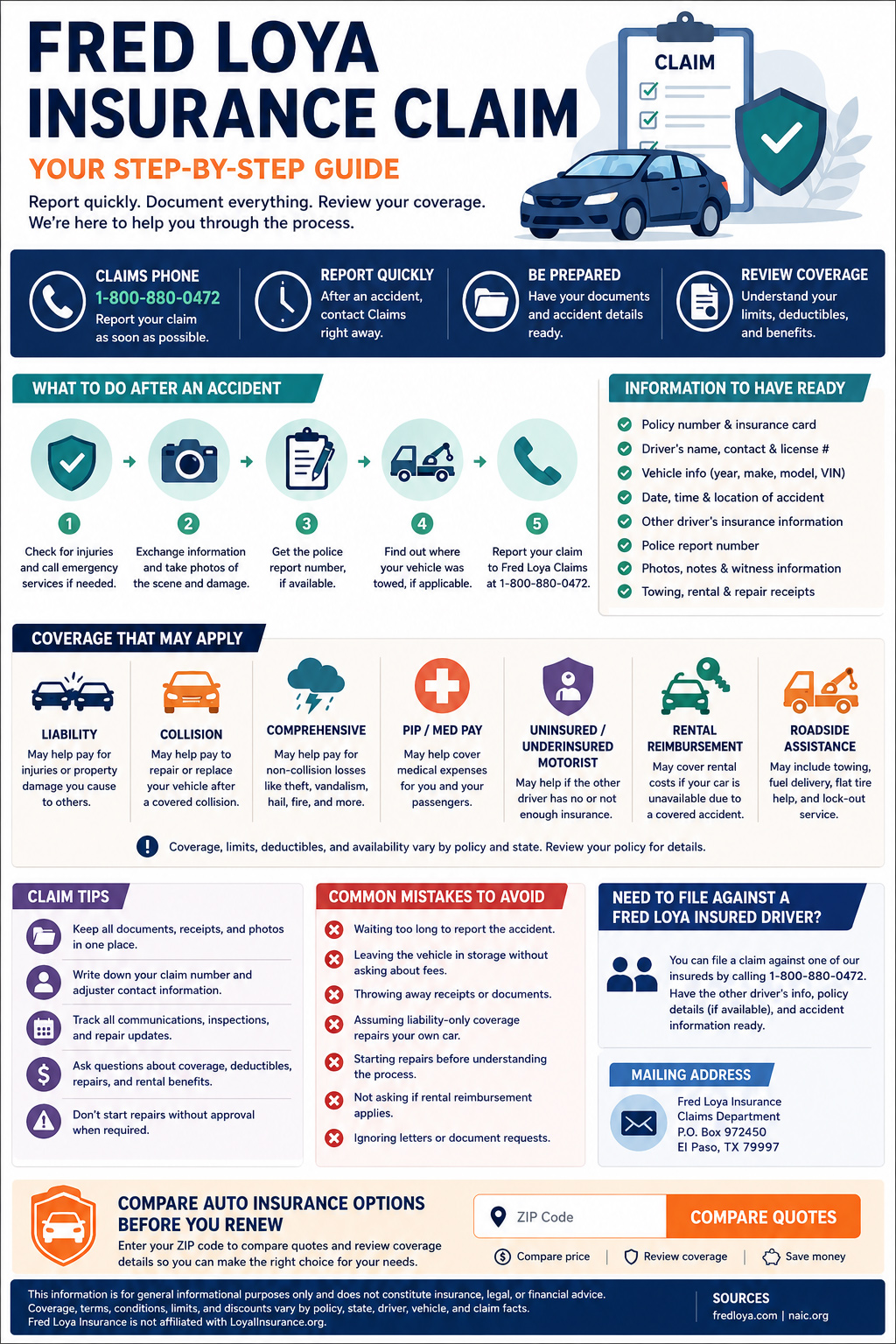
What to Do After an Accident
Fred Loya’s own accident instructions emphasize four immediate tasks: report the claim, protect the vehicle from additional damage, locate the vehicle if it was towed, and create a file containing documents related to the loss.[3]
Accident information worth keeping together
- Insurance and driver information exchanged at the scene
- Photos of vehicle damage and the accident scene
- Police report or accident exchange information
- Towing company and storage-yard information
- Repair estimates and inspection information
- Rental, towing, storage, and other claim-related receipts
- Claim number and assigned adjuster contact information
- Emails, letters, and notes from claim-related calls
Information to Have Ready When You File
Fred Loya’s FAQ specifically asks callers to have all accident information readily available. Having the basic policy, vehicle, driver, and loss details together can reduce unnecessary follow-up.
- Policy information Policy number, named insured, insurance card, and effective dates.
- Driver details Names, phone numbers, license information, and addresses for involved drivers.
- Vehicle details Year, make, model, license plate, VIN, and current vehicle location.
- Accident facts Date, time, location, and a factual description of what happened.
- Other party information Insurance information, vehicle details, and contact information when available.
- Police information Report number and responding agency when a report was made.
- Photos and documents Scene photos, damage photos, accident exchange forms, and towing documents.
- Expenses Receipts for towing, storage, rental, and other claim-related costs.
What Coverage May Apply?
The type of coverage that matters depends on the loss and the policy. Current Fred Loya materials describe liability, collision, comprehensive, medical payments, personal injury protection, rental reimbursement, and roadside assistance among its auto insurance categories. The NAIC also explains that auto policies can combine required and optional coverage differently by state and policy.[4] [5]
| Coverage | When It May Matter | What to Check |
|---|---|---|
| Liability | A covered accident causes injury or property damage to another person. | Check the bodily injury and property damage limits and applicable exclusions. |
| Collision | Your insured vehicle is damaged in a covered collision. | Confirm that collision is included and which deductible applies. |
| Comprehensive | The vehicle has a covered non-collision loss such as theft, hail, fire, flood, vandalism, or animal impact. | Check the deductible, exclusions, and covered causes of loss. |
| Medical or PIP | Medical expenses or other covered injury-related costs arise after an accident. | Availability, requirements, limits, and benefits depend on the state and policy. |
| Uninsured/underinsured motorist | The other driver has no insurance or insufficient insurance and the applicable coverage responds. | Check whether the coverage exists on the policy and what limits or state rules apply. |
| Rental reimbursement | Your vehicle is being repaired after a covered accident and the rental benefit applies. | Confirm the benefit, limits, qualifying circumstances, and any authorization requirements. |
If an accident exposes a limit, deductible, or missing protection that you had not considered before, the question of how much auto insurance coverage fits your situation becomes especially relevant before the next renewal.
Liability Claims vs. Damage to Your Own Vehicle
Liability coverage and physical-damage coverage serve different purposes. Liability generally addresses covered injuries or property damage caused to others. Damage to your own vehicle usually requires the applicable collision or comprehensive coverage, subject to the policy and deductible.
A policy that contains only liability coverage should not be assumed to pay for repairs to your own vehicle. Check the declarations page before making assumptions about what the policy includes.
What If the Vehicle Was Towed?
Fred Loya specifically tells drivers to find out where the vehicle was taken if it was towed. That information can be important because the adjuster may need the storage location and access information, while towing and storage charges can continue to accumulate.[3]
Keep these towing details
- Towing company name and phone number
- Storage-yard address
- Date the vehicle was towed
- Police or tow-report number when available
- Current storage charges and release requirements
- Towing and storage receipts
Rental Reimbursement and Roadside Assistance Are Different
Fred Loya currently describes rental reimbursement as coverage that can pay for a rental car while an insured vehicle is repaired after a covered accident when the vehicle is unavailable for more than 24 hours. Whether it applies to a particular loss depends on the policy and claim.[6]
Roadside assistance is described separately for non-accident vehicle damage or breakdowns and can include towing to the nearest repair facility, flat-tire assistance, fuel delivery, and lock-out service. It should not automatically be treated as accident-claim towing coverage.
Filing Against a Fred Loya Insured Driver
You do not need to be a Fred Loya customer to report a claim against one of its insured drivers. The company’s FAQ directs both policyholders and people filing against one of its insureds to the same Claims Department number, 1-800-880-0472.[2]
Fred Loya’s published claim process says the adjuster gathers statements and other evidence, evaluates policy coverage and accident facts, prepares or obtains damage information, and reaches a final claim disposition based on the investigation.
How to Check a Fred Loya Claim Status
Fred Loya says claim-status questions can be directed to 1-800-880-0472 during its listed claims hours. Once the claim has been filed and an adjuster assigned, the company says you can contact that adjuster directly for questions or to provide and obtain information needed to move the claim forward.[1]
- Claim number Keep it available whenever you call or send documents.
- Adjuster Save the adjuster’s direct contact information once assigned.
- Timeline Record calls, inspections, document requests, and repair updates.
- Documents Keep police reports, estimates, receipts, photos, and letters together.
- Open requests Note anything the adjuster still needs from you.
- Next contact Ask when you should expect the next update if no date has been provided.
When Payment Status and a Claim Overlap
A claim and a billing issue are separate questions. A payment receipt does not by itself establish that a particular loss is covered, and a claim report does not resolve an overdue premium or cancellation issue.
If the accident occurred close to a due date or cancellation notice, check the policy documents and the Fred Loya payment deadlines and account tools so you have the billing record, receipt, and policy-status information available when speaking with the insurer.
Common Claim Problems to Avoid
Keep the process documented
- Do not delay reporting the accident unnecessarily.
- Do not lose track of where a towed vehicle is being stored.
- Keep receipts, estimates, photos, and claim correspondence.
- Do not assume liability coverage repairs your own vehicle.
- Confirm the applicable deductible before making financial assumptions.
- Ask whether rental reimbursement applies before relying on a rental benefit.
- Respond to reasonable document and information requests from the assigned claims representative.
What If You Are Unhappy With the Claim Experience?
Start by asking which policy term, coverage limit, deductible, exclusion, or claim fact affected the decision. Keep the response and supporting correspondence with the rest of your claim file.
If the experience leads you to change insurers, arrange the replacement policy before canceling the current one. The steps for switching car insurance without creating a coverage gap matter because even a short lapse can leave you uninsured and may affect future pricing.
After the claim: Check your declarations page again and note the liability limits, collision and comprehensive deductibles, rental reimbursement, uninsured/underinsured motorist coverage, excluded drivers, vehicle information, and any coverage that did not work the way you expected.
Frequently Asked Questions About Fred Loya Insurance Claims
What is the Fred Loya claims phone number?
Fred Loya currently lists 1-800-880-0472 for filing an auto insurance claim.
When should I report a Fred Loya claim?
Fred Loya says a claim should be reported as soon as possible after an accident occurs.
Can I file against a Fred Loya insured driver?
Yes. Fred Loya’s FAQ says its Claims Department handles claims filed on your own policy or against one of its insureds.
How do I check my claim status?
Fred Loya directs claim-status questions to 1-800-880-0472 during its claims hours. After an adjuster is assigned, the company says you can contact that adjuster directly for claim-related questions.
Does reporting a claim mean the damage is covered?
No. Reporting starts the process. Coverage still depends on the policy, coverage in force, limits, deductibles, exclusions, and the facts of the loss.
Does liability-only insurance repair my own vehicle?
Liability generally addresses covered injury or property damage caused to others. Damage to your own vehicle ordinarily requires applicable physical-damage coverage such as collision or comprehensive, depending on the type of loss and policy terms.
Compare Auto Insurance Options After a Claim
Enter your ZIP code to compare auto insurance quote options and check coverage details before choosing or renewing a policy.
Compare price, liability limits, deductibles, rental benefits, and policy terms before choosing coverage.
Sources
This article uses current Fred Loya public claim information and consumer auto-insurance resources. Claim instructions, hours, policy terms, coverage, and benefits can change, so confirm time-sensitive information with the insurer and the policy documents.
- Fred Loya Insurance — Claims Process, Claims Hours, and Claim Status ↩ ↩ ↩
- Fred Loya Insurance — Filing a Claim ↩ ↩
- Fred Loya Insurance — What to Do After an Accident ↩ ↩
- Fred Loya Insurance — Current Auto Coverage, Rental Reimbursement, and Roadside Assistance ↩ ↩
- National Association of Insurance Commissioners — What Does Auto Insurance Cover? ↩
- Fred Loya Insurance — Contact and Claims Mailing Address