

Loya basic car insurance is best understood as a search phrase drivers may use when they want simple, affordable auto coverage. It is not usually a single fixed coverage package. A “basic” policy can mean different things depending on your state, vehicle, lender requirements, selected limits, deductibles, and optional coverages.
For many drivers, basic car insurance starts with liability coverage. Depending on the state and policy, it may also involve uninsured or underinsured motorist coverage, personal injury protection, medical payments, collision, comprehensive, roadside assistance, or rental reimbursement. The key is to compare what the policy actually covers instead of judging it only by the monthly payment.
What Does Loya Basic Car Insurance Mean?
The phrase “basic car insurance” usually describes a practical coverage level rather than a formal product name. Some drivers use it to mean the lowest legal coverage required by their state. Others use it to mean a simple policy that includes liability plus a few extra protections.
That difference matters. A state-minimum policy may help you drive legally, but it may not protect you well after a serious accident. A basic policy with stronger limits or selected optional coverages may cost more, but it may reduce financial risk if you cause damage, are hit by an uninsured driver, or need repairs after a covered loss.
Important coverage reminder: Do not choose auto insurance only because it has the lowest monthly payment. Review the declarations page, liability limits, deductibles, excluded drivers, payment fees, cancellation rules, optional coverages, and claims instructions before buying.
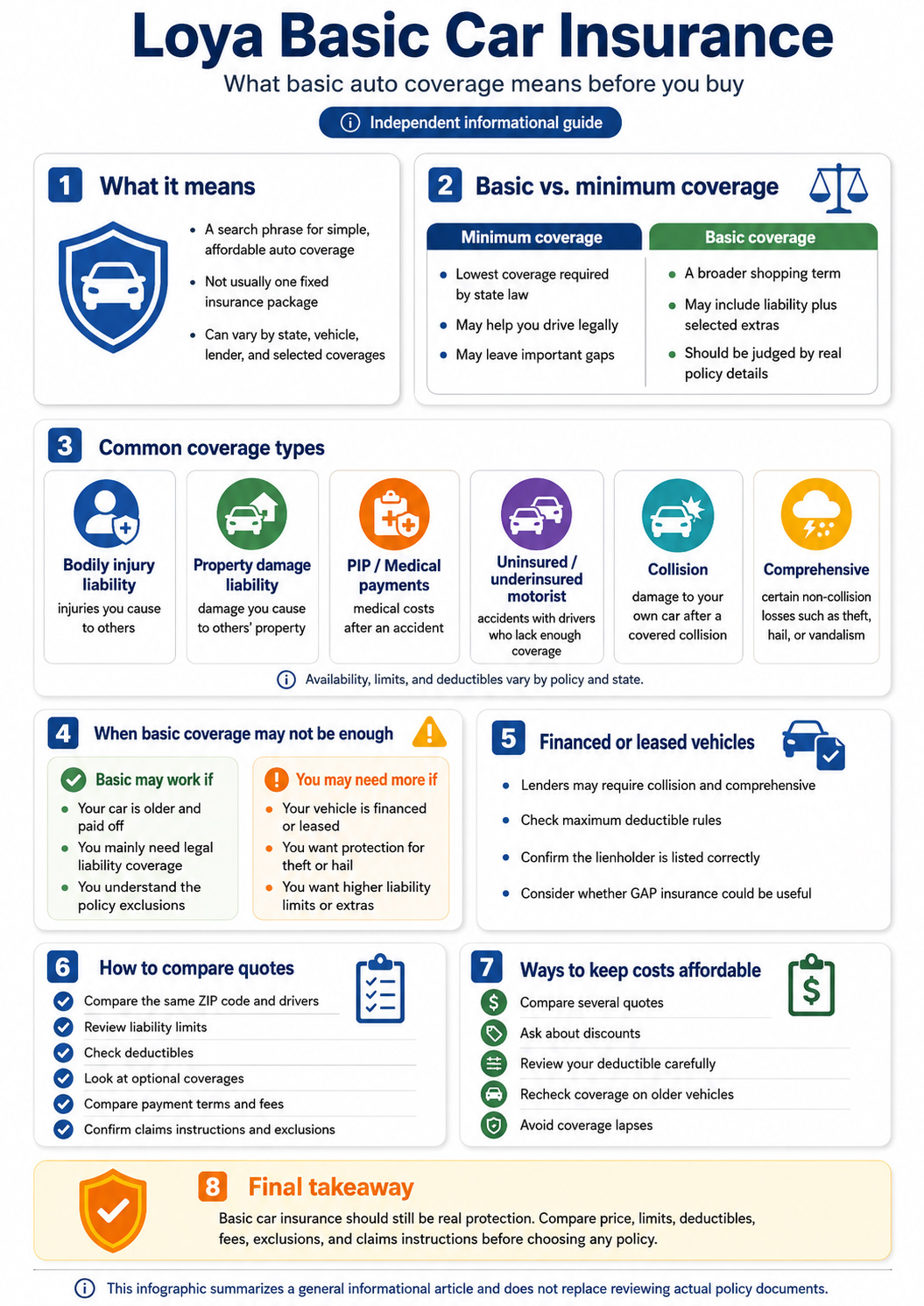
Basic Coverage vs. Minimum Coverage
Minimum coverage means the lowest coverage level required by your state’s financial responsibility or auto insurance laws. Basic coverage is a broader shopping phrase. It may include state-minimum liability only, or it may include additional protection depending on what you choose.
The NAIC explains that auto insurance coverage can include liability, collision, comprehensive, medical payments, personal injury protection, uninsured or underinsured motorist coverage, and other options depending on the policy and state rules.[1] Fred Loya’s coverage information also describes common options such as liability, comprehensive, collision, medical payments or PIP, uninsured or underinsured motorist coverage, rental reimbursement, and roadside assistance.[2]
| Coverage Type | What It May Help With | What to Compare |
|---|---|---|
| Bodily injury liability | May help pay for injuries you cause to others in a covered accident. | Compare per-person and per-accident limits, exclusions, and state requirements. |
| Property damage liability | May help pay for damage you cause to another person’s vehicle or property. | Review the property damage limit and whether higher limits are affordable. |
| Personal injury protection or medical payments | May help with medical costs after an accident, depending on your state and policy. | Ask whether it is required, optional, available, or excluded where you live. |
| Uninsured or underinsured motorist coverage | May help after certain accidents involving drivers with no insurance or not enough insurance. | Confirm whether it is required, included, optional, rejected, or subject to separate limits. |
| Collision coverage | May help pay for damage to your own vehicle after a covered collision. | Review the deductible, lender requirements, vehicle value, and exclusions. |
| Comprehensive coverage | May help with certain non-collision losses such as theft, hail, fire, vandalism, flood, falling objects, or animal impact, depending on the policy. | Check covered causes of loss, deductible amount, vehicle value, and exclusions. |
Liability Coverage Is Usually the Starting Point
Liability coverage is often the foundation of a basic auto policy. It generally has two parts: bodily injury liability and property damage liability. Bodily injury liability may help with covered injuries you cause to another person. Property damage liability may help with covered damage you cause to another person’s vehicle, fence, mailbox, building, or other property.
Most states require drivers to carry liability coverage or meet financial responsibility requirements. New Hampshire is commonly discussed as an exception because state materials explain that New Hampshire motor vehicle laws do not require every driver to carry auto insurance, although drivers remain responsible for meeting financial responsibility requirements if they cause damage or are required to file proof of insurance.[3]
Practical tip: Even when a state minimum is legally enough to drive, it may not be enough to protect your finances after a serious accident. Compare minimum limits with higher-limit quotes before deciding.
When Basic Coverage May Not Be Enough
A basic policy can be useful if you need affordable legal coverage, but it may leave important gaps. Liability coverage generally does not repair your own vehicle after an at-fault accident. It also may not cover your own medical costs unless the policy includes medical payments, PIP, or another applicable coverage.
Basic coverage may be enough if:
- Your car is older and paid off.
- You mainly need legal liability coverage.
- You can afford certain out-of-pocket repair costs.
- You understand what the policy excludes.
- You are comparing several quotes with the same limits.
You may need more coverage if:
- Your vehicle is financed or leased.
- You could not afford to replace your car after a loss.
- You want protection for theft, hail, vandalism, or animal impact.
- You want rental reimbursement or roadside assistance.
- You want higher liability limits than the state minimum.
Financed or Leased Vehicles May Need More Than Basic Liability
If your vehicle is financed or leased, your lender or lease company may require collision and comprehensive coverage. These coverages can help protect the vehicle itself, while liability coverage mainly addresses covered injuries or property damage you cause to others.
Before choosing a basic policy, check your loan or lease agreement. Removing physical damage coverage from a financed or leased vehicle can create problems with the lender and may leave you responsible for repairs or replacement costs after a covered loss.
Questions to ask if your car is financed or leased
- Does the lender require collision and comprehensive coverage?
- Is there a maximum deductible allowed by the lender?
- Does the policy list the lienholder correctly?
- Would GAP insurance be useful if the car is worth less than the loan balance?
- Would you need rental reimbursement if your car is being repaired?
- Can you afford the deductible after a claim?
How to Compare Loya Basic Car Insurance Quotes
The best way to compare basic car insurance is to use the same information for every quote. Compare the same ZIP code, drivers, vehicles, liability limits, deductibles, and optional coverages. If one quote is much cheaper, look closely to see whether it has lower limits, fewer protections, a higher deductible, or extra fees.
- Liability limits Compare bodily injury and property damage limits, not just monthly price.
- Deductibles Review collision and comprehensive deductibles if physical damage coverage is included.
- Optional coverages Ask about uninsured motorist, PIP, MedPay, roadside, rental, and GAP options.
- Payment terms Compare down payment, monthly payment, installment fees, and due dates.
- Policy exclusions Look for excluded drivers, use restrictions, coverage gaps, or special endorsements.
- Claims process Confirm how to report a claim and what documents you may need after an accident.
Ways to Keep Basic Car Insurance More Affordable
There is no single discount or trick that guarantees the cheapest rate for every driver. Auto insurance prices vary by state, ZIP code, vehicle, driving history, prior coverage, selected limits, deductible, and insurer. However, some practical steps may help you compare lower-cost options more carefully.
The Insurance Information Institute recommends shopping around, comparing insurance costs before buying a vehicle, asking about higher deductibles, reviewing coverage on older vehicles, and asking about discounts as ways to lower auto insurance costs.[4]
| Cost-Saving Step | How It May Help | What to Watch For |
|---|---|---|
| Compare several quotes | Different insurers may price the same driver differently. | Use the same limits and deductibles so the comparison is fair. |
| Ask about discounts | Discounts may be available for safe driving, low mileage, autopay, paperless billing, or multiple policies. | Discount names and eligibility vary by company and state. |
| Review your deductible | A higher deductible may lower the premium for collision or comprehensive coverage. | Do not choose a deductible you could not afford after a claim. |
| Review older vehicle coverage | Collision or comprehensive may not always be cost-effective on an older paid-off vehicle. | Removing coverage means you may have to pay for your own repair or replacement. |
| Avoid coverage lapses | Keeping continuous coverage may help avoid legal and pricing problems later. | Do not cancel your old policy before a new one is active. |
Should You Choose the Cheapest Basic Policy?
Not automatically. A cheaper policy can help your budget, but it may also have lower limits, fewer coverages, higher deductibles, stricter exclusions, or additional payment fees. The right choice is the policy that gives you legal coverage, fits your budget, and provides enough protection for your real risk.
If two quotes look similar, compare the declarations page details. The declarations page usually summarizes the named insured, covered vehicles, listed drivers, policy period, coverage limits, deductibles, premium, lienholder information, and selected options.
Before buying, confirm:
- The legal insurer name on the policy
- The policy number, effective date, and expiration date
- The vehicle year, make, model, and VIN
- All listed drivers and excluded drivers
- Liability limits and optional coverages
- Collision and comprehensive deductibles if included
- Down payment, monthly payment, fees, and cancellation rules
- Claim reporting instructions and required documents
Where Loya Fits Into Basic Car Insurance Searches
Some drivers search for basic coverage because they want a simple policy that helps them meet state requirements without adding options they may not need. A Loya car insurance option may be worth comparing if you want local office support, payment discussions, or a straightforward auto policy, but the final decision should still depend on the actual coverage terms.
Before choosing any basic policy, check whether the quote includes only liability coverage or whether it also includes uninsured motorist protection, PIP, medical payments, roadside assistance, rental reimbursement, collision, or comprehensive coverage. A policy can be “basic” and still have important differences from another quote.
When a basic Loya-related quote may make sense
- You need legal auto coverage and want to compare simple policy options.
- You prefer speaking with a local office instead of handling everything online.
- You want to review payment options before choosing a policy.
- You are comparing liability-only coverage against broader coverage.
- You want to understand the trade-off between lower monthly cost and lower protection.
Use a quote to check the real price
A Fred Loya quote can help you see how the price changes when you adjust limits, deductibles, vehicles, drivers, or optional coverage. Do not compare the first payment only. Compare the total policy cost, installment fees, cancellation rules, and effective date.
If one quote looks much cheaper, check what was removed. The lower price may come from state-minimum limits, no physical damage coverage, no rental reimbursement, a higher deductible, or fewer optional benefits.
When affordability is the main concern
Drivers shopping on a tight budget should also review low income car insurance options before choosing the cheapest basic policy. A lower monthly payment can help, but the policy still needs to fit your legal requirements, lender rules, vehicle situation, and claim-time risk.
Bottom line: Basic car insurance should still be real protection. Compare price, liability limits, deductibles, optional coverage, fees, exclusions, and claims instructions before choosing any policy.
Bottom line: Basic car insurance should still be real protection. Compare price, limits, deductibles, fees, exclusions, and claims instructions before choosing any policy.
Frequently Asked Questions About Loya Basic Car Insurance
Is Loya basic car insurance a specific policy?
Usually, no. It is better understood as a search phrase for simple or affordable auto insurance coverage. The actual policy depends on the insurer, state, driver, vehicle, limits, deductibles, and selected options.
Is basic car insurance the same as state-minimum coverage?
Not always. State-minimum coverage is the lowest coverage required by law in a state. Basic car insurance may mean state-minimum coverage, but it may also include additional options such as uninsured motorist, medical payments, roadside assistance, or physical damage coverage.
Does liability insurance repair my own car?
Usually no. Liability coverage generally helps with covered injuries or property damage you cause to others. Repairing your own vehicle after a covered collision usually depends on whether collision coverage or another applicable coverage is included.
Do I need collision and comprehensive coverage?
It depends on your vehicle, budget, lender or lease requirements, and risk tolerance. If your car is financed or leased, your lender may require both. If your car is older and paid off, you may want to compare the cost of the coverage with the vehicle’s value.
What should I compare before choosing basic auto insurance?
Compare liability limits, deductibles, optional coverages, payment terms, fees, excluded drivers, cancellation rules, claims instructions, and whether the policy satisfies your state, lender, or lease requirements.
Compare Basic Auto Insurance Quotes by ZIP Code
Enter your ZIP code to compare auto insurance quote options and review coverage details before choosing a policy.
Compare price, coverage limits, deductibles, fees, and policy terms before choosing auto insurance.
Sources
This article was updated using official company coverage information and consumer-focused insurance resources. Drivers should confirm final rates, policy terms, coverage availability, discounts, fees, claims handling, and legal requirements directly with the insurer, agent, quote provider, or state insurance department before buying coverage.
- National Association of Insurance Commissioners — What You Should Know About Auto Insurance Coverage ↩
- Fred Loya Insurance — Car Insurance Coverage ↩
- New Hampshire Insurance Department — Automobile Insurance Consumer Guide ↩
- Insurance Information Institute — Nine Ways to Lower Your Auto Insurance Costs ↩