Category: Insurance Articles

Insurance Articles covering auto insurance and money saving tips for other types of insurance.

  • Loya Casualty Insurance Company

    Company Profile

    Loya Casualty Insurance Company is a California-domiciled property and casualty insurer. The current California Department of Insurance profile lists NAIC #12589, California Company ID #4961-9, an authorization date of June 7, 2006, and license status UNLIMITED-NORMAL.

    The same regulator lists the company in NAIC Group #3702 — Loya Group and shows Automobile, Disability, and Liability among its authorized lines of business. Those regulatory lines do not tell you which coverages are included on an individual auto policy; the declarations page and policy forms do that.

    NAIC 12589
    CA Company ID 4961-9
    Domicile California
    CA License Status Unlimited-Normal

    Current California Regulatory Profile

    The California Department of Insurance currently lists Loya Casualty Insurance Company at 1800 Lee Trevino, Suite 201, El Paso, Texas 79936, with telephone number 1-800-880-0472. The profile identifies California as the company’s state of domicile, even though its listed office address is in El Paso, Texas.

    The company profile also identifies Loya Group as NAIC Group #3702. For consumers, the regulatory profile is useful for confirming that the company name and NAIC number on a policy or claim document match the insurer you intend to verify.

    Company identity and coverage are different questions: confirming NAIC #12589 identifies Loya Casualty Insurance Company, but it does not establish the limits, deductibles, exclusions, endorsements, or benefits on a particular policy.
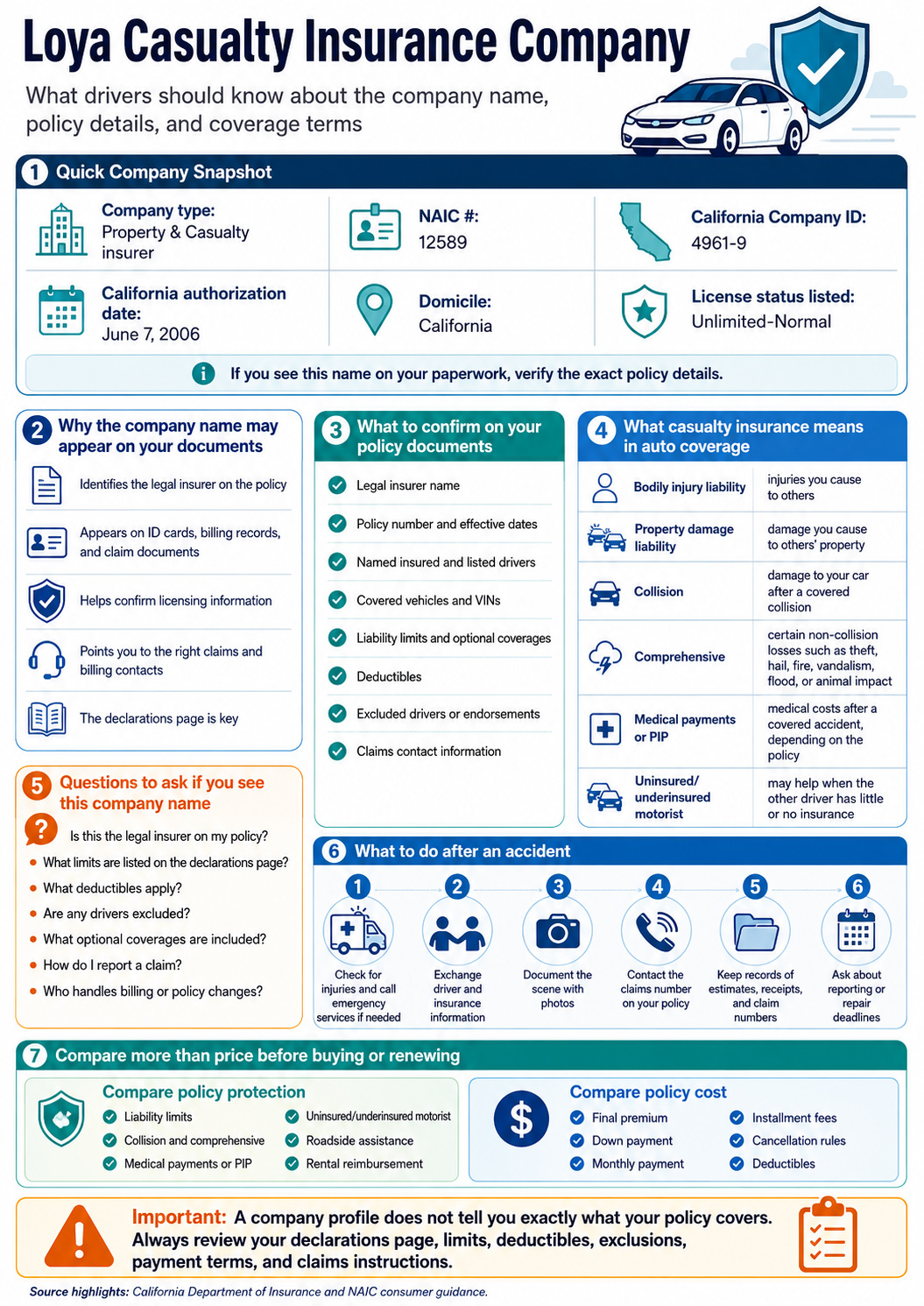
    Loya Casualty Insurance Company profile with NAIC number, California regulatory information, policy document checks, and auto insurance details.

    Company History and Relationship to the Loya Group

    California’s 2022 examination report states that Loya Casualty Insurance Company was incorporated in California on December 14, 2004 and received its California Certificate of Authority on June 7, 2006.

    The examination describes Loya Casualty as part of the Loya insurance holding-company system. Its organizational chart identifies Loya Insurance Company as the parent company of Loya Casualty Insurance Company and shows other affiliated entities within the group, including Young America Insurance Company, Vision Insurance Company, and Fred Loya Insurance Agency.

    What Business Did Loya Casualty Write?

    The 2022 California examination report says that, as of December 31, 2022, Loya Casualty Insurance Company was licensed to transact automobile insurance business only in California. It wrote six-month policies centered on basic auto liability coverage and low-value automobile property-damage coverage through affiliated agencies.

    The report says the company wrote approximately $163.8 million in direct premium in 2022. Of that amount, 55.4% was private-passenger automobile liability and 40.4% was private-passenger automobile physical damage. These are historical examination-period figures, not current quotes or coverage guarantees.

    Current California Automobile Complaint Data

    California’s current Automobile Complaint Composite Report includes Loya Casualty Insurance Company among the 50 large automobile insurers licensed to conduct business in the state. For complaint year 2025, the report lists approximately 213,756 earned exposures, 38 justified complaints, and a justified complaint ratio of 17.8.

    The California Department of Insurance defines that ratio as the number of justified complaints per 100,000 earned exposures. The report places Loya Casualty at rank 45 of 50 for 2025. Complaint ratios are one consumer-comparison signal and should be read together with coverage, price, policy terms, and the insurer’s response to your specific needs.

    Complaint data changes by year: use the current California Department of Insurance complaint composite rather than copying an older complaint count or relying on reviews from a different Loya-related entity.

    How to Verify Loya Casualty on Your Policy

    If your declarations page, insurance card, bill, or claim correspondence shows Loya Casualty Insurance Company, match the company name and NAIC number before assuming that information about another Loya-related insurer applies to your policy.

    • Legal insurer name Check that the policy identifies Loya Casualty Insurance Company if that is the issuing insurer.
    • NAIC number Compare the document with NAIC #12589 when the number is shown.
    • Policy number Use the exact number shown on the declarations page or insurance card.
    • Effective dates Confirm when coverage begins and ends.
    • Drivers and vehicles Check listed and excluded drivers plus the correct vehicle information.
    • Limits and deductibles Read the actual dollar limits and applicable deductibles.
    • Endorsements Check any forms that add, remove, or modify coverage.
    • Claims information Follow the claims instructions associated with the issued policy.

    Coverage Belongs on the Policy, Not the Company Profile

    A regulator’s company profile tells you who the insurer is. It does not tell you whether your policy includes collision, comprehensive, medical benefits, uninsured-motorist coverage, rental reimbursement, roadside assistance, or a particular liability limit.

    For coverage questions, use the declarations page, policy forms, endorsements, and any applicable notices issued for your policy. Those documents show the limits, deductibles, physical-damage coverage, exclusions, and other terms that actually apply.

    Questions to ask before relying on a policy

    • Which legal insurance company issued the policy?
    • What are the bodily-injury and property-damage liability limits?
    • Are collision and comprehensive listed?
    • What deductible applies to each physical-damage coverage?
    • Which drivers are listed or excluded?
    • What is the total premium and payment schedule?
    • Which endorsements or exclusions change the base policy?
    • Where and how should a claim be reported?

    What the 2022 Examination Does—and Does Not—Tell You

    A financial examination is a regulatory review of the insurer, not a consumer rating of an individual policy. California’s report reviewed the company’s financial condition, corporate governance, risks, controls, accounts, and statutory reporting for the examination period from 2018 through 2022.

    The report says the company’s loss and loss-adjustment-expense reserves as of December 31, 2022 were found to be reasonably stated for examination purposes. It also made recommendations concerning an amended managing-general-agency agreement and annual-statement disclosures. Those findings should not be interpreted as a promise about a future claim or policy outcome.

    Frequently Asked Questions About Loya Casualty Insurance Company

    What is the NAIC number for Loya Casualty Insurance Company?

    The California Department of Insurance currently lists NAIC #12589 for Loya Casualty Insurance Company.

    Where is Loya Casualty Insurance Company domiciled?

    The current California regulator profile lists California as the state of domicile. Its listed company address is 1800 Lee Trevino, Suite 201, El Paso, Texas 79936.

    Is Loya Casualty part of the Loya insurance group?

    Yes. The California profile places it in NAIC Group #3702, Loya Group, and the 2022 examination describes it as part of the Loya insurance holding-company system.

    What lines of insurance is Loya Casualty authorized for in California?

    The current California company profile lists Automobile, Disability, and Liability as authorized lines of business.

    Does the company profile tell me what my auto policy covers?

    No. Coverage is determined by the issued policy, declarations page, endorsements, limits, deductibles, exclusions, and applicable law.

    Optional: Compare Other Coverage

    Compare Auto Insurance Quotes by ZIP Code

    If you are shopping for a different policy rather than verifying an existing Loya Casualty policy, enter your ZIP code to compare auto insurance quote options.

    Compare the legal insurer, equivalent coverage limits, deductibles, total premium, and policy terms before choosing coverage.

  • Fred Loyal Insurance: Did You Mean Fred Loya Insurance?

    Editorially maintained information about Fred Loya Insurance names, official contacts, and policy verification.

    • Fred Loyal Insurance
    • Fred Loya Insurance
    • Company Name Check

    The LoyalInsurance.org Editorial Team maintains consumer-focused information about insurance companies, policy documents, contact paths, coverage, and claims.

    LoyalInsurance.org is an independent informational website and is not affiliated with Fred Loya Insurance or any insurer. Always use the company name, policy number, and contact information shown on your own policy documents.

    Name Clarification

    If you searched for Fred Loyal Insurance while trying to reach the auto insurer, the official company website uses the name Fred Loya Insurance. Use the exact company name shown on your insurance card, declarations page, bill, or claim correspondence when checking a policy, payment, office, or claim.

    Fred Loya’s official contact page currently lists 1-800-444-4040 for quotes and customer service and 1-800-880-0472 for claims. Its website also provides an official office finder and online account tools.

    Official brand Fred Loya Insurance
    Customer service 1-800-444-4040
    Claims 1-800-880-0472
    Best verification Your policy documents

    Fred Loyal Insurance vs. Fred Loya Insurance

    “Fred Loyal Insurance” is not the name used on Fred Loya’s official website. The public-facing brand is Fred Loya Insurance, while official company materials also use the broader Loya Insurance Group name.

    The distinction matters because similar Loya-related names can appear on insurance documents. Fred Loya’s claims page says Loya Insurance Group handles claims for subsidiaries including Loya Insurance Company, Fred Loya Insurance, and Young America Insurance. The relationship between Loya Insurance Company and Fred Loya Insurance is relevant when the legal insurer on a policy differs from the consumer-facing brand.

    Do not rely on spelling alone: The legal insurer shown on the declarations page or policy forms is more important than the brand name used in an advertisement, search result, or office sign.

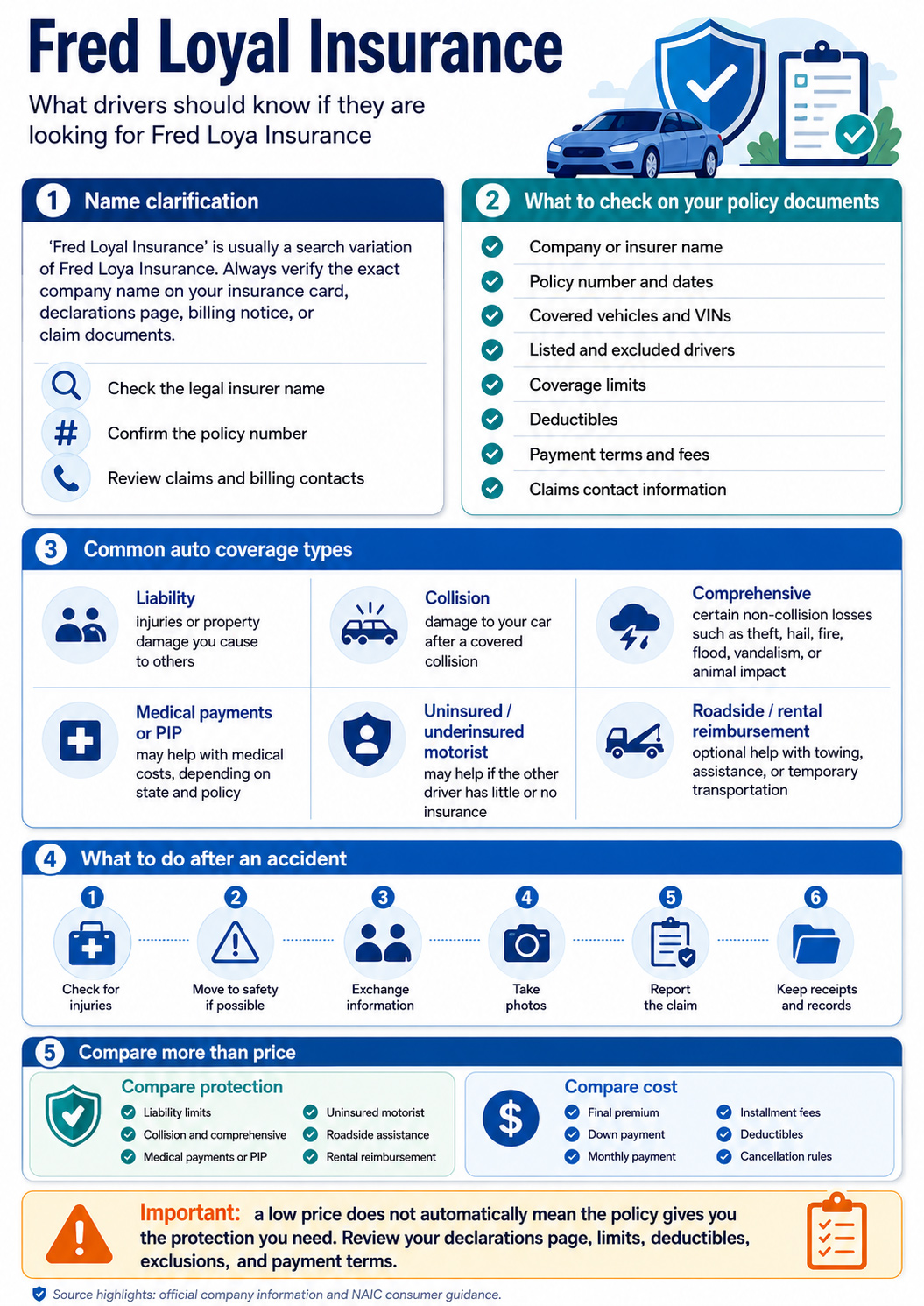
    Fred Loyal Insurance spelling clarification for Fred Loya Insurance, including official contact paths and policy document checks.

    Official Fred Loya Pages for Common Tasks

    If you were looking for Fred Loya Insurance, use the official page that matches what you need. Payments, claims, office information, account access, and contact details can change, so the current Fred Loya website is the best place to verify time-sensitive information.

    What You Need Official Fred Loya Page What to Verify
    Company website Fred Loya official website Use the official domain before entering policy or personal information.
    Customer service or quote Fred Loya customer service and contact Current phone numbers, mailing addresses, and quote information.
    Find an office Fred Loya office finder Branch address, local phone number, hours, and directions.
    Report or check a claim Fred Loya claims Claims number, current live-agent hours, and claim process.
    Make a payment Fred Loya online payment Policy information, payment details, receipt, and current payment-page instructions.
    Online account Fred Loya account login Payments, ID cards, declarations, policy details, and payment summary tools.

    How to Verify the Name on an Insurance Document

    If the document in front of you says Fred Loya, Loya Insurance Company, Young America Insurance, or another insurer name, do not rewrite that name based on what you remember seeing online. Use the exact company name printed on the document when discussing a policy, payment, or claim.

    • Declarations page Check the insurer name, policy number, effective dates, vehicles, drivers, limits, and deductibles.
    • Insurance card Confirm the insurer name and policy number before using it as proof of insurance.
    • Billing notice Match the policy number and insured name before submitting a payment.
    • Claim correspondence Keep the claim number, assigned adjuster information, and insurer name together.
    • Website domain For Fred Loya online services, verify that you are on the official fredloya.com domain.

    Frequently Asked Questions About “Fred Loyal Insurance”

    Is the auto insurer called Fred Loyal Insurance?

    The official website uses the name Fred Loya Insurance. If you entered “Fred Loyal Insurance” while looking for that company, use the official Fred Loya spelling when searching for its website, offices, customer service, or claims information.

    What is the official Fred Loya website?

    The current official website is FredLoya.com.

    What is the Fred Loya customer service number?

    Fred Loya currently lists 1-800-444-4040 for quotes and customer service.

    What is the Fred Loya claims number?

    Fred Loya currently lists 1-800-880-0472 for filing or checking an auto insurance claim.

    Why might a different Loya-related company name appear on my documents?

    Fred Loya’s claims page says Loya Insurance Group handles claims for subsidiaries including Loya Insurance Company, Fred Loya Insurance, and Young America Insurance. Use the exact insurer name shown on your own policy documents.

    Optional: Compare Other Coverage

    Compare Auto Insurance Quotes by ZIP Code

    If you are shopping for alternatives rather than trying to service an existing Fred Loya policy, enter your ZIP code to compare auto insurance quote options. This comparison is separate from Fred Loya’s official website and policy-service tools.

    Compare equivalent limits, deductibles, total premium, and policy terms before choosing an insurer.

    Sources

    This page uses current Fred Loya public information to clarify the company name and identify the appropriate official service channels. Contact details and online tools can change, so verify time-sensitive information on the current Fred Loya website.

    1. Fred Loya Insurance — Official Website
    2. Fred Loya Insurance — Contact, Customer Service, and Claims Numbers
    3. Fred Loya Insurance — Claims Process and Loya Insurance Group Subsidiary Names
    4. Fred Loya Insurance — Official Location Finder
    5. Fred Loya Insurance — Online Payment
    6. Fred Loya Insurance — Online Account Login
  • Fred Loya Review

    Editorially maintained information about Fred Loya Insurance, coverage, claims, service access, and consumer feedback.

    • Fred Loya Review
    • Auto Insurance
    • Consumer Comparison

    The LoyalInsurance.org Editorial Team maintains consumer-focused information about auto insurers, coverage, claims, service access, policy terms, and shopping decisions.

    LoyalInsurance.org is an independent informational website and is not affiliated with Fred Loya Insurance or any insurer. Pricing, coverage, discounts, claims outcomes, fees, and service experiences vary by state, policy, location, driver, and claim facts.

    Fred Loya Insurance Review

    Fred Loya Insurance is an auto-focused insurance group that says it began with one storefront in El Paso, Texas, in 1974 and has expanded to more than 800 offices across 12 states. Its public website emphasizes basic auto insurance, local offices, same-day policy issuance, no-credit-check options, and several common discounts.

    The company can be worth comparing for drivers who value local office access or are shopping for straightforward auto coverage, but price should not be the only deciding factor. Coverage limits, deductibles, payment terms, claims access, legal insurer name, and consumer-service signals should all be checked before buying.

    Founded 1974
    Office network 800+ offices / 12 states
    Primary focus Personal auto insurance
    BBB snapshot B rating / not accredited

    Fred Loya Insurance at a Glance

    Fred Loya’s current website says the group has sold more than 4.5 million policies and operates in Alabama, Arizona, California, Colorado, Georgia, Illinois, Indiana, New Mexico, Nevada, Ohio, Oklahoma, and Texas. Its office model includes stand-alone locations and agencies inside or near large retail stores and supermarkets.

    The company markets immediate coverage, saying an auto policy can be issued the same day, and says policies can be issued with no credit check. It also advertises prior-insurance, homeowner, multi-car, and good-driver discounts, while noting that discounts vary by state and restrictions apply.

    What those marketing points do not tell you: They do not establish your final rate, eligibility, coverage limits, deductible, fees, or claim outcome. Those details come from the quote, declarations page, policy forms, and insurer underwriting.

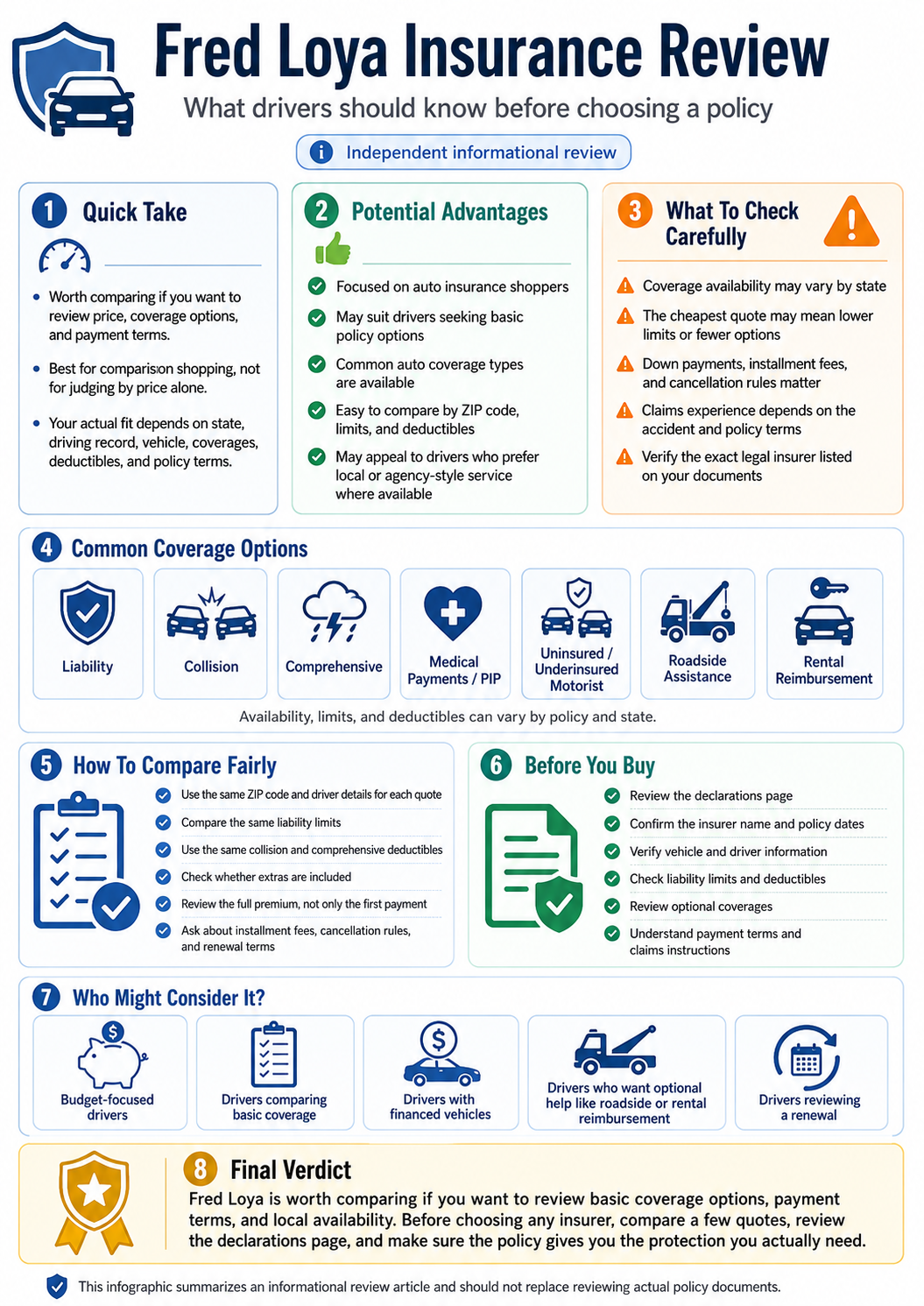
    Fred Loya Insurance review with office network, coverage considerations, claims contacts, consumer feedback, and policy details to compare.

    Potential Strengths

    Large local-office network

    Fred Loya currently lists more than 800 offices in 12 states. That can be useful for drivers who prefer in-person service rather than handling every policy question online.

    Auto-focused product

    The company’s public materials are centered on personal auto insurance rather than a broad mix of unrelated products. That makes the website and office network relatively focused on auto-policy questions.

    Same-day policy availability

    Fred Loya states that policies can be issued the same day. That can matter when a driver needs replacement coverage quickly, although the policy should still be confirmed before relying on it.

    No-credit-check option

    The current website says policies can be issued with no credit check. This does not mean every rating factor is ignored or that every applicant receives the same rate.

    Important Drawbacks and Consumer-Service Signals

    A useful insurer review should include current independent feedback, not only company marketing. As of this September 2026 review, the Better Business Bureau profile for Fred Loya Insurance, LP. shows a B rating and says the business is not BBB accredited. BBB’s complaint page currently reports 343 complaints in the last three years, including 59 closed in the last 12 months.

    BBB’s customer-review page currently shows an average rating of 1.01 out of 5 from 134 customer reviews. Those numbers can change and should not be treated as a regulatory complaint ratio or as proof that every customer has the same experience. BBB reviews are self-selected, and the headquarters profile says its complaint data can include corporate-owned locations.

    How to use complaint data: Treat it as one comparison signal. Check your state insurance department, policy documents, claims contacts, and current quote alongside BBB information rather than relying on a single rating.

    Coverage Available Through Fred Loya

    Fred Loya’s current public website lists liability, comprehensive, collision, medical coverage, personal injury protection, rental reimbursement, and roadside assistance among its auto insurance categories. Exact availability, limits, deductibles, exclusions, and pricing can vary by state and policy.

    Coverage What It Generally Addresses What to Verify
    Liability Covered bodily injury or property damage for which the insured is legally responsible. Dollar limits, exclusions, state requirements, and whether higher limits are available.
    Collision Covered collision damage to the insured vehicle. Deductible, vehicle value, lender requirements, and exclusions.
    Comprehensive Certain covered non-collision losses such as theft, weather, vandalism, fire, or animal impact. Deductible, covered causes of loss, and exclusions.
    Medical / PIP Specified medical or injury-related benefits depending on state law and policy terms. Availability, limits, eligibility, and whether coverage is required or optional.
    Rental reimbursement Specified rental-car costs when the policy benefit applies after a covered loss. Daily or total limits, qualifying circumstances, and exclusions.
    Roadside assistance Specified roadside services such as towing, fuel delivery, flat-tire help, or lock-out service. Whether it is included or optional and which service limits apply.

    “Full Coverage” Needs a Closer Look

    Fred Loya’s own FAQ says there is no single policy that literally provides “full coverage.” Every policy has limits, deductibles, and exclusions. That is a useful standard for evaluating any quote: focus on the actual coverage shown rather than a broad label.

    A quote that includes liability, collision, and comprehensive can still differ substantially from another policy because the liability limits, deductibles, optional benefits, excluded drivers, policy term, and payment structure may differ.

    Claims Process and Access

    Fred Loya currently lists 1-800-880-0472 for reporting claims. Its claims page publishes hours of Monday through Friday, 8:00 a.m. to 7:00 p.m. MST and Saturday, 8:00 a.m. to 4:00 p.m. MST. Claims reporting therefore does not appear to be presented as a 24/7 live-agent service on the current claims page.

    Fred Loya says a liability claims adjuster is assigned to the loss report and will contact the claimant within 24 hours. Its published process includes policy review, accident statements, vehicle-damage estimates, evidence gathering, and a final claim disposition based on the liability investigation.

    If you are unsure which department to contact for a policy, billing, claims, or roadside issue, the Loya insurance phone numbers and department contacts separate the main support channels.

    Customer Service and Office Access

    Fred Loya currently lists 1-800-444-4040 for quotes and customer service. Its contact page says the group has more than 800 offices in 12 states, while the location finder provides branch addresses, local phone numbers, hours, language information, directions, and quote access.

    Local access can be useful, but it should not substitute for checking the policy itself. Office convenience does not determine the liability limits, deductible, exclusions, legal insurer, or how a future claim will be resolved.

    How to Compare Fred Loya With Another Insurer

    Compare equivalent coverage rather than comparing only monthly payments. Use the same drivers, vehicles, liability limits, physical-damage coverage, deductibles, and major optional benefits whenever possible.

    Compare protection

    • Bodily injury and property-damage limits
    • Collision and comprehensive
    • Deductibles
    • Medical or PIP coverage
    • UM/UIM where available
    • Rental and roadside benefits

    Compare service and cost

    • Total policy premium
    • Down payment and installment schedule
    • Applicable fees
    • Claims reporting access
    • Local office availability
    • Complaint and customer-feedback signals

    Who May Want to Compare Fred Loya?

    Fred Loya may be worth including in a comparison if you live in one of its 12 operating states, prefer access to a physical office, want an auto-focused insurer, or are interested in its advertised no-credit-check and same-day-policy options.

    It deserves closer comparison if claims access outside the published live-agent hours is important to you, if you place substantial weight on BBB customer feedback, or if another insurer offers materially stronger limits, benefits, or pricing for equivalent coverage.

    What to Check Before Buying

    Policy details that matter

    • Legal insurer name shown on the policy
    • Effective and expiration dates
    • Covered vehicles and VINs
    • Listed and excluded drivers
    • Liability limits
    • Collision and comprehensive coverage and deductibles, if included
    • Medical, UM/UIM, rental, roadside, or other optional benefits, if included
    • Total premium and payment schedule
    • Applicable fees and cancellation terms
    • Claim-reporting instructions

    Verdict

    Fred Loya has a long operating history, a large physical-office network, and an auto-focused product lineup. Its same-day-policy and no-credit-check marketing may appeal to some drivers, particularly those who prefer local access or straightforward auto-insurance shopping.

    The tradeoff is that current BBB feedback is weak, and the published claims line has defined live-agent hours rather than being presented as 24/7. For that reason, Fred Loya is better treated as an insurer to compare carefully rather than one to choose or reject based on brand recognition alone. The deciding factors should be your actual quote, coverage limits, deductible, total premium, policy documents, and the service features that matter to you.

    Frequently Asked Questions About Fred Loya Insurance

    Is Fred Loya Insurance a good company?

    There is no single answer for every driver. Fred Loya has a large office network and auto-focused products, but current BBB feedback is poor. Compare the actual policy, price, service access, and consumer-feedback signals against other insurers available to you.

    Is Fred Loya BBB accredited?

    No. The current BBB headquarters profile says Fred Loya Insurance, LP. is not BBB accredited and shows a B rating. BBB ratings and complaint counts can change over time.

    Does Fred Loya have many complaints?

    BBB’s headquarters complaint page currently shows hundreds of complaints over the last three years. BBB says the profile includes headquarters and corporate-owned locations, so the number should be treated as one consumer-feedback signal rather than a regulatory complaint ratio.

    Does Fred Loya offer “full coverage”?

    Fred Loya says there is no single policy that provides literal “full coverage.” Every policy has limits, deductibles, and exclusions, so check the actual declarations page and policy forms.

    What is the Fred Loya claims phone number?

    Fred Loya currently lists 1-800-880-0472 for claims. Its published claims hours are Monday through Friday, 8:00 a.m. to 7:00 p.m. MST, and Saturday, 8:00 a.m. to 4:00 p.m. MST.

    Compare Quote Options

    Compare Auto Insurance Quotes by ZIP Code

    Enter your ZIP code to compare auto insurance options. Match equivalent limits, deductibles, and policy features before choosing an insurer.

    Compare the total premium, coverage, deductible, service access, and policy terms—not just the first payment.

  • Loya Basic Car Insurance

    Editorially maintained information about basic auto coverage, liability limits, deductibles, and policy choices.

    • Basic Car Insurance
    • Liability Coverage
    • Policy Comparison

    The LoyalInsurance.org Editorial Team maintains consumer-focused information about auto insurance coverage, liability limits, deductibles, vehicle protection, lender requirements, and policy shopping.

    LoyalInsurance.org is an independent informational website and is not affiliated with Fred Loya Insurance or any insurer. Coverage availability, pricing, limits, deductibles, exclusions, and policy terms vary by state, insurer, policy, vehicle, and driver.

    Basic Car Insurance

    Fred Loya currently markets “Basic Car Insurance And More”, but “basic car insurance” should not be treated as one fixed policy package. The actual policy depends on the state, liability limits, vehicle, deductibles, optional coverage, and the insurer shown on the policy documents.

    For many drivers, a basic policy starts with liability coverage. Fred Loya’s current quote flow can also present options such as collision, comprehensive, uninsured or underinsured motorist coverage, medical payments, personal injury protection, rental, and towing, depending on the quote and state. The declarations page is what confirms which coverages were actually purchased.

    Starting point Liability coverage
    Compare Limits and deductibles
    Do not assume “Full coverage”
    Final authority Policy documents

    Basic Coverage Is Not the Same as Minimum Coverage

    “Minimum coverage” usually means the lowest insurance or financial-responsibility requirement established by a state. “Basic coverage” is a broader shopping term and can describe anything from minimum liability to liability plus selected optional protections.

    The NAIC notes that each state sets its own auto insurance rules and that most states require at least a basic level of coverage. It also explains that consumers often buy more than the minimum because a legal minimum does not necessarily match the financial risk of a serious accident.[1]

    Minimum does not mean sufficient: A policy can satisfy the legal requirement and still leave substantial costs above the liability limit. Compare the actual dollar limits rather than relying on labels such as “basic,” “minimum,” or “full coverage.”

    What Fred Loya Currently Shows as Coverage Options

    Fred Loya’s public website currently lists liability, comprehensive, collision, medical coverage, personal injury protection, rental reimbursement, and roadside assistance among its auto insurance categories. Its quote flow also presents uninsured/underinsured motorist and other coverage choices.[2] [3]

    Coverage What It Generally Addresses What to Confirm
    Bodily injury liability Covered injuries you cause to other people. Per-person and per-accident limits, exclusions, and state requirements.
    Property damage liability Covered damage you cause to another person’s vehicle or property. The property-damage limit and whether higher limits are available.
    Collision Covered collision damage to your insured vehicle. Whether it is included and which deductible applies.
    Comprehensive Certain covered non-collision losses such as theft, hail, fire, vandalism, flood, or animal impact. Deductible, covered causes of loss, exclusions, and vehicle value.
    Medical or PIP Covered medical or injury-related expenses, depending on state law and policy terms. Whether the coverage is required, optional, rejectable, or available in the state.
    UM/UIM Certain losses involving an uninsured or underinsured driver. Availability, limits, state requirements, and any rejection options.
    Rental or roadside Specified temporary transportation or roadside-service expenses when the coverage applies. Limits, qualifying events, exclusions, and whether the option was actually purchased.

    Liability Is Usually the Foundation

    Liability coverage generally focuses on covered bodily injury or property damage for which the insured is legally responsible. It should not be confused with coverage for damage to the insured vehicle.

    Fred Loya’s FAQ states that liability covers third-party bodily injury and that Personal Injury Protection or Medical Payments may be purchased to address the insured’s own medical costs where available. It also says there is no single policy that provides “full coverage”; policies have limits, deductibles, and exclusions.[4]

    Liability may address

    • Covered bodily injury to another person
    • Covered damage to another person’s vehicle
    • Covered damage to other property
    • Policy obligations associated with a covered liability claim

    Liability alone should not be assumed to cover

    • Repairs to your own vehicle
    • Your own medical expenses
    • Rental reimbursement
    • Roadside assistance
    • Losses above the policy limits

    When Basic Liability May Leave a Large Gap

    A lower-cost liability policy can be a reasonable choice for some paid-off vehicles, but the tradeoff is important: damage to your own car may remain your responsibility if you do not carry applicable physical-damage coverage. Low liability limits can also leave you personally exposed when a covered loss exceeds the policy limit.

    The amount of auto insurance coverage that fits your situation depends on more than the legal minimum. Vehicle value, assets, lender requirements, deductible tolerance, driving exposure, and the amount of risk you can absorb all matter.

    Financed or Leased Vehicles

    Fred Loya’s current FAQ says a lienholder may require physical-damage coverage on a financed vehicle. Its description includes collision and damage from events such as hail, flood, and vandalism, subject to policy terms and a deductible.[4]

    Before reducing coverage on a financed vehicle

    • Check the loan or lease agreement.
    • Confirm whether collision and comprehensive are required.
    • Check any maximum deductible allowed by the lender.
    • Confirm that the lienholder information is correct.
    • Do not remove required coverage solely to lower the premium.

    How to Compare Basic Auto Insurance Quotes

    A fair comparison uses the same drivers, vehicles, liability limits, physical-damage coverage, deductibles, and major optional benefits whenever possible. A lower monthly payment can simply mean the quote contains less coverage.

    • Liability limits Compare the actual dollar limits, not just the coverage name.
    • Deductibles Match collision and comprehensive deductibles when comparing physical-damage coverage.
    • Optional coverage Check medical, UM/UIM, rental, roadside, and other options separately.
    • Policy term Confirm the length of each quoted policy.
    • Total premium Compare the full policy cost, not just the down payment or monthly installment.
    • Fees Check applicable installment or policy charges shown in the quote or policy documents.
    • Excluded drivers Confirm who is and is not covered to drive the insured vehicle.
    • Effective date Make sure coverage starts when you expect it to start.

    Ways to Lower Cost Without Relying Only on Minimum Coverage

    Triple-I recommends shopping around, checking insurance costs before buying a vehicle, considering higher deductibles that you could afford, evaluating collision or comprehensive on older vehicles, and asking about discounts. It also recommends getting at least three price quotes when shopping.[5]

    Cost Decision Possible Benefit Tradeoff to Check
    Compare insurers Different insurers can price the same risk differently. Make sure the coverage being compared is equivalent.
    Higher deductible Can reduce some collision or comprehensive premiums. You pay more out of pocket after a covered loss.
    Older vehicle coverage Dropping physical damage can reduce premium on some paid-off vehicles. You may have no policy payment for your own vehicle after certain losses.
    Discounts Qualifying discounts can reduce the premium. Eligibility and availability vary by company and state.

    If You Prefer In-Person Help

    Some drivers prefer to discuss limits, deductibles, and required documents face to face. A nearby Loya insurance office may be useful for quote or policy questions, but confirm the specific branch, hours, and service you need before visiting.

    What to Check on the Policy Before Buying

    Policy details that matter

    • Legal insurer name
    • Policy effective and expiration dates
    • Covered vehicles and VINs
    • Listed and excluded drivers
    • Bodily injury and property-damage liability limits
    • Collision and comprehensive coverage and deductibles, if included
    • Medical, UM/UIM, rental, roadside, or other optional coverage, if included
    • Total premium and payment schedule
    • Claim-reporting information

    Bottom line: “Basic” should describe a simpler coverage structure, not a reason to ignore limits, exclusions, deductibles, lender requirements, or the cost of a serious loss.

    Frequently Asked Questions About Loya Basic Car Insurance

    Is Loya basic car insurance one specific policy?

    Fred Loya markets “Basic Car Insurance And More,” but the public website does not describe one fixed policy package that every customer receives. The issued policy and declarations page determine the actual coverage.

    Is basic insurance the same as state-minimum coverage?

    Not necessarily. Minimum coverage is tied to state requirements. A basic policy can include the minimum, higher liability limits, or selected optional coverage depending on the quote and policy.

    Does liability insurance repair my own car?

    Liability generally addresses covered injuries or property damage caused to others. Damage to your own vehicle ordinarily requires applicable physical-damage coverage such as collision or comprehensive, depending on the loss and policy.

    What does Fred Loya mean by “full coverage”?

    Fred Loya’s FAQ says there is no policy that literally provides “full coverage.” Every policy has limits, deductibles, and exclusions.

    Do financed vehicles need more than liability?

    They often do. Fred Loya’s FAQ says lienholders may require physical-damage coverage. Check the finance or lease agreement before reducing coverage.

    Compare Quote Options

    Compare Basic Auto Insurance Quotes by ZIP Code

    Enter your ZIP code to compare auto insurance quote options. Check equivalent liability limits, deductibles, optional coverage, and total premium before choosing a policy.

    Compare the actual coverage and policy terms, not only the first payment.

    Sources

    This article uses current Fred Loya public coverage information and consumer auto-insurance resources. Actual coverage depends on the issued policy, state rules, limits, deductibles, exclusions, and endorsements.

    1. National Association of Insurance Commissioners — Auto Insurance ↩
    2. Fred Loya Insurance — Basic Car Insurance and Coverage Categories ↩
    3. Fred Loya Insurance — Current Quote Coverage Selections ↩
    4. Fred Loya Insurance — Coverage and Policy Questions ↩ ↩
    5. Triple-I — Nine Ways to Lower Your Auto Insurance Costs ↩
  • Loya Car Insurance Calculators Online

    Editorially maintained information about auto insurance pricing factors, coverage choices, and quote comparison.

    • Car Insurance Calculator
    • Pricing Factors
    • Quote Comparison

    The LoyalInsurance.org Editorial Team maintains consumer-focused information about auto insurance pricing, coverage limits, deductibles, vehicle factors, prior insurance, and policy shopping.

    LoyalInsurance.org is an independent informational website and is not affiliated with Fred Loya Insurance or any insurer. This page does not calculate an insurer-approved premium. Actual rates depend on the insurer, state rules, driver and vehicle information, selected coverage, discounts, and underwriting.

    Car Insurance Cost Factors

    A car insurance calculator can be useful for organizing the factors that may affect a quote, but an independent website cannot reliably calculate a Fred Loya premium without the insurer’s current rating rules and underwriting data.

    This page therefore separates two things: the factors that commonly influence auto insurance pricing and the actual quote you receive from an insurer. The interactive tool below creates a personalized cost-factor summary without inventing a dollar premium.

    Useful for Planning scenarios
    Compare Equivalent coverage
    Not provided Fake dollar premiums
    Final step Get insurer quotes

    What Can Affect a Car Insurance Quote?

    The NAIC identifies location, age, driving experience, driving record, claims history, previous insurance coverage, vehicle type, vehicle use, miles driven, selected coverage, and deductibles among common auto insurance rating factors. Which factors may be used, and how much weight they receive, can differ by insurer and state.[1]

    Triple-I likewise notes that driving record, vehicle use, location, age, vehicle type, coverage amount, deductibles, and other permitted rating information can affect the price of an auto policy.[2]

    • Location Territory, repair costs, theft, crashes, weather, and other local loss patterns can affect pricing.
    • Driving record Tickets, accidents, and serious violations can affect the insurer’s assessment of risk.
    • Vehicle Value, repair cost, theft experience, safety characteristics, and vehicle use can matter.
    • Coverage Higher limits and added physical-damage or optional coverage generally change the premium.
    • Deductible A higher deductible can reduce some physical-damage premiums but increases out-of-pocket risk after a covered loss.
    • Prior insurance Previous coverage is one of the rating factors identified by the NAIC.

    Calculator Estimate vs. Actual Quote

    Tool What It Can Do What It Cannot Confirm
    Cost-factor calculator Organize the driver, vehicle, coverage, and deductible factors that may influence pricing. It cannot calculate the insurer’s filed rate, underwriting result, discounts, or final premium.
    Online quote Use more detailed information to produce a preliminary or current insurer price. The price may still change if information, eligibility, discounts, or policy choices change.
    Issued policy Show the legal insurer, policy period, premium, limits, deductibles, vehicles, and other contract details. It should not be replaced by an estimate or marketing summary.

    Coverage Choices That Can Change the Price

    Fred Loya currently describes liability, comprehensive, collision, medical coverage, personal injury protection, rental reimbursement, and roadside assistance among its auto insurance categories. Availability and policy terms can vary by state and policy.[3]

    Coverage Choice Pricing Consideration What to Compare
    Liability limits Changing the amount of liability protection can change the premium. Compare equivalent bodily injury and property-damage limits across quotes.
    Collision Adding physical-damage protection for covered collisions adds coverage that liability-only policies do not provide. Check the deductible, vehicle value, and lender requirements.
    Comprehensive Coverage for certain non-collision losses changes both protection and cost. Compare the deductible and covered causes of loss.
    Medical or PIP Availability and requirements depend on the state and policy. Check the limit, eligibility, and whether the coverage is required, optional, or rejectable.
    Rental or roadside Optional benefits can add cost but may reduce certain out-of-pocket expenses when they apply. Compare limits, covered events, and exclusions.

    Financed or Leased Vehicles

    Fred Loya’s current FAQ says a lienholder may require physical-damage coverage on a financed vehicle. Its description includes vehicle damage from hail, flood, vandalism, and collision, subject to the policy and deductible.[4]

    That means a calculator scenario using liability-only coverage may not be appropriate for a financed or leased vehicle. Check the loan or lease agreement before removing collision or comprehensive coverage simply to lower the premium.

    Before Buying a Vehicle, Check Insurance Costs Too

    Triple-I recommends checking insurance costs before buying a new or used vehicle because vehicle price, repair cost, theft likelihood, and safety characteristics can affect insurance pricing. It also recommends comparing prices from multiple insurers rather than shopping on price alone.[5]

    Include these costs in the vehicle budget

    • Vehicle payment
    • Auto insurance premium
    • Fuel or charging
    • Registration and taxes
    • Maintenance and repairs
    • Deductible you would need after a covered claim

    Car Insurance Cost Factor Calculator

    Select a few details below. The tool will identify pricing factors and policy questions that deserve attention. It deliberately does not produce a dollar estimate because this site does not have an insurer’s current rating model.

    Planning Tool

    Build Your Cost-Factor Summary

    This tool identifies general pricing considerations only. It does not calculate an insurer rate, premium, discount, eligibility decision, or binding quote.

    Ways to Lower Auto Insurance Costs

    Triple-I recommends shopping around, checking insurance costs before buying a vehicle, considering higher deductibles you could afford, evaluating collision or comprehensive on older vehicles, and asking about discounts. It also recommends getting at least three price quotes.[5]

    Compare savings without losing sight of coverage

    • Use equivalent liability limits when comparing insurers.
    • Check the total policy premium, not only the first payment.
    • Choose a deductible you could actually pay after a claim.
    • Ask which discounts are already included and which require verification.
    • Check lender requirements before removing physical-damage coverage.

    Using Estimates When You Are Changing Insurers

    An estimate can help organize the comparison, but the replacement policy must be active before the old one is canceled. If the calculator is part of a planned insurer change, the timing steps for switching car insurance without a coverage gap matter more than the preliminary estimate itself.

    What to Check Before Choosing a Policy

    Policy details that matter more than an estimate

    • The legal insurer name
    • Policy effective and expiration dates
    • Covered vehicles and listed or excluded drivers
    • Bodily injury and property-damage liability limits
    • Collision and comprehensive coverage and deductibles
    • Optional medical, UM/UIM, rental, or roadside benefits when applicable
    • Total premium, down payment, installment charges, and payment schedule
    • Claim-reporting information

    Frequently Asked Questions About Car Insurance Calculators

    Is this an official Fred Loya calculator?

    No. LoyalInsurance.org is independent. The interactive tool on this page summarizes general cost factors and does not use Fred Loya’s proprietary rating or underwriting system.

    Why does the calculator no longer show a dollar estimate?

    A dollar premium would require current insurer rates, rating factors, state rules, underwriting data, discounts, and detailed applicant information. Inventing a dollar range from simplified multipliers would create false precision.

    What information commonly affects a quote?

    Common factors include location, driving record, claims history, vehicle type and use, prior insurance, selected coverage, deductibles, and other permitted driver information. State rules can limit which factors may be used.

    Should I check insurance before buying a vehicle?

    Yes. Triple-I recommends comparing insurance costs before buying a new or used vehicle because insurance can materially change the total cost of ownership.

    How should I compare live quotes?

    Use the same drivers, vehicle, liability limits, physical-damage coverage, deductibles, and major optional benefits whenever possible, then compare the total premium and policy terms.

  • How to switch your car insurance

    Editorially maintained information about changing auto insurers, avoiding coverage gaps, and comparing policies.

    • Switch Car Insurance
    • Coverage Gaps
    • Policy Comparison

    The LoyalInsurance.org Editorial Team maintains consumer-focused information about auto insurance costs, policy changes, coverage limits, deductibles, cancellation questions, and practical shopping decisions.

    LoyalInsurance.org is an independent informational website and is not affiliated with any insurer. Cancellation rules, refunds, notice requirements, fees, lender requirements, and policy terms can vary by state, insurer, policy, and customer situation.

    Switching Car Insurance

    Switching car insurance does not have to wait until renewal, but the timing matters. The safest sequence is to compare policies, buy the replacement coverage, confirm its effective date and proof of insurance, and only then cancel the old policy for the correct date.

    The NAIC notes that consumers can cancel an auto policy before its normal expiration date and that a partial premium refund may apply after cancellation, depending on the policy and state rules. The bigger risk is allowing the old policy to end before the new one is actually in force.

    Priority Avoid a coverage gap
    Compare Equivalent coverage
    Confirm New effective date
    Keep Proof and cancellation records

    When Does Switching Car Insurance Make Sense?

    Common reasons include a large renewal increase, a vehicle change, adding or removing a driver, moving, paying off a loan, changes in annual mileage, a change in coverage needs, or dissatisfaction with service. None of those automatically means another insurer will be cheaper, so compare the full policy rather than assuming a lower advertised payment is a better deal.

    Shopping before the final days of the current policy gives you more time to compare limits, deductibles, optional coverage, payment schedules, insurer requirements, and the exact effective date of the replacement policy.

    Timing matters: Do not cancel the current policy because you received a quote. A quote is not the same thing as active coverage. Wait until the replacement policy has been issued, its effective date is confirmed, and you have proof of insurance.

    How to Switch Car Insurance Without a Coverage Gap

    Step What to Do Why It Matters
    1. Check the current policy Note the expiration date, limits, deductibles, vehicles, drivers, optional benefits, and payment schedule. This gives you a clean baseline for comparison.
    2. Get comparable quotes Use the same drivers, vehicles, limits, deductibles, and major coverage choices whenever possible. A lower price may simply reflect lower protection.
    3. Check the replacement insurer Confirm the legal insurer name, state availability, total premium, policy term, fees, claims contact, and payment requirements. The monthly payment alone does not describe the contract.
    4. Buy the new policy Choose an effective date and time that leaves no interruption after the old coverage ends. A gap can create legal, lender, registration, and insurance problems.
    5. Save proof of insurance Keep the new ID card, declarations page, policy number, and payment confirmation. You may need proof for a lender, registration, or cancellation request.
    6. Cancel the old policy Contact the old insurer and request cancellation for the intended date. Do not assume the new insurer will cancel the old policy for you.
    7. Keep the final records Save written cancellation confirmation, any final bill or refund information, and both policy dates. These records help resolve later billing or coverage questions.

    Compare the Same Coverage Before You Switch

    A meaningful comparison uses equivalent coverage as closely as possible. The NAIC Auto Insurance Shopping Tool encourages consumers to record limits and deductibles for each insurer so quotes can be compared on a consistent basis.

    • Liability limits Match bodily injury and property damage limits whenever possible.
    • Collision deductible Compare the same deductible if collision coverage is included.
    • Comprehensive deductible Use the same deductible when comparing comprehensive coverage.
    • UM/UIM Check whether uninsured or underinsured motorist coverage is included, optional, or rejected.
    • Medical coverage Compare PIP or MedPay choices where available or required.
    • Rental and roadside Compare the actual limits and benefits, not just whether the name appears on the quote.
    • Policy term Confirm whether each quote covers six months, twelve months, or another term.
    • Total premium Compare the total policy price, not only the first or monthly payment.

    Should You Cancel the Old Policy First?

    No. The replacement policy should be in force before the old policy’s cancellation becomes effective. The NAIC specifically warns consumers changing insurers to avoid an interruption between policies. If the vehicle is financed, it also recommends notifying the lender and providing proof of the new coverage.

    Avoid a lapse: Confirm the replacement policy’s effective date and time, save proof of insurance, and then request cancellation of the old policy for the appropriate date.

    Can You Receive a Refund After Canceling?

    Possibly. The NAIC says an insurer may refund part of the premium when a policy is canceled before its normal expiration date. The amount and timing can depend on the insurer, state rules, cancellation date, amounts still owed, and the terms of the policy.

    Questions for the current insurer

    • What date and time will the cancellation take effect?
    • Is written or signed notice required?
    • Is any unused premium refundable?
    • How will the refund be calculated?
    • Are any balances or charges still due?
    • How and when will the final statement or refund be sent?
    • Will automatic payments stop automatically after cancellation?

    Financed or Leased Vehicles Need Extra Attention

    Do not reduce physical-damage coverage on a financed or leased vehicle without checking the contract. Lenders commonly require insurance protecting their interest in the vehicle, and the NAIC recommends notifying the lender when insurance companies change and providing proof of replacement coverage.

    If required coverage lapses, a lender may have remedies under the finance agreement, including lender-placed insurance in some situations. The replacement policy should therefore satisfy both state requirements and any contractual lender or lease requirements.

    Ways to Lower the Cost Without Cutting the Wrong Coverage

    Triple-I recommends shopping around, checking insurance costs before buying a vehicle, considering higher deductibles you could actually afford, looking at whether collision or comprehensive still makes economic sense on an older vehicle, and asking about applicable discounts.

    Triple-I also recommends obtaining at least three price quotes when shopping around. The lowest premium is not automatically the best choice if the coverage or insurer service differs materially.

    Cost changes worth testing

    • Different collision and comprehensive deductibles
    • Available multi-policy or multi-vehicle discounts
    • Low-mileage or usage-based options where offered
    • Coverage on an older paid-off vehicle
    • Equivalent quotes from multiple insurers

    Changes that need more caution

    • Lower liability limits
    • Removing collision or comprehensive from a financed vehicle
    • Dropping UM/UIM or medical coverage without checking state rules
    • Choosing a deductible you could not afford after a loss
    • Canceling before replacement coverage is active

    Estimate Different Coverage Choices Before You Commit

    If you are still deciding how much of the premium comes from the vehicle, deductible, or coverage level, you can estimate car insurance costs at different coverage levels before requesting final quotes. Treat the result as a planning estimate rather than an insurer-approved premium.

    Drivers whose main concern is affordability can also compare lower-cost car insurance options without assuming that the lowest monthly payment is automatically the safest policy choice.

    What to Do After the New Policy Starts

    After-switch checklist

    • Confirm the replacement policy number, effective date, and effective time.
    • Save the new insurance ID card and declarations page.
    • Update proof of insurance kept in the vehicle or mobile wallet.
    • Notify the lender or leasing company when required.
    • Cancel the old policy for the intended date only after the replacement coverage is confirmed.
    • Save written cancellation confirmation from the old insurer.
    • Check for any final bill, refund, or automatic-payment activity.

    Common Problems to Avoid

    • Canceling too early A quote or application is not proof that replacement coverage is active.
    • Comparing different limits Lower limits can make one quote appear cheaper than another.
    • Ignoring deductibles A lower premium may come with much higher out-of-pocket claim costs.
    • Missing lender requirements Financed or leased vehicles can have contractual insurance requirements.
    • Comparing only monthly payments Down payments, fees, policy terms, and total premiums can differ.
    • Not keeping cancellation proof Written records help if billing continues after the intended cancellation date.
    • Leaving autopay unchecked Verify that recurring payments are handled correctly after cancellation.

    Frequently Asked Questions About Switching Car Insurance

    Can I switch car insurance before the policy expires?

    Yes. The NAIC consumer guide states that a policyholder can cancel an auto policy before its normal expiration date. Check the insurer’s cancellation process and your state’s rules before doing so.

    Should I cancel the old policy before buying the new one?

    No. Confirm that the replacement coverage is active and save proof of insurance before the old policy’s cancellation takes effect.

    Will I receive a refund after canceling?

    You may. The NAIC says an insurer may refund part of the premium after a cancellation. The amount and timing depend on the policy, insurer, state rules, and any remaining balance.

    Does switching insurers automatically lower the premium?

    No. Insurers use different rating methods, but the final price also depends on driver, vehicle, location, coverage, deductible, eligibility, and other rating factors.

    How many quotes should I compare?

    Triple-I recommends getting at least three price quotes when shopping around. Compare equivalent coverage and the total premium rather than price alone.

    What should I keep after switching?

    Keep the new policy documents and proof of insurance, plus written confirmation showing when the old policy was canceled and any final bill or refund information.

    Compare Before You Switch

    Compare Auto Insurance Quotes by ZIP Code

    Enter your ZIP code to compare auto insurance quote options before switching. Check equivalent limits, deductibles, total premiums, and policy terms before canceling existing coverage.

    Confirm the replacement policy first, then cancel the old policy for the correct date.

    Sources

    This article uses consumer insurance resources from the NAIC and Triple-I. Cancellation rules, refunds, notice requirements, pricing, lender requirements, and policy terms can vary, so confirm time-sensitive details with the current and replacement insurers and, when applicable, the lender.

    1. National Association of Insurance Commissioners — A Consumer’s Guide to Auto Insurance
    2. National Association of Insurance Commissioners — Auto Insurance Shopping Tool
    3. National Association of Insurance Commissioners — Changing Insurers on a Financed Vehicle
    4. Triple-I — Nine Ways to Lower Your Auto Insurance Costs
    5. Triple-I — Auto Policy Cancellation and Nonrenewal
  • Fred Loya Insurance Claim

    Editorially maintained information about Fred Loya claims, accident reporting, and auto insurance coverage.

    • Fred Loya Claims
    • Accident Reporting
    • Claim Coverage

    The LoyalInsurance.org Editorial Team maintains consumer-focused information about claim reporting, policy coverage, deductibles, accident documentation, repair questions, and insurance shopping topics.

    LoyalInsurance.org is an independent informational website and is not affiliated with Fred Loya Insurance or any insurer. Claim decisions depend on the policy, coverage in force, exclusions, deductibles, state rules, and the facts of the loss.

    Fred Loya Claims

    A Fred Loya insurance claim can be reported at 1-800-880-0472. Fred Loya says claims should be reported as soon as possible after an accident, with accident information ready when you call.

    The company’s official claims page also tells drivers to protect the vehicle from additional damage, find out where it was taken if it was towed, and keep documents such as police reports and accident exchange information together.

    Claims number 1-800-880-0472
    Report As soon as possible
    Have ready Accident information
    Keep Photos and documents

    Fred Loya Claims Phone Number and Hours

    Fred Loya currently lists 1-800-880-0472 for reporting an auto insurance claim. Its claims page lists claim-reporting hours as Monday through Friday, 8:00 a.m. to 7:00 p.m. MST, and Saturday, 8:00 a.m. to 4:00 p.m. MST.[1]

    The same number can be used to file a claim on your own policy or against a Fred Loya insured driver. Fred Loya asks callers to have accident information readily available.[2]

    How the Fred Loya Claim Process Works

    Fred Loya’s current claims page describes a five-part process after the loss is reported: the policy and coverage are checked, accident details are gathered, vehicle damage is estimated, additional evidence is collected when needed, and the claim reaches a final disposition based on the information gathered during the liability investigation.[1]

    The company states that a liability claims adjuster will be assigned to the loss report and contact the claimant within 24 hours. The adjuster may obtain statements from the parties, photos, estimates, police reports, witness information, scene evidence, and applicable traffic-law information as part of the investigation.

    Coverage is not automatic: Reporting a claim starts the claim process, but it does not guarantee that every loss or expense is covered. The policy, coverage in force, exclusions, deductibles, limits, driver status, payment status, and facts of the loss can affect the outcome.

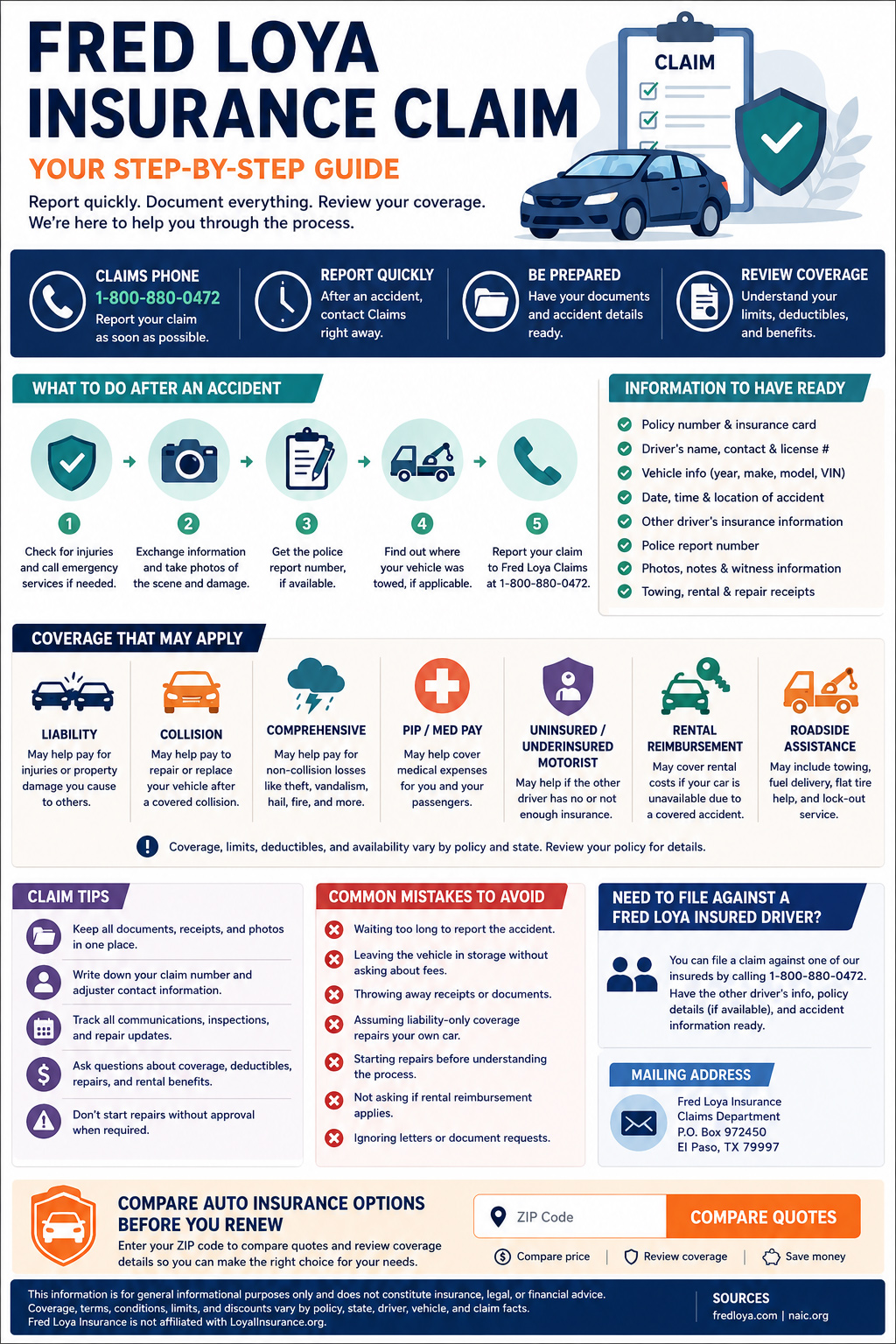
    Fred Loya insurance claim process with the claims phone number, accident documentation, towing information, coverage questions, and claim follow-up steps.

    What to Do After an Accident

    Fred Loya’s own accident instructions emphasize four immediate tasks: report the claim, protect the vehicle from additional damage, locate the vehicle if it was towed, and create a file containing documents related to the loss.[3]

    Accident information worth keeping together

    • Insurance and driver information exchanged at the scene
    • Photos of vehicle damage and the accident scene
    • Police report or accident exchange information
    • Towing company and storage-yard information
    • Repair estimates and inspection information
    • Rental, towing, storage, and other claim-related receipts
    • Claim number and assigned adjuster contact information
    • Emails, letters, and notes from claim-related calls

    Information to Have Ready When You File

    Fred Loya’s FAQ specifically asks callers to have all accident information readily available. Having the basic policy, vehicle, driver, and loss details together can reduce unnecessary follow-up.

    • Policy information Policy number, named insured, insurance card, and effective dates.
    • Driver details Names, phone numbers, license information, and addresses for involved drivers.
    • Vehicle details Year, make, model, license plate, VIN, and current vehicle location.
    • Accident facts Date, time, location, and a factual description of what happened.
    • Other party information Insurance information, vehicle details, and contact information when available.
    • Police information Report number and responding agency when a report was made.
    • Photos and documents Scene photos, damage photos, accident exchange forms, and towing documents.
    • Expenses Receipts for towing, storage, rental, and other claim-related costs.

    What Coverage May Apply?

    The type of coverage that matters depends on the loss and the policy. Current Fred Loya materials describe liability, collision, comprehensive, medical payments, personal injury protection, rental reimbursement, and roadside assistance among its auto insurance categories. The NAIC also explains that auto policies can combine required and optional coverage differently by state and policy.[4] [5]

    Coverage When It May Matter What to Check
    Liability A covered accident causes injury or property damage to another person. Check the bodily injury and property damage limits and applicable exclusions.
    Collision Your insured vehicle is damaged in a covered collision. Confirm that collision is included and which deductible applies.
    Comprehensive The vehicle has a covered non-collision loss such as theft, hail, fire, flood, vandalism, or animal impact. Check the deductible, exclusions, and covered causes of loss.
    Medical or PIP Medical expenses or other covered injury-related costs arise after an accident. Availability, requirements, limits, and benefits depend on the state and policy.
    Uninsured/underinsured motorist The other driver has no insurance or insufficient insurance and the applicable coverage responds. Check whether the coverage exists on the policy and what limits or state rules apply.
    Rental reimbursement Your vehicle is being repaired after a covered accident and the rental benefit applies. Confirm the benefit, limits, qualifying circumstances, and any authorization requirements.

    If an accident exposes a limit, deductible, or missing protection that you had not considered before, the question of how much auto insurance coverage fits your situation becomes especially relevant before the next renewal.

    Liability Claims vs. Damage to Your Own Vehicle

    Liability coverage and physical-damage coverage serve different purposes. Liability generally addresses covered injuries or property damage caused to others. Damage to your own vehicle usually requires the applicable collision or comprehensive coverage, subject to the policy and deductible.

    A policy that contains only liability coverage should not be assumed to pay for repairs to your own vehicle. Check the declarations page before making assumptions about what the policy includes.

    What If the Vehicle Was Towed?

    Fred Loya specifically tells drivers to find out where the vehicle was taken if it was towed. That information can be important because the adjuster may need the storage location and access information, while towing and storage charges can continue to accumulate.[3]

    Keep these towing details

    • Towing company name and phone number
    • Storage-yard address
    • Date the vehicle was towed
    • Police or tow-report number when available
    • Current storage charges and release requirements
    • Towing and storage receipts

    Rental Reimbursement and Roadside Assistance Are Different

    Fred Loya currently describes rental reimbursement as coverage that can pay for a rental car while an insured vehicle is repaired after a covered accident when the vehicle is unavailable for more than 24 hours. Whether it applies to a particular loss depends on the policy and claim.[6]

    Roadside assistance is described separately for non-accident vehicle damage or breakdowns and can include towing to the nearest repair facility, flat-tire assistance, fuel delivery, and lock-out service. It should not automatically be treated as accident-claim towing coverage.

    Filing Against a Fred Loya Insured Driver

    You do not need to be a Fred Loya customer to report a claim against one of its insured drivers. The company’s FAQ directs both policyholders and people filing against one of its insureds to the same Claims Department number, 1-800-880-0472.[2]

    Fred Loya’s published claim process says the adjuster gathers statements and other evidence, evaluates policy coverage and accident facts, prepares or obtains damage information, and reaches a final claim disposition based on the investigation.

    How to Check a Fred Loya Claim Status

    Fred Loya says claim-status questions can be directed to 1-800-880-0472 during its listed claims hours. Once the claim has been filed and an adjuster assigned, the company says you can contact that adjuster directly for questions or to provide and obtain information needed to move the claim forward.[1]

    • Claim number Keep it available whenever you call or send documents.
    • Adjuster Save the adjuster’s direct contact information once assigned.
    • Timeline Record calls, inspections, document requests, and repair updates.
    • Documents Keep police reports, estimates, receipts, photos, and letters together.
    • Open requests Note anything the adjuster still needs from you.
    • Next contact Ask when you should expect the next update if no date has been provided.

    When Payment Status and a Claim Overlap

    A claim and a billing issue are separate questions. A payment receipt does not by itself establish that a particular loss is covered, and a claim report does not resolve an overdue premium or cancellation issue.

    If the accident occurred close to a due date or cancellation notice, check the policy documents and the Fred Loya payment deadlines and account tools so you have the billing record, receipt, and policy-status information available when speaking with the insurer.

    Common Claim Problems to Avoid

    Keep the process documented

    • Do not delay reporting the accident unnecessarily.
    • Do not lose track of where a towed vehicle is being stored.
    • Keep receipts, estimates, photos, and claim correspondence.
    • Do not assume liability coverage repairs your own vehicle.
    • Confirm the applicable deductible before making financial assumptions.
    • Ask whether rental reimbursement applies before relying on a rental benefit.
    • Respond to reasonable document and information requests from the assigned claims representative.

    What If You Are Unhappy With the Claim Experience?

    Start by asking which policy term, coverage limit, deductible, exclusion, or claim fact affected the decision. Keep the response and supporting correspondence with the rest of your claim file.

    If the experience leads you to change insurers, arrange the replacement policy before canceling the current one. The steps for switching car insurance without creating a coverage gap matter because even a short lapse can leave you uninsured and may affect future pricing.

    After the claim: Check your declarations page again and note the liability limits, collision and comprehensive deductibles, rental reimbursement, uninsured/underinsured motorist coverage, excluded drivers, vehicle information, and any coverage that did not work the way you expected.

    Frequently Asked Questions About Fred Loya Insurance Claims

    What is the Fred Loya claims phone number?

    Fred Loya currently lists 1-800-880-0472 for filing an auto insurance claim.

    When should I report a Fred Loya claim?

    Fred Loya says a claim should be reported as soon as possible after an accident occurs.

    Can I file against a Fred Loya insured driver?

    Yes. Fred Loya’s FAQ says its Claims Department handles claims filed on your own policy or against one of its insureds.

    How do I check my claim status?

    Fred Loya directs claim-status questions to 1-800-880-0472 during its claims hours. After an adjuster is assigned, the company says you can contact that adjuster directly for claim-related questions.

    Does reporting a claim mean the damage is covered?

    No. Reporting starts the process. Coverage still depends on the policy, coverage in force, limits, deductibles, exclusions, and the facts of the loss.

    Does liability-only insurance repair my own vehicle?

    Liability generally addresses covered injury or property damage caused to others. Damage to your own vehicle ordinarily requires applicable physical-damage coverage such as collision or comprehensive, depending on the type of loss and policy terms.

    Review Your Options

    Compare Auto Insurance Options After a Claim

    Enter your ZIP code to compare auto insurance quote options and check coverage details before choosing or renewing a policy.

    Compare price, liability limits, deductibles, rental benefits, and policy terms before choosing coverage.