

There is no single amount of auto insurance coverage that is right for every driver. The appropriate policy depends on state requirements, the value and financing of the vehicle, your liability exposure, the amount you could pay after a loss, and the risks you want the policy to absorb.
A useful starting point is to separate three questions: how much liability protection you want, whether you need coverage for your own vehicle, and which optional benefits are worth paying for. State-required minimums are legal baselines, not personalized recommendations.
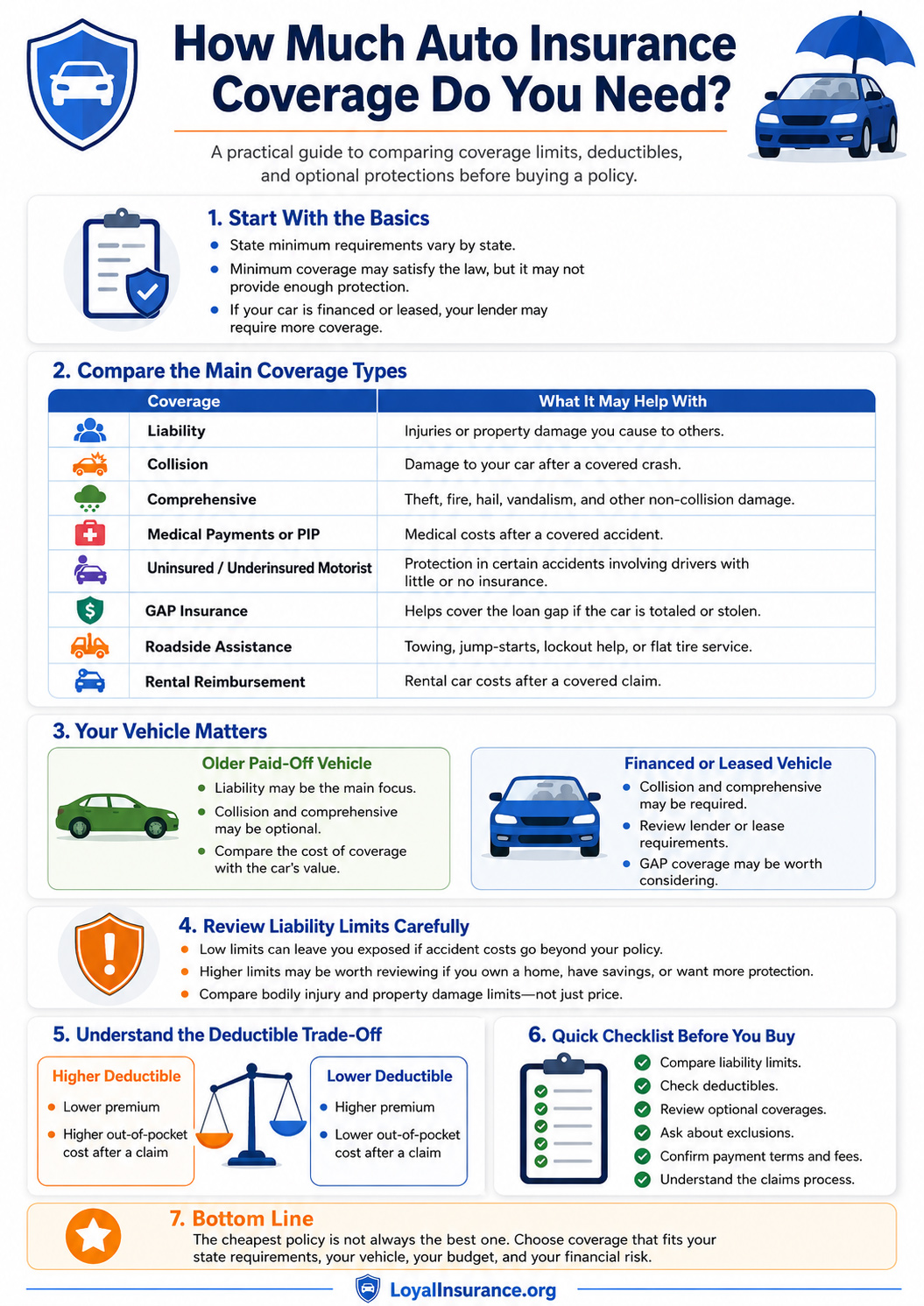
Start With the State Minimum, but Treat It as a Floor
State law determines the minimum auto insurance or financial-responsibility requirements that apply where the vehicle is insured. Those requirements can include liability coverage and, depending on the state, other protections such as PIP or uninsured-motorist coverage.
Minimum limits can make a policy less expensive, but they also cap how much the policy can pay for a covered liability loss. If you are considering the lowest legal option, the tradeoffs behind basic auto liability coverage are worth checking before you decide that the minimum is enough for your situation.
Legal minimum vs. financial protection: a policy can satisfy state law and still leave you personally responsible for amounts above the policy limits.
How to Think About Liability Limits
Liability coverage generally addresses covered bodily injury or property damage for which you are legally responsible. The limit is the maximum the policy will pay under the applicable coverage, subject to the policy terms.
Instead of choosing a liability limit by habit, consider the financial consequences of a serious accident. Assets, savings, income, driving exposure, and the amount of loss you could absorb yourself can all affect whether a higher liability limit is worth comparing.
Higher liability limits may deserve closer consideration when
- You have savings, investments, home equity, or other assets you want to protect.
- You have meaningful income or future earning power.
- You drive frequently or in dense traffic.
- You regularly carry passengers.
- You want more protection than the legal minimum.
- An umbrella policy or other insurer requirement calls for specific underlying auto limits.
Coverage for Your Own Vehicle Is a Separate Decision
Liability coverage does not generally pay to repair your own vehicle after an at-fault collision. Collision and comprehensive are the main physical-damage coverages used to protect the insured vehicle, subject to deductibles, exclusions, and policy terms.
Collision generally addresses covered damage from a collision, while comprehensive generally addresses certain covered non-collision losses such as theft, fire, hail, flood, vandalism, or animal impact. If you have an auto loan, the NAIC notes that the lender typically requires collision and comprehensive coverage.
Older paid-off vehicle
- Compare the annual physical-damage premium with the vehicle’s current value.
- Consider whether you could repair or replace the vehicle yourself.
- Check the deductible before deciding the coverage is worth keeping.
- Remember that dropping coverage transfers more loss risk to you.
Financed or leased vehicle
- Check the finance or lease agreement before changing coverage.
- Collision and comprehensive may be contractually required.
- Check whether the lender or lease agreement sets deductible requirements.
- Keep the lienholder information correct on the policy.
Uninsured Motorist, PIP, and Medical Payments
These coverages solve different problems and their availability or requirements vary by state. Uninsured or underinsured motorist coverage can apply when an at-fault driver has no insurance or insufficient insurance, while PIP or Medical Payments can address specified injury-related expenses depending on the policy and state law.
Check whether each coverage is required, automatically included, optional, or rejectable in writing where you live. Also compare the limits rather than assuming the coverage name alone tells you how much protection you have.
Choose a Deductible You Could Actually Pay
The deductible is the amount you are responsible for under certain coverages before the insurer pays the remainder of a covered loss, subject to the policy terms. Higher deductibles can reduce some physical-damage premiums, but they also increase your out-of-pocket obligation after a claim.
When comparing deductible scenarios, the car insurance cost factors can help you organize how the vehicle, coverage level, prior insurance, and deductible choices change the comparison before you request live quotes.
| Choice | Possible Benefit | Tradeoff |
|---|---|---|
| Higher deductible | Can reduce some collision or comprehensive premiums. | You must absorb more of a covered loss yourself. |
| Lower deductible | Reduces the amount you may need to pay after an applicable covered loss. | The premium can be higher. |
| No physical-damage coverage | Can substantially reduce premium on some paid-off vehicles. | You may receive no policy payment for damage to your own car after certain losses. |
GAP Is Different From Ordinary Auto Insurance Coverage
GAP is generally an optional product intended to address the difference between what you still owe on an auto loan and what the primary auto insurer pays when the vehicle is stolen or totaled and the loan balance is higher than the vehicle value. The Consumer Financial Protection Bureau notes that GAP can be offered by dealers, lenders, or insurers and that prices can vary significantly.
GAP should not be confused with collision or comprehensive coverage. It is tied to the financing shortfall, and eligibility restrictions or exclusions can apply. Compare the cost and terms before adding it to the loan or policy.
GAP check: If a dealer or lender says GAP is required, ask where that requirement appears in the contract. CFPB says GAP is generally optional in most auto-loan situations.
Roadside Assistance and Rental Reimbursement Are Convenience Coverages
Roadside assistance and rental reimbursement can be useful, but they serve different purposes from liability or physical-damage coverage. Roadside benefits can cover specified services after a breakdown or roadside event, while rental reimbursement can help with temporary transportation when the policy conditions are met.
Compare benefit limits, exclusions, qualifying events, and cost. If you already receive roadside service through a vehicle warranty, credit card, auto club, or another source, check for unnecessary duplication.
A Practical Framework for Deciding How Much Coverage to Buy
| Question | Why It Matters | What to Review |
|---|---|---|
| What does my state require? | Establishes the legal floor. | Liability, PIP, UM/UIM, or other state-specific requirements. |
| How much liability risk can I absorb? | Damages above the limit can become your responsibility. | Assets, income, savings, driving exposure, and available higher limits. |
| Could I replace my car myself? | Helps determine how valuable physical-damage coverage may be. | Vehicle value, collision/comprehensive premium, and deductible. |
| Does a lender require coverage? | Finance and lease contracts can require more than state law. | Collision, comprehensive, deductible limits, and lienholder requirements. |
| Could I afford the deductible tomorrow? | A lower premium does not help if the deductible is unusable after a loss. | Emergency savings and the deductible on each coverage. |
| Which optional benefits would I actually use? | Prevents paying for benefits that do not fit your situation. | Rental, roadside, GAP, medical coverage, and other optional benefits. |
Balance Coverage With Affordability
More coverage is not automatically better if the premium becomes impossible to maintain. A policy that repeatedly risks cancellation can create a different kind of financial problem. Compare several insurers using the same limits and deductibles, then decide which level of protection you can realistically keep in force.
If affordability is forcing you toward the minimum, compare the price difference between the legal floor and the next higher liability option. Sometimes the increase is manageable; sometimes it is not. The decision should be based on real quotes rather than assumptions.
Revisit Coverage When Your Situation Changes
Coverage that made sense several years ago may not fit after buying a different vehicle, paying off a loan, moving, adding a driver, changing commute patterns, accumulating savings, or changing household finances. Renewal is a useful time to check those changes rather than automatically repeating the prior limits.
If a better policy will replace your current one, the timing for switching car insurance without a coverage gap matters just as much as the new limits. Confirm the replacement policy and effective date before ending the old coverage.
Before buying or renewing, confirm
- The legal insurer name
- Policy effective and expiration dates
- Bodily-injury and property-damage liability limits
- Collision and comprehensive coverage and deductibles, if included
- UM/UIM, PIP, MedPay, or other state-specific coverage
- Rental, roadside, GAP, or other optional benefits
- Listed and excluded drivers
- Total premium, payment schedule, and applicable fees
- Claim-reporting information
Frequently Asked Questions About Auto Insurance Coverage
Is state-minimum insurance enough?
It can satisfy the legal requirement, but it may not provide enough financial protection for every driver. Compare the potential loss above the minimum limits with the cost of higher limits.
How much liability coverage should I carry?
There is no universal number. Start with the state requirement, then consider your assets, income, savings, driving exposure, available higher limits, and the amount of financial risk you are willing to retain.
Do I need collision and comprehensive?
A lender commonly requires them on a financed vehicle. On a paid-off vehicle, compare the premium and deductible with the vehicle’s value and your ability to repair or replace it yourself.
Is GAP insurance required?
GAP is generally optional in most auto-loan situations. It can be useful when the loan balance is higher than the vehicle’s value, but check the contract, price, eligibility restrictions, and cancellation terms before buying.
Should I choose a higher deductible to lower the premium?
Only if the savings are worthwhile and you could realistically pay the larger deductible after a covered loss.
Compare Auto Insurance Quotes by ZIP Code
Enter your ZIP code to compare auto insurance quote options. Use equivalent limits, deductibles, drivers, and vehicle information so the prices are comparable.
Compare the total premium and policy terms, not only the monthly payment.
Sources
This article uses current consumer auto-insurance and auto-finance resources. Coverage requirements, lender rules, policy terms, and optional products can change, so confirm time-sensitive details with the insurer, regulator, lender, or issued policy documents.
- National Association of Insurance Commissioners — Auto Insurance
- National Association of Insurance Commissioners — What Does Auto Insurance Cover?
- National Association of Insurance Commissioners — Auto Insurance Shopping Tool
- Consumer Financial Protection Bureau — What Is GAP Insurance?
- Consumer Financial Protection Bureau — Is GAP Insurance Required?