Tag: Loya Casualty Insurance

  • Loya Casualty Insurance Company

    Company Profile Guide

    Loya Casualty Insurance Company is a property and casualty insurer listed by the California Department of Insurance. If you see this name on policy documents, insurance cards, billing records, claim documents, or company information, it is important to understand what the company name means and how to review the policy details connected to it.

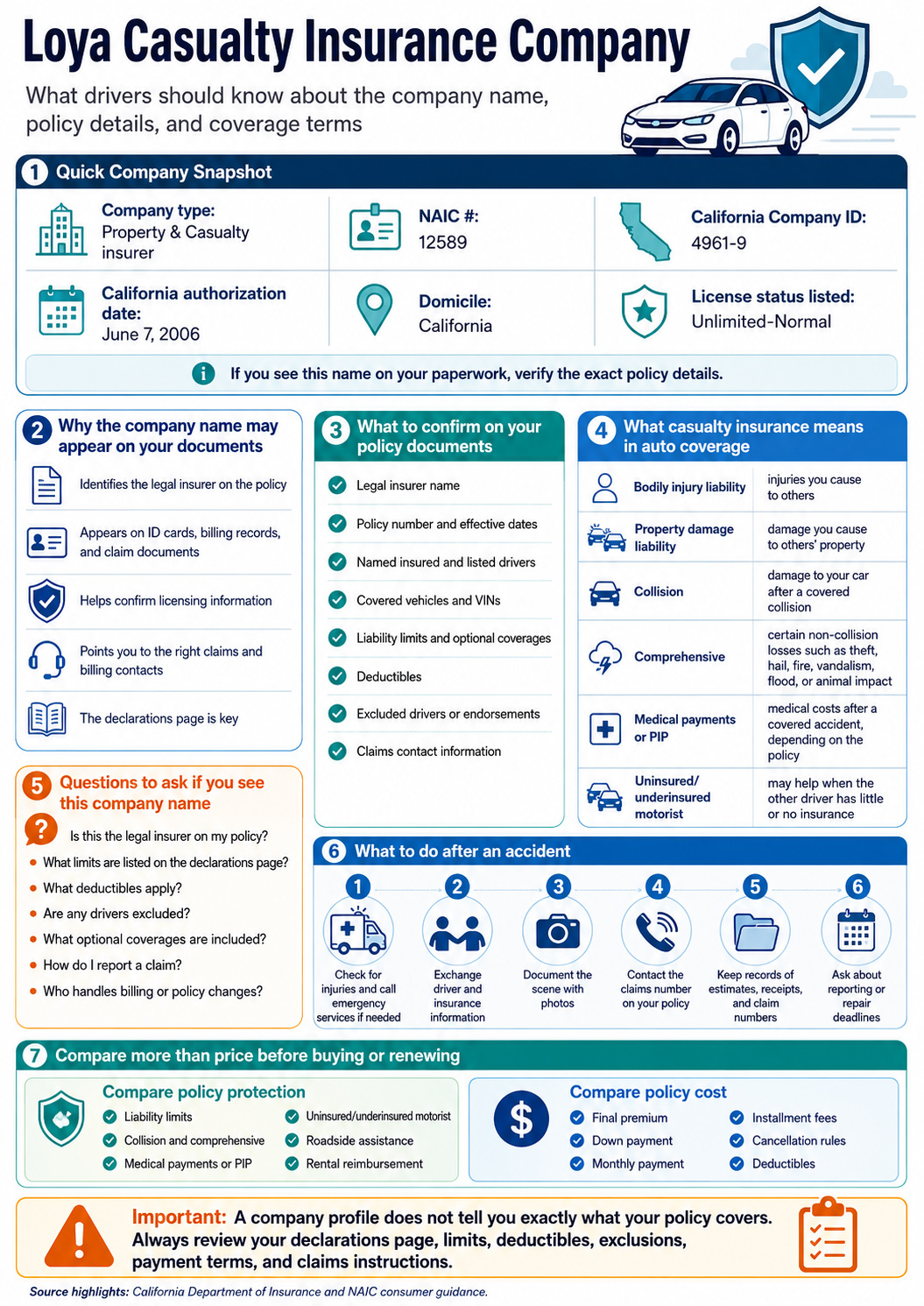
    The California Department of Insurance profile lists Loya Casualty Insurance Company with NAIC #12589, California Company ID #4961-9, a California authorization date of June 7, 2006, license status listed as unlimited-normal, company type listed as Property & Casualty, and state of domicile listed as California.[1]

    This guide explains what drivers should know about the company profile, how casualty insurance relates to auto coverage, what coverage terms to review, and what questions to ask before choosing or renewing an auto policy.

    What Is Loya Casualty Insurance Company?

    Loya Casualty Insurance Company is not the same thing as a generic “coverage type.” It is the name of an insurance company. A company profile can matter because your policy, claim, declarations page, ID card, or billing record may show the legal insurer or related company responsible for the policy.

    According to the California Department of Insurance, the company is authorized for lines of business including automobile, disability, and liability.[1] Drivers should still confirm the exact product, coverage, limits, fees, and claims process directly from their own policy documents or representative.

    Important company reminder: A company profile does not tell you whether a specific policy is right for you. Always review the declarations page, limits, deductibles, exclusions, payment terms, effective date, and claims instructions before relying on coverage.

    Infographic explaining Loya Casualty Insurance Company, including company profile details, NAIC number, policy document checklist, auto coverage terms, accident steps, and quote comparison tips.

    Why the Company Name May Appear on Your Documents

    Auto insurance shoppers often focus on the brand name, local office, or quote platform. However, the legal insurer listed on the policy documents can be important. It may help you identify which company issued the policy, where to confirm license information, and which company may appear in claim or billing records.

    If your paperwork shows Loya Casualty Insurance Company, check the declarations page carefully. The declarations page is usually where you can find the named insured, covered vehicle, policy period, coverage limits, deductibles, premium, lienholder information, and any listed drivers or excluded drivers.

    Information to confirm on your policy documents

    • Legal insurer name
    • Policy number and effective dates
    • Named insured and listed drivers
    • Covered vehicles and VINs
    • Liability limits and optional coverages
    • Deductibles for physical damage coverage
    • Excluded drivers, restrictions, or endorsements
    • Claims contact information

    California Licensing and Company Background

    The California Department of Insurance company profile lists Loya Casualty Insurance Company as a California-domiciled property and casualty company with NAIC #12589.[1] The department’s 2022 examination report says the company was incorporated in California on December 14, 2004 and received its Certificate of Authority from the California Department of Insurance on June 7, 2006 to transact property and casualty business.[2]

    The same examination report states that, as of December 31, 2022, the company was licensed to transact automobile insurance business only in California and wrote six-month policies for low limits of liability automobile insurance and low-value property damage automobile insurance through affiliates.[2]

    Practical tip: If you are checking company information, use official state insurance department resources and your own policy documents. Do not rely only on old blog posts, third-party summaries, or search snippets for licensing or claims details.

    What Casualty Insurance Means in Auto Coverage

    In auto insurance, casualty-related coverage often connects to legal responsibility for injuries or property damage caused to others. For a driver, the most familiar example is liability coverage. Liability coverage is usually divided into bodily injury liability and property damage liability.

    The NAIC explains that auto insurance coverage depends on the type of coverage chosen, and that many states require certain types of auto insurance. Its consumer guidance describes bodily injury liability, property damage liability, uninsured and underinsured motorist coverage, comprehensive coverage, collision coverage, medical payments, PIP, rental coverage, roadside coverage, and GAP insurance as separate concepts that may apply differently depending on state and policy terms.[3]

    Coverage Term What It May Help With What to Review
    Bodily injury liability May help pay for injuries you cause to someone else in a covered accident. Review the per-person and per-accident limits, exclusions, and whether the limits are enough for your risk level.
    Property damage liability May help pay for damage you cause to another person’s vehicle, property, or structures. Confirm the property damage limit and whether higher limits are available.
    Collision coverage May help pay for damage to your own vehicle after a covered collision. Ask whether the coverage is included, optional, or required by your lender or lease company.
    Comprehensive coverage May help with non-collision losses such as theft, hail, fire, vandalism, flood, or animal impact, depending on the policy. Review the deductible, exclusions, vehicle value, and covered causes of loss.
    Medical payments or PIP May help with medical costs after a covered accident, depending on the state and policy. Confirm whether it is required, optional, available, or excluded in your state.
    Uninsured or underinsured motorist May help after certain accidents involving drivers with no insurance or not enough insurance. Ask whether it is required, optional, included, or rejected in writing in your state.

    How This Page Differs From a General Loya Car Insurance Guide

    This page focuses on the company profile and policy-document questions connected to Loya Casualty Insurance Company. If you want a broader overview of coverage, offices, quotes, payment options, and what to compare before buying, you can read our Loya car insurance guide.

    For this page, the most important point is simple: the company name on your paperwork should lead you to verify the policy details, not assume what is covered. Two policies can come from similar brands or related companies but still have different limits, deductibles, exclusions, endorsements, fees, and claims instructions.

    Questions to ask if you see this company name

    • Is Loya Casualty Insurance Company the legal insurer on my policy?
    • What is the policy number and effective date?
    • What coverage limits are listed on the declarations page?
    • What deductibles apply to collision or comprehensive coverage?
    • Are any drivers excluded?
    • Are roadside assistance, rental reimbursement, or medical payments included?
    • How do I report a claim?
    • Who should I contact for billing, cancellation, or policy changes?

    What to Do After an Accident

    If an accident happens, your first priority should be safety. Call emergency services if anyone is hurt or there is immediate danger. If it is safe and legal to do so, move vehicles out of traffic, exchange information, document the scene, and contact the claims number or instructions listed on your insurance documents.

    Do not assume that every expense will be covered. Claim handling depends on the policy, coverage type, fault, limits, deductibles, exclusions, state rules, available documentation, and the specific facts of the accident.

    • Check for injuries Call emergency services if anyone is injured or there is immediate danger.
    • Exchange information Collect driver, vehicle, insurance, and contact details from the parties involved.
    • Document the scene Take photos of vehicles, damage, road conditions, signs, and relevant surroundings if safe.
    • Contact claims Use the claim instructions on your policy documents or insurer website.
    • Keep records Save claim numbers, repair estimates, rental receipts, towing receipts, and correspondence.
    • Ask about deadlines Confirm any reporting, inspection, document, or repair deadlines that may apply.

    Coverage Details to Compare Before Buying or Renewing

    Before buying or renewing any auto policy, compare more than the monthly price. A cheaper policy may have lower limits, higher deductibles, fewer optional coverages, stricter exclusions, or added payment fees. A more expensive policy may or may not provide enough extra value to justify the cost.

    The NAIC advises drivers to understand what a policy covers, review required and optional coverage types, and compare policy terms carefully before buying auto insurance.[5]

    Compare policy protection

    • Liability limits
    • Collision and comprehensive
    • Medical payments or PIP
    • Uninsured or underinsured motorist
    • Roadside assistance
    • Rental reimbursement

    Compare policy cost

    • Final premium
    • Down payment
    • Monthly payment
    • Installment fees
    • Cancellation rules
    • Deductibles

    Frequently Asked Questions About Loya Casualty Insurance Company

    Is Loya Casualty Insurance Company an insurance company?

    Yes. The California Department of Insurance lists Loya Casualty Insurance Company as a Property & Casualty company with NAIC #12589 and state of domicile listed as California.

    What does NAIC #12589 mean?

    An NAIC number is an identifier used for insurance companies in regulatory and company-reference contexts. If your documents list NAIC #12589, compare that information with the company profile and your policy paperwork.

    Does the company profile tell me what my policy covers?

    No. The company profile helps identify the insurer, but your actual coverage depends on your policy documents, declarations page, endorsements, limits, deductibles, exclusions, and state rules.

    Is comprehensive coverage the same as collision coverage?

    No. Collision coverage generally applies to damage from a covered collision, while comprehensive coverage generally applies to certain non-collision losses such as theft, hail, fire, vandalism, flood, or animal impact, depending on the policy.

    Should I choose a policy only because the price is low?

    No. Price matters, but you should also compare coverage limits, deductibles, exclusions, payment fees, claims process, and whether the policy satisfies your state, lender, or lease requirements.

    Compare Quote Options

    Compare Auto Insurance Quotes by ZIP Code

    Enter your ZIP code to compare auto insurance quote options and review coverage details before choosing a policy.

    Compare price, coverage limits, deductibles, fees, and policy terms before choosing auto insurance.

    Sources

    This article was updated using official company-regulatory and consumer-focused insurance resources. Drivers should confirm final rates, policy terms, company information, coverage availability, discounts, fees, and legal requirements directly with the insurer, agent, state insurance department, or quote provider before buying coverage.

    1. California Department of Insurance — Loya Casualty Insurance Company Profile
    2. California Department of Insurance — Loya Casualty Insurance Company 2022 Examination Report
    3. National Association of Insurance Commissioners — What Does Auto Insurance Cover?
    4. Fred Loya Insurance — Car Insurance Coverage
    5. National Association of Insurance Commissioners — Auto Insurance Consumer Information
  • Coverage of Loya Casualty Insurance

    Editorially reviewed informational content for U.S. car insurance topics

    • Loya Casualty Coverage
    • Auto Insurance Terms
    • Policy Comparison

    The LoyalInsurance.org Editorial Team creates informational content focused on auto insurance costs, insurer names, coverage types, quote comparison, policy terms, claims information, and practical shopping topics for U.S. drivers.

    Articles are written to help readers better understand how liability limits, deductibles, optional coverage, policy documents, lender requirements, and claim instructions may affect the process of shopping for auto insurance.

    This content is for general informational purposes only and does not constitute insurance, legal, or financial advice. Coverage availability, pricing, discounts, fees, claims handling, and policy terms vary by insurer, state, location, vehicle, and driver profile. LoyalInsurance.org is an independent informational website and is not affiliated with Loya Casualty Insurance Company, Fred Loya Insurance, or any insurer.

    Coverage Guide

    Loya Casualty Insurance coverage can refer to auto insurance coverage terms that appear on policy documents, quote materials, insurance cards, billing records, or claim paperwork connected to Loya-related insurance companies. This page focuses on the coverage terms a driver should review, not on the company profile itself.

    If you need to verify the legal company name, NAIC number, state of domicile, or regulatory profile, read our separate Loya Casualty Insurance Company profile. If your goal is to understand what the coverage may include, this guide explains liability, collision, comprehensive, PIP, medical payments, uninsured motorist coverage, roadside assistance, rental reimbursement, deductibles, and policy details to check before buying or renewing.

    Page focus Coverage terms
    Check first Policy documents
    Compare Limits and deductibles
    Before buying Review exclusions

    What Does Loya Casualty Insurance Coverage Mean?

    Insurance shoppers sometimes use the phrase “Loya Casualty Insurance coverage” when they are trying to understand what a policy covers. That phrase can be confusing because it mixes two ideas: the company name that may appear on documents and the coverage terms inside an auto policy.

    The California Department of Insurance lists Loya Casualty Insurance Company as a California-domiciled property and casualty company with NAIC #12589 and California Company ID #4961-9.[1] However, a company profile does not tell you what your specific policy covers. Your actual coverage depends on your declarations page, policy contract, endorsements, limits, deductibles, exclusions, payment status, state rules, and claim facts.

    Important coverage note: Do not assume coverage based only on a company name, brand name, old blog post, or search result. Always review the declarations page and policy documents connected to your own quote or policy.

    How This Page Differs From the Company Profile Page

    This page is designed to avoid duplicating the company profile article. The company profile page should help readers identify Loya Casualty Insurance Company as an insurer name and verify regulatory details. This page helps readers understand coverage terms that may appear in an auto insurance policy.

    Page Main Purpose Best For
    Loya Casualty Insurance Company profile Explains the company identity, regulatory profile, NAIC number, and document-verification questions. Readers who see the company name on an insurance card, bill, claim file, or declarations page.
    This coverage guide Explains common coverage types, deductibles, optional protections, and what to compare before buying. Readers who want to understand liability, collision, comprehensive, PIP, MedPay, UM/UIM, roadside, and rental options.

    Common Auto Insurance Coverage Types to Review

    Fred Loya’s coverage information describes common auto insurance options such as liability, comprehensive, collision, medical payments or personal injury protection, uninsured or underinsured motorist coverage, roadside assistance, and rental reimbursement.[2] Availability, limits, deductibles, exclusions, and pricing can vary by state and policy.

    The NAIC also explains that auto insurance coverage can include separate parts such as property damage liability, uninsured and underinsured motorist coverage, collision, comprehensive, medical payments, and personal injury protection depending on the policy and state rules.[3]

    Coverage Type What It May Help With What to Check
    Bodily injury liability May help pay for injuries you cause to other people in a covered accident. Review per-person and per-accident limits, exclusions, and whether higher limits are available.
    Property damage liability May help pay for damage you cause to another person’s vehicle, building, fence, mailbox, or other property. Compare the property damage limit with your state minimum and your real financial risk.
    Collision coverage May help pay for damage to your own vehicle after a covered collision. Check whether it is included, optional, required by a lender, or subject to a deductible.
    Comprehensive coverage May help with certain non-collision losses such as theft, fire, vandalism, hail, falling objects, flood, or animal impact, depending on the policy. Review the deductible, covered causes of loss, exclusions, and vehicle value.
    PIP or medical payments May help with medical costs after an accident, depending on state rules and policy terms. Ask whether it is required, optional, available, or excluded in your state.
    Uninsured or underinsured motorist coverage May help after certain accidents involving a driver with no insurance or not enough insurance. Confirm whether it is required, optional, included, rejected, or subject to separate limits.
    Roadside assistance May help with services such as towing, fuel delivery, or flat tire assistance, depending on the selected option. Check dollar limits, service limits, exclusions, and whether it is included or added separately.
    Rental reimbursement May help with rental car costs if your vehicle is unavailable after a covered accident, depending on policy terms. Review daily limits, maximum limits, waiting periods, and covered situations.

    Liability Coverage Is Not the Same as Full Protection

    Liability coverage is usually one of the most important parts of an auto policy, but it does not protect every loss. It generally focuses on covered injuries or property damage you cause to others. It does not usually repair your own vehicle after an at-fault accident or pay your own medical bills unless your policy includes another applicable coverage.

    Fred Loya’s FAQ explains that liability only covers third parties’ bodily injury and that Personal Injury Protection or Medical Payments may be purchased to help cover your own medical costs, depending on availability and policy terms.[4]

    Liability may help with

    • Injuries you cause to other people
    • Damage you cause to another vehicle
    • Damage you cause to another person’s property
    • Covered legal defense, depending on policy terms

    Liability may not cover

    • Your own car repairs
    • Your own medical bills
    • Rental car costs after every situation
    • Losses above your policy limits

    Collision and Comprehensive Coverage: Why They Matter

    Collision and comprehensive are often discussed together, but they cover different categories of loss. Collision generally relates to damage to your vehicle from a covered collision. Comprehensive generally relates to certain non-collision losses such as theft, fire, vandalism, falling objects, or animal damage, depending on policy terms. The NAIC describes collision and comprehensive as separate coverage concepts for protecting your own vehicle.[5]

    If your vehicle is financed or leased, your lender may require physical damage coverage. Fred Loya’s FAQ explains that coverage required by a lienholder is physical damage coverage and that it may involve vehicle damage from sand, hail, flood, vandalism, and collision, subject to the deductible and policy terms.[4]

    Questions to ask if your car is financed or leased

    • Does the lender require collision and comprehensive coverage?
    • Is there a maximum deductible allowed by the lender?
    • Is the lienholder listed correctly on the policy?
    • Would GAP coverage be useful if the loan balance is higher than the vehicle value?
    • Would rental reimbursement help if your car is being repaired after a covered loss?
    • Could you afford the deductible after an accident?

    PIP, Medical Payments, and Your Own Medical Costs

    Personal Injury Protection and Medical Payments coverage are often confused with liability coverage. Liability generally addresses covered injuries you cause to others. PIP or Medical Payments may help with your own medical costs after an accident, depending on the state, policy, and selected coverage.

    Some states require PIP or similar no-fault coverage, while others make medical payments or PIP optional or unavailable. Before buying or renewing, ask whether these coverages are required, available, included, rejected, or excluded where you live.

    Medical coverage details to compare

    • Whether PIP or Medical Payments is required in your state
    • Whether the coverage applies to you, passengers, or household members
    • The coverage limit
    • Whether deductibles or coordination rules apply
    • How claims are reported
    • What documents may be needed after an accident

    Uninsured and Underinsured Motorist Coverage

    Uninsured motorist coverage may help if an uninsured or hit-and-run driver hits you. Underinsured motorist coverage may help when the at-fault driver has insurance, but not enough to cover the loss, depending on the state and policy. The NAIC explains that these coverages can apply differently by state and policy terms.[3]

    This coverage can be especially important if you want protection beyond the at-fault driver’s insurance. However, it may be required, optional, automatically included, or rejected in writing depending on the state.

    Practical tip: If you reject uninsured or underinsured motorist coverage to lower the premium, make sure you understand what costs you could face after an accident with a driver who has no insurance or not enough insurance.

    Roadside Assistance and Rental Reimbursement

    Additional coverage options can make a policy more useful after a covered accident or roadside problem. Fred Loya’s coverage information says roadside assistance can cover costs related to towing services, fuel delivery, and flat tire repair, while rental reimbursement can cover costs associated with a rental car if your car is damaged and unavailable for use for more than 24 hours as the result of a covered accident.[2]

    These options should still be reviewed carefully. A policy may include dollar limits, daily limits, maximum limits, covered-situation restrictions, waiting periods, or exclusions. Do not assume that every rental, tow, breakdown, mechanical problem, or transportation need will be covered.

    Roadside questions

    • Is towing included?
    • Is fuel delivery included?
    • Is flat tire assistance included?
    • Are there dollar or service limits?
    • Are mechanical breakdowns excluded?

    Rental questions

    • When does rental reimbursement apply?
    • Is there a daily limit?
    • Is there a maximum total limit?
    • Does the car need to be unavailable for a covered reason?
    • Are there time restrictions?

    Non-Standard Auto Insurance and Higher-Risk Drivers

    Some drivers search for Loya-related coverage because they are comparing options after tickets, accidents, coverage lapses, limited insurance history, or other factors that may make coverage harder to find or more expensive. Non-standard auto insurance generally refers to coverage for drivers who may not qualify for preferred rates or standard-market options.

    A non-standard policy can still require careful review. The lowest monthly payment may come with lower limits, stricter exclusions, higher fees, or fewer optional coverages. If you are considered higher risk, compare the policy details even more carefully before buying.

    Higher-risk drivers should compare

    • Liability limits and whether higher limits are available
    • Down payment and installment fees
    • Cancellation and reinstatement rules
    • Excluded drivers or household-driver rules
    • SR-22 or financial responsibility filing options if needed
    • Claims instructions and repair process
    • Whether optional coverage is available or excluded

    State Rules and Company Names Can Vary

    Auto insurance requirements vary by state. Company names and affiliated entities may also vary across insurance documents. The California Department of Insurance examination report for Loya Casualty Insurance Company states that, as of December 31, 2022, the company was licensed to transact automobile insurance business only in California and wrote six-month policies for low limits of liability automobile insurance and low-value property damage automobile insurance through affiliates.[6]

    This is why it is important to confirm the legal insurer name on your own policy documents. If your policy, bill, claim letter, or insurance card lists Loya Casualty Insurance Company, use that exact name when verifying company information, claims instructions, complaint resources, and policy details.

    Document reminder: Do not assume that every Loya-related entity operates the same way in every state. Confirm the insurer name, state, policy number, coverage limits, and claims contact using your actual documents.

    What to Check on Your Declarations Page

    The declarations page is one of the most important documents in an auto policy. It usually summarizes the named insured, covered vehicles, policy period, coverages, limits, deductibles, premium, lienholder, listed drivers, and sometimes excluded drivers or special endorsements.

    • Legal insurer name Confirm the company listed on the policy, bill, or insurance card.
    • Policy dates Check the effective date and expiration date.
    • Vehicle details Confirm the year, make, model, and VIN.
    • Drivers Review listed drivers, household drivers, and excluded drivers.
    • Liability limits Compare bodily injury and property damage limits.
    • Deductibles Check collision and comprehensive deductibles if included.
    • Optional coverage Review PIP, MedPay, UM/UIM, roadside, rental, or GAP options.
    • Payment terms Review down payment, monthly payment, installment fees, and due dates.
    • Claims instructions Save claim phone numbers, online claim links, and required documentation steps.
    • Restrictions Look for exclusions, endorsements, coverage gaps, or special rules.

    What to Do After an Accident

    After an accident, start with safety. Check for injuries, call emergency services if needed, move to a safe location when legal and safe, exchange information, document the scene, and report the claim using the instructions on your policy documents.

    Coverage after an accident depends on fault, policy terms, coverage type, limits, deductibles, exclusions, state rules, available documentation, and the specific facts of the loss. Do not assume that every repair, rental, tow, medical bill, or legal expense will be covered.

    Basic accident document checklist

    • Driver names, license information, and contact details
    • Vehicle information and license plate numbers
    • Insurance company names and policy numbers
    • Photos of vehicles, damage, road conditions, signs, and surroundings
    • Police report information if available
    • Witness names and contact details if available
    • Claim number and adjuster contact information
    • Repair estimates, towing receipts, rental receipts, and correspondence

    How to Compare Coverage Before Buying or Renewing

    Before choosing or renewing a policy, compare more than the monthly payment. A lower premium may have lower limits, higher deductibles, fewer optional coverages, stricter exclusions, or extra fees. A higher premium may or may not provide enough extra protection to justify the cost.

    Compare Why It Matters Question to Ask
    Liability limits Low limits may not be enough after a serious accident. Can I afford higher bodily injury or property damage limits?
    Deductibles A higher deductible may lower premium but increase claim-time costs. Could I afford this deductible after an accident?
    Physical damage coverage Collision and comprehensive may protect your own vehicle. Is my vehicle financed, leased, newer, or expensive to repair?
    Medical coverage PIP or MedPay may help with medical expenses, depending on the state and policy. Is this required, optional, included, or unavailable where I live?
    UM/UIM coverage May help after accidents with uninsured or underinsured drivers. Is this coverage included, optional, required, or rejected?
    Roadside or rental Can help with certain towing or temporary transportation costs. What are the limits, exclusions, and covered situations?
    Payment terms Fees and cancellation rules can change total cost. What is the full policy cost, not just the first payment?

    Frequently Asked Questions About Loya Casualty Insurance Coverage

    Is this page the same as the Loya Casualty Insurance Company profile?

    No. The company profile page focuses on identifying the company, NAIC number, state of domicile, and regulatory information. This page focuses on coverage terms that may appear in an auto insurance policy.

    Does Loya Casualty Insurance coverage mean one specific policy?

    No. Coverage depends on the specific policy, state, limits, deductibles, endorsements, exclusions, payment status, and selected options. Always review your declarations page and policy documents.

    Is liability coverage enough?

    It depends on your state requirements, vehicle, budget, and risk tolerance. Liability may help with covered injuries or property damage you cause to others, but it usually does not repair your own car or cover your own medical bills unless other coverage applies.

    Do financed vehicles need collision and comprehensive?

    Many lenders or lease companies require physical damage coverage, which may include collision and comprehensive coverage. Check your loan or lease agreement before choosing liability-only coverage.

    Does rental reimbursement cover every rental car situation?

    No. Rental reimbursement usually depends on policy terms, limits, covered reasons, waiting periods, and exclusions. Review the daily limit, maximum limit, and covered situations before relying on it.

    Compare Coverage Options

    Compare Auto Insurance Quotes by ZIP Code

    Enter your ZIP code to compare auto insurance quote options and review coverage details before choosing a policy.

    Compare price, liability limits, deductibles, optional coverage, fees, and policy terms before choosing auto insurance.

    Sources

    This article was updated using official company, regulatory, and consumer-focused insurance resources. Drivers should confirm final rates, coverage availability, policy terms, discounts, fees, claims handling, and legal requirements directly with the insurer, agent, quote provider, or state insurance department before buying coverage.

    1. California Department of Insurance — Loya Casualty Insurance Company Profile
    2. Fred Loya Insurance — Car Insurance Coverage
    3. National Association of Insurance Commissioners — What You Should Know About Auto Insurance Coverage
    4. Fred Loya Insurance — Car Insurance Questions
    5. National Association of Insurance Commissioners — Does Your Vehicle Have the Right Protection?
    6. California Department of Insurance — Loya Casualty Insurance Company 2022 Examination Report