

Loya Insurance Company is a phrase many drivers use when searching for Fred Loya Insurance, Loya Insurance Group, local Loya offices, quote options, policy support, or contact details. This guide explains the general Loya insurance model, what drivers can do online or through an office, what information to prepare before requesting a quote, and how to compare policy details before buying.
This page is a general overview. It is not meant to replace a dedicated quote guide, locations guide, claims guide, or coverage guide. The goal is to help you understand how the Loya-related insurance experience may work before you decide whether to request a quote, call customer service, visit an office, or compare another insurer.
Loya Insurance Company, Fred Loya Insurance, and Loya Insurance Group
Search results, office signs, and customer conversations may use slightly different names, including Loya Insurance Company, Fred Loya Insurance, or Loya Insurance Group. The official Fred Loya website uses Fred Loya Insurance branding, while its contact page refers to Loya Insurance Group offices.
For consumers, the most important detail is the legal company name that appears on your quote, declarations page, insurance card, bill, claim letter, or policy documents. Brand names can help you find the company, but the policy documents control the coverage, insurer name, limits, deductibles, exclusions, and claim instructions.
Important document reminder: Do not rely only on a brand name or office sign. Before buying or renewing, confirm the legal insurer name, policy number, effective date, coverage limits, deductibles, fees, and claims instructions on your own documents.
How This Page Connects to Other Loya Guides
This overview is designed to sit above the more specific Loya and Fred Loya pages on this site. It should help readers decide where to go next without turning this article into a duplicate of those pages.
| Reader Need | Best Next Page | Why It Helps |
|---|---|---|
| Compare a quote | Fred Loya quote guide | Useful when you want to compare price, deductibles, limits, fees, and whether the quote is final or still subject to verification. |
| Find an office | Fred Loya Insurance locations guide | Useful when you want to check office access, what to bring, and how local support compares with online quote options. |
| Call the right number | Loya insurance phone number guide | Useful when you need quotes, customer service, claims, payments, roadside assistance, or policy support. |
| Understand coverage | Loya car insurance overview | Useful when you want to compare liability, collision, comprehensive, medical coverage, roadside, rental, and policy terms. |
| File or understand a claim | Fred Loya insurance claim guide | Useful after an accident when you need claim contact details, documents, repair questions, and coverage review steps. |
Why Direct Communication Still Matters
Insurance decisions are easier to start online, but many drivers still benefit from a human explanation. A quote can show a monthly price, but it may not clearly explain what is included, what is excluded, what deductible applies, or how much financial protection the policy actually provides.
Speaking with a local office or representative can help drivers understand liability limits, deductibles, optional coverage, payment schedules, cancellation rules, proof of insurance, and state-specific requirements. This can be especially useful for first-time buyers, drivers with prior coverage gaps, households adding a vehicle, or shoppers comparing minimum coverage with broader protection.
Comparison reminder: Always compare coverage, not just price. A cheaper policy may cost less each month, but it may also include lower limits, fewer protections, stricter payment rules, or higher out-of-pocket costs after a claim.
The Loya Insurance Local Office Model
The Loya insurance model is commonly associated with physical offices, local support, and auto insurance access for drivers who may prefer direct help. A local office may be useful when you want to ask questions, bring documents, review payment options, request proof of insurance, or understand what a quote includes before buying.
At the same time, many drivers now begin online because it is faster to request a quote, compare basic price ranges, and prepare questions before calling or visiting an office. The best approach is often a mix: start with the information you can gather online, then confirm final policy details directly before purchasing.
Office support may help with
- First-time insurance questions
- Coverage explanations
- Payment and billing questions
- Policy document help
- Vehicle or driver changes
- Proof of insurance questions
Online access may help with
- Starting a quote quickly
- Comparing general pricing
- Paying online when available
- Accessing account tools
- Preparing information before a call
- Checking general coverage resources
What Drivers Can Do Online or by Phone
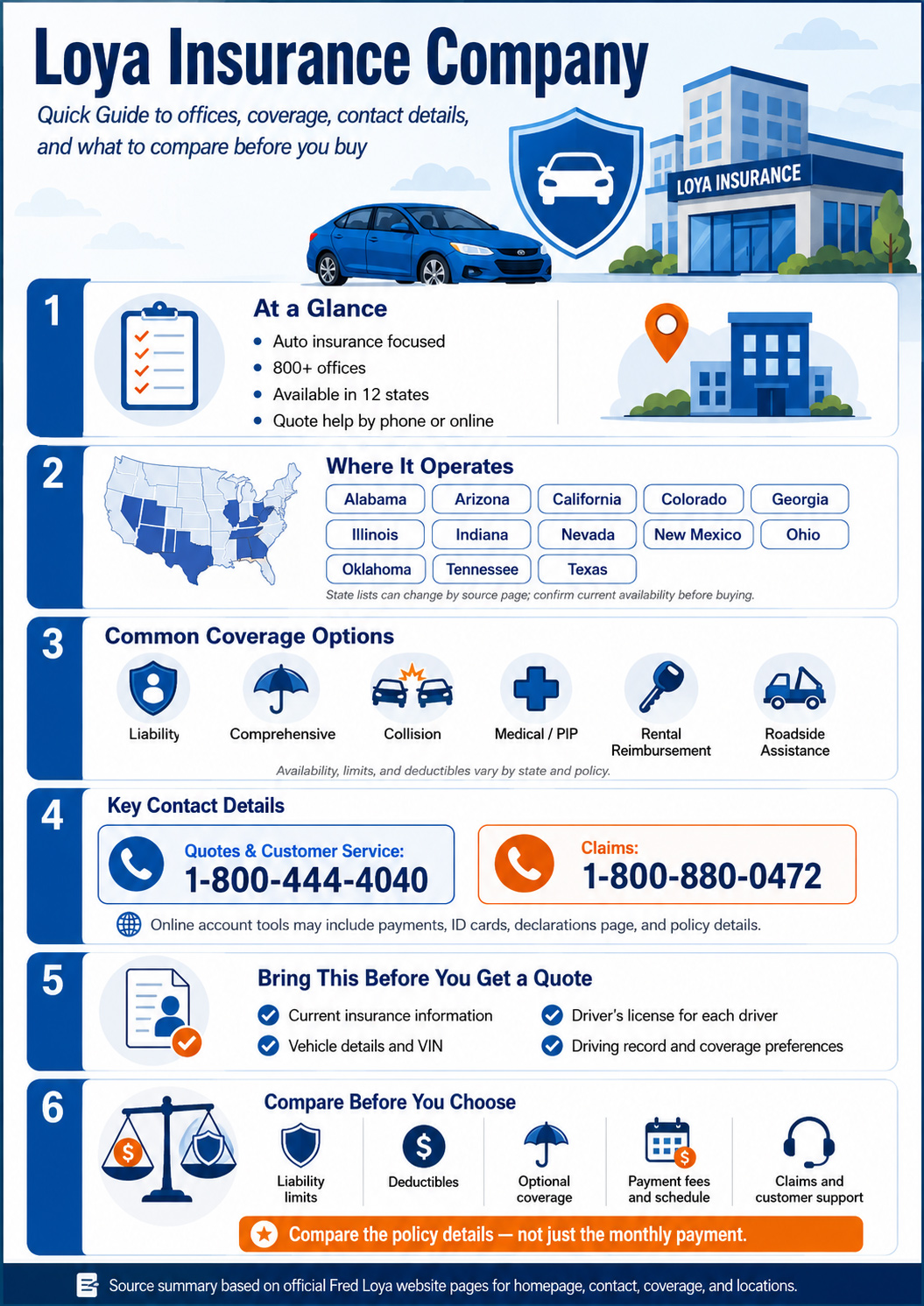
Fred Loya’s official website provides access to online quote tools, payment options, account login, coverage information, claims resources, and location search. These tools can help drivers start the process, but final policy details should still be confirmed before relying on coverage.
For quotes and customer service, Fred Loya’s contact page lists 1-800-444-4040. For claims, it lists 1-800-880-0472. For roadside assistance, it lists 1-855-548-5626. Contact paths may change, so confirm numbers directly on official documents or the official website before taking action.
Common reasons to contact the company
- Requesting a new auto insurance quote
- Reviewing coverage options before buying
- Making or confirming a payment
- Getting proof of insurance or ID cards
- Asking about policy changes
- Reporting or following up on a claim
- Checking roadside assistance details
- Finding a nearby office
Office Availability and State Listings Can Change
Fred Loya’s official website describes more than 800 offices and offers a location finder by ZIP code, city, or state. Because office lists, hours, and services can change, drivers should confirm location details directly before visiting.
When using a location finder, check the address, phone number, business hours, language support, parking access, and whether the office can help with the specific issue you have. A nearby office can be convenient, but it is still important to compare policy terms before buying.
Before visiting an office, confirm:
- The address and office hours
- The local phone number
- Whether the office handles quotes, payments, or policy changes
- Whether you need an appointment
- Which documents to bring
- Whether the office can help with your specific policy or claim issue
What to Have Ready Before Requesting a Quote
Preparing your information before requesting a quote can make the process smoother. Fred Loya’s contact page says drivers should have current insurance policy information, current vehicle and driving record information, driver’s license number for each driver, and the vehicle identification number ready when seeking a quote.
- ZIP code and address Location can affect availability, pricing, and state-specific requirements.
- Driver details Names, dates of birth, license numbers, and household driver information may be needed.
- Vehicle information VIN, year, make, model, mileage, ownership, and usage details can affect the quote.
- Current insurance Prior insurer, coverage dates, limits, and lapse information may affect eligibility or pricing.
- Driving history Accidents, tickets, claims, and violations may affect the quote.
- Coverage preferences Liability limits, deductible preferences, and optional coverage choices should be reviewed.
Coverage Terms to Understand Before Buying
Fred Loya’s coverage page explains that car insurance coverage defines what car-related incidents and expenses are covered by your insurance. It also explains common terms such as policy, premium, deductible, and limits.
This overview does not need to repeat every coverage detail. The important point is that drivers should understand the basics before accepting any policy: what the policy covers, what it excludes, how much it may pay, how much the driver may pay out of pocket, and how the claims process works.
| Term | Simple Meaning | Why It Matters |
|---|---|---|
| Policy | The contract that explains your coverage. | The policy documents control what is covered and excluded. |
| Premium | The price you pay for insurance. | Compare the full policy cost, not only the first payment. |
| Deductible | The amount you may pay out of pocket for certain claims. | A higher deductible may lower the premium but can increase claim-time costs. |
| Limits | The maximum amount a policy may pay for specific coverage. | Low limits can leave you exposed after a serious accident. |
| Exclusions | Situations or uses the policy does not cover. | Exclusions can matter for household drivers, business use, rideshare use, or excluded drivers. |
How Drivers Should Compare Auto Insurance
Before choosing a policy, compare more than the advertised price. The right policy depends on the vehicle, driving history, location, coverage needs, state requirements, lender or lease rules, and the amount of financial risk the driver is willing to keep.
A fair comparison uses the same driver details, vehicles, coverage limits, deductibles, and optional coverages whenever possible. If one quote is cheaper, ask whether it has lower liability limits, a higher deductible, fewer optional benefits, a different policy term, or additional fees.
Compare by cost
- First payment
- Monthly payment
- Total policy cost
- Installment fees
- Cancellation fees
- Reinstatement rules
Compare by protection
- Liability limits
- Collision deductible
- Comprehensive deductible
- Uninsured motorist coverage
- Medical coverage options
- Roadside or rental options
Application Process: What to Review Before Accepting a Policy
The application process usually begins with basic information about the driver, vehicle, location, and coverage needs. A driver may be asked for ZIP code, vehicle details, current insurance status, driving history, listed drivers, and preferred coverage level.
After a quote is generated, the most important step is review. Drivers should look at liability limits, deductibles, optional protections, total monthly cost, total policy cost, fees, payment schedule, exclusions, and effective date. This helps avoid choosing a policy that looks affordable at first but does not provide the protection expected.
Before accepting a quote, confirm:
- The legal insurer name
- The policy term and effective date
- The listed drivers and covered vehicles
- The liability limits and deductibles
- Whether collision and comprehensive are included or excluded
- Whether roadside, rental, PIP, MedPay, or UM/UIM options are included
- The total cost, first payment, installment fees, and cancellation rules
- How to get ID cards or proof of insurance
When This Overview Is Most Useful
This Loya Insurance Company overview is most useful when you are early in the research process. It can help you understand the general model before you decide whether to request a quote, call customer service, visit a location, or compare another insurer.
For detailed pricing questions, use a quote-focused page and confirm all final terms directly. For local office questions, check a location-focused guide and verify details through the official location finder. For policy questions, review coverage-specific resources and your own declarations page.
Best next step: Use this page to understand the company model, then compare actual policy documents before buying. The final decision should depend on coverage, limits, deductibles, fees, claims support, payment terms, and your own risk level.
Frequently Asked Questions About Loya Insurance Company
Is LoyalInsurance.org affiliated with Fred Loya Insurance?
No. LoyalInsurance.org is an independent informational website. It is not affiliated with Fred Loya Insurance, Loya Insurance Group, or any insurer. Drivers should confirm final rates, terms, and coverage directly with the insurer, agent, or quote provider.
What can drivers do through Loya or Fred Loya online tools?
The official Fred Loya website provides access to online quote tools, payment options, account login, coverage information, claims resources, and location search. Availability and exact features can vary, so drivers should confirm directly through the official site or their policy documents.
What should I prepare before requesting a quote?
Have your ZIP code, driver’s license information, vehicle identification number, current insurance details, driving record information, and preferred coverage choices ready. This can make the quote process easier and reduce mistakes.
Should I choose a policy only because there is a local office nearby?
No. A local office can be helpful, but the policy details matter more. Compare coverage limits, deductibles, optional coverages, payment fees, cancellation rules, claims process, and final premium before buying.
What is the difference between a quote and a final policy?
A quote is an estimated offer based on the information provided. The final policy may depend on verification, eligibility, payment, state rules, driver details, vehicle details, discounts, and policy documents.
Compare Auto Insurance Quote Options
Enter your ZIP code to start comparing auto insurance options and review quote paths that may fit your coverage needs and budget.
Compare price, coverage limits, deductibles, fees, payment terms, and policy details before choosing auto insurance.
Sources
This article was updated using consumer-focused insurance resources, public insurance education materials, and publicly available company information reviewed for general accuracy. Drivers should confirm final rates, policy terms, coverage availability, office services, discounts, fees, claims handling, and eligibility directly with the insurer, agent, quote provider, or state insurance department before buying coverage.
- National Association of Insurance Commissioners — Auto Insurance Consumer Resources
- National Association of Insurance Commissioners — Auto Insurance Shopping Tool
- Insurance Information Institute — What Determines the Price of an Auto Insurance Policy?
- Insurance Information Institute — Auto Insurance Basics