
Fred Loya currently offers an online quote flow that collects driver, vehicle, coverage, and contact information before presenting a quote. You can start with the official Fred Loya online quote form, call 1-800-444-4040, or use the company’s location finder to reach a local agent.
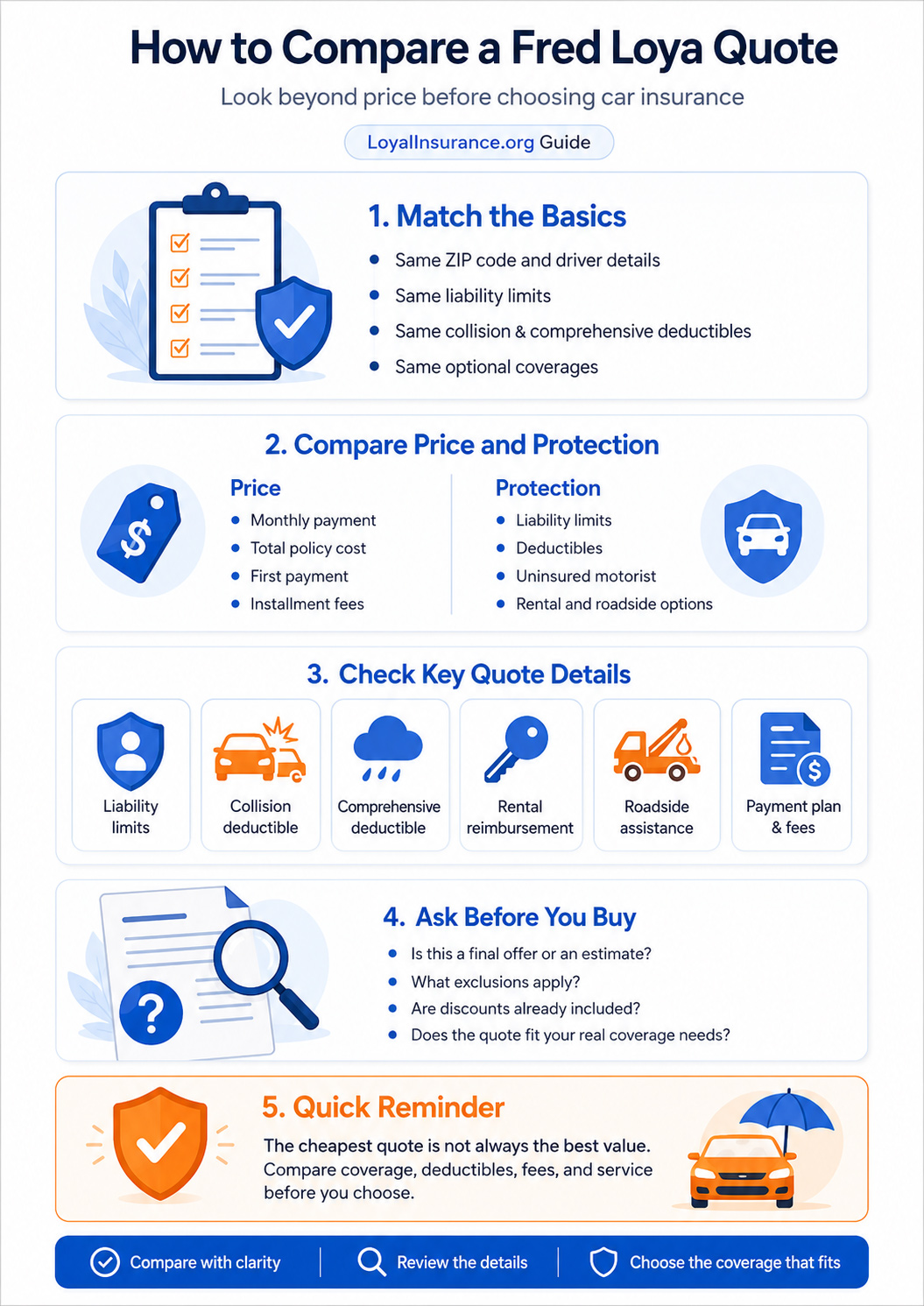
A useful quote comparison goes beyond the first payment. Match the liability limits, deductibles, collision and comprehensive choices, optional benefits, policy term, total premium, and effective date so you are comparing similar protection rather than different policies with different prices.
What Fred Loya Asks for in an Online Quote
Fred Loya’s current online quote process asks for identifying and contact information first, then moves through policy-holder, driver, vehicle, coverage, and additional-information stages. The form can request your address, date of birth, marital status, driver’s-license information, driving experience, vehicle details, annual mileage, ownership status, and other information used to build the quote.
It also asks whether you are currently insured, whether you are a homeowner, and whether you are interested in Auto Pay. Accurate answers matter because the quote is built from the information and coverage choices entered.
Information worth having ready
- Driver names, dates of birth, and license information
- Current address and ZIP code
- Vehicle VIN or year, make, model, and body style
- Annual mileage and vehicle ownership status
- Current insurance information
- Coverage limits and deductible preferences
- Any SR-22 requirement that applies to a driver
Coverage Choices in the Current Fred Loya Quote Flow
The current quote form presents bodily-injury and property-damage liability selections and asks whether comprehensive and collision should be included. It also shows uninsured and underinsured motorist selections, Medical Payments, Personal Injury Protection, Rental, Towing, and other optional coverage fields.
If you are trying to keep the quote simple, the tradeoffs behind basic auto insurance coverage are worth checking before choosing the lowest limits or removing physical-damage coverage. A cheaper quote can simply contain less protection.
Compare the Same Coverage Across Quotes
The NAIC Auto Insurance Shopping Tool specifically tells consumers to record the coverage limits for each company so that quotes are compared on the same basis. It separates bodily-injury liability, property-damage liability, uninsured/underinsured motorist coverage, medical coverage, collision and comprehensive deductibles, optional benefits, and total premium.
| Quote Detail | Why It Matters | What to Match |
|---|---|---|
| Liability limits | A lower price may reflect lower protection for injuries or property damage. | Match bodily-injury and property-damage limits as closely as possible. |
| Collision deductible | A higher deductible can reduce premium but increases your share after a covered collision. | Compare the same deductible amount. |
| Comprehensive deductible | Different deductibles can make two otherwise similar quotes look very different in price. | Match the deductible and confirm comprehensive is actually included. |
| UM/UIM and medical coverage | These protections can vary significantly by state and quote. | Check limits, availability, and whether coverage was selected or rejected. |
| Rental and towing | Optional benefits can add cost but may reduce specific out-of-pocket expenses later. | Compare benefit limits and qualifying situations. |
| Total premium | The first payment does not show the complete policy cost. | Compare the full six-month, annual, or quoted policy-term premium. |
Why Fred Loya Quotes Can Differ From Another Insurer
Insurers do not necessarily price the same driver in the same way. Triple-I identifies driving record, vehicle use, location, age, vehicle characteristics, selected coverage, deductibles, and other permitted rating information as factors that can affect an auto insurance premium.
A lower Fred Loya quote may therefore reflect a genuinely different insurer price, different discounts, or different coverage selections. Check the actual inputs and policy structure before deciding what created the difference.
Price is only one part of the comparison. The Fred Loya Insurance review summarizes current service, claims, office, and consumer-feedback considerations that can help you decide which questions to ask before binding coverage.
Do Not Compare Only the Monthly Payment
A quote with a small first payment or monthly installment can still have a higher total cost, different fees, a different policy term, or less coverage. Record the down payment, remaining installments, total premium, and any charges displayed in the quote or policy documents.
The same applies to deductibles. A policy with a $1,000 deductible can cost less than one with a $500 deductible, but you would need to absorb more of an applicable covered loss before the insurance payment.
Quote comparison rule: If the limits, deductibles, drivers, vehicles, or optional benefits are different, the prices are not directly comparable.
Check the Legal Insurer and Policy Documents
Before relying on the quote, check which legal insurer will issue the policy and make sure that name, the insured vehicles, drivers, limits, deductibles, and effective dates are correct on the issued documents.
This matters especially when you are comparing a quote against information found elsewhere online. The declarations page and policy forms govern the issued coverage, not a general company description or an old search result.
Service and Consumer Feedback Belong in the Decision Too
Price and coverage are central, but service access also matters. Fred Loya currently publishes customer-service, claims, payment, account, and local-office channels. If those service features are important to you, compare them with what another insurer offers before buying.
Financed or Leased Vehicles Need the Right Physical-Damage Coverage
A lender or leasing company may require collision and comprehensive coverage even when the state only requires liability. Do not remove physical-damage coverage from the quote simply to reduce the premium without checking the finance or lease agreement.
Before accepting a quote for a financed vehicle
- Confirm collision and comprehensive are included when required.
- Check the deductible against lender requirements.
- Make sure the lienholder information is correct.
- Confirm the effective date leaves no gap in required coverage.
- Compare the added premium with the protection being purchased.
Quote vs. Active Coverage
A quote is part of the shopping process; it is not the same thing as proof that coverage is active. Before driving on a replacement policy or canceling an existing one, confirm that the new policy has been issued, check the effective date and time, save the insurance ID card or other proof of coverage, and verify any required payment.
If the quote will replace an existing insurer, confirm the replacement policy first, save proof of insurance, and only then cancel the old policy for the appropriate date.
How to Get a Fred Loya Quote
Fred Loya currently provides three practical starting points: its online quote form, the quotes and customer-service number 1-800-444-4040, and local offices found through the official location finder.
The online form is the most direct path if you want to enter driver, vehicle, and coverage information yourself. Calling or visiting an office may be more useful when you need help interpreting a coverage option or providing information.
Official option: Start a Fred Loya quote on FredLoya.com if you specifically want a quote from Fred Loya Insurance.
Frequently Asked Questions About Fred Loya Quotes
Can I get a Fred Loya quote online?
Yes. Fred Loya currently operates an online quote form that collects policy-holder, driver, vehicle, coverage, and additional information before presenting the quote.
What information does Fred Loya ask for?
The current form can request contact information, address, date of birth, driver’s-license information, driving experience, vehicle information, annual mileage, current-insurance status, coverage selections, homeowner status, and Auto Pay interest, among other details.
Does the Fred Loya quote form include collision and comprehensive?
The current form asks whether you want to include comprehensive and collision and then presents separate collision and comprehensive selections for the vehicle.
Should I compare the first payment or the total premium?
Compare the total premium and payment schedule. A low first payment does not necessarily mean the policy has the lowest overall cost.
Can I cancel my current policy as soon as I receive a cheaper quote?
Do not cancel an existing policy merely because you received a quote. The sequence for switching car insurance without a coverage gap starts with confirming that the replacement policy is issued and active for the intended date before ending the old coverage.
Compare Auto Insurance Quotes by ZIP Code
If you want to compare alternatives in addition to Fred Loya, enter your ZIP code below. Use equivalent limits, deductibles, drivers, and vehicle information when comparing results.
This comparison is separate from Fred Loya’s official quote form.
Sources
This article uses current Fred Loya public quote information and consumer auto-insurance resources. Quote fields, coverage availability, pricing, discounts, and eligibility can change, so confirm time-sensitive details through the current insurer quote process.
- Fred Loya Insurance — Official Online Quote Form
- Fred Loya Insurance — Quote and Customer Service Contact
- Fred Loya Insurance — Official Location Finder
- National Association of Insurance Commissioners — Auto Insurance Shopping Tool
- National Association of Insurance Commissioners — Auto Insurance
- Triple-I — What Determines the Price of an Auto Insurance Policy?